QUESTION IMAGE
Question
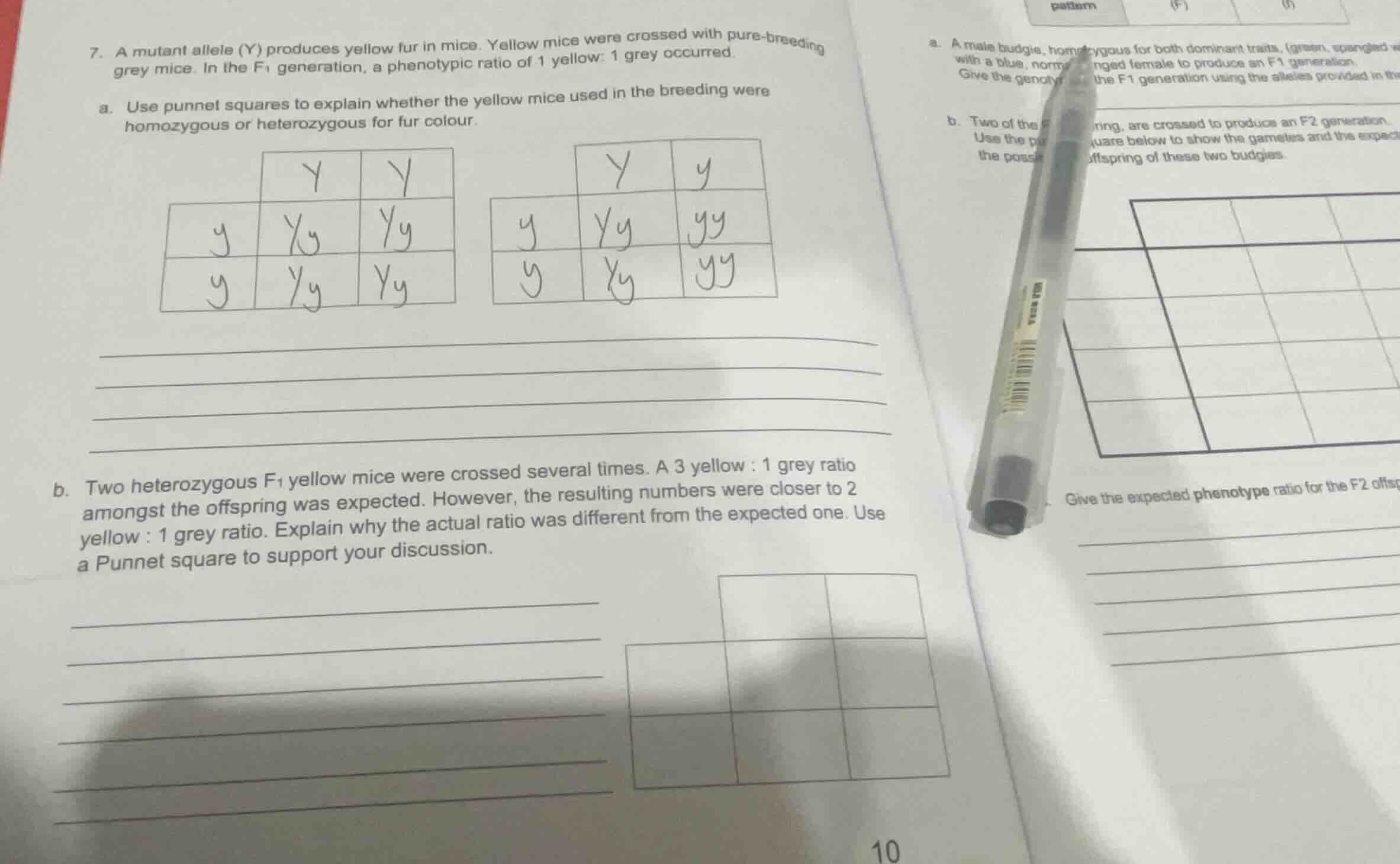
- a mutant allele (y) produces yellow fur in mice. yellow mice were crossed with pure-breeding grey mice. in the \\(f_1\\) generation, a phenotypic ratio of 1 yellow : 1 grey occurred.
a. use punnet squares to explain whether the yellow mice used in the breeding were homozygous or heterozygous for fur colour.
b. two heterozygous \\(f_1\\) yellow mice were crossed several times. a 3 yellow : 1 grey ratio amongst the offspring was expected. however, the resulting numbers were closer to 2 yellow : 1 grey ratio. explain why the actual ratio was different from the expected one. use a punnet square to support your discussion.
Analyze the first cross
We are given that a mutant allele \(Y\) produces yellow fur in mice. Yellow mice were crossed with pure-breeding grey mice. The resulting \(F_1\) generation had a phenotypic ratio of 1 yellow : 1 grey.
Pure-breeding grey mice must be homozygous recessive (\(yy\)) because grey is the non-mutant, wild-type phenotype.
If the yellow parent were homozygous (\(YY\)), crossing \(YY \times yy\) would yield 100% heterozygous yellow (\(Yy\)) offspring.
If the yellow parent is heterozygous (\(Yy\)), crossing \(Yy \times yy\) yields a 1:1 ratio of yellow (\(Yy\)) to grey (\(yy\)) offspring.
Thus, the yellow parent must be heterozygous.
Analyze the second cross
Two heterozygous \(F_1\) yellow mice (\(Yy \times Yy\)) are crossed.
The expected Mendelian genotypic ratio is:
- \(1\ YY\) (yellow)
- \(2\ Yy\) (yellow)
- \(1\ yy\) (grey)
This normally gives a 3 yellow : 1 grey phenotypic ratio.
However, the actual observed ratio is closer to 2 yellow : 1 grey.
This deviation occurs because the homozygous dominant genotype (\(YY\)) is lethal. Embryos with the \(YY\) genotype die during early development and are not born.
Therefore, only the \(2\ Yy\) (yellow) and \(1\ yy\) (grey) mice survive, resulting in a 2:1 phenotypic ratio.
Construct the Punnett squares
For part (a), the two Punnett squares shown in the image are:
- Homozygous yellow (\(YY\)) crossed with grey (\(yy\)):
- Gametes: \(Y\), \(Y\) and \(y\), \(y\)
- Offspring: all \(Yy\) (100% yellow)
- Heterozygous yellow (\(Yy\)) crossed with grey (\(yy\)):
- Gametes: \(Y\), \(y\) and \(y\), \(y\)
- Offspring: \(2\ Yy\) (yellow), \(2\ yy\) (grey) (1:1 ratio)
For part (b), the Punnett square for \(Yy \times Yy\) is:
- Gametes: \(Y\), \(y\) and \(Y\), \(y\)
- Offspring:
- \(YY\) (Lethal / dies)
- \(Yy\) (Yellow)
- \(Yy\) (Yellow)
- \(yy\) (Grey)
- If the yellow parent were homozygous (\(YY\)), crossing it with a pure-breeding grey mouse (\(yy\)) would result in 100% heterozygous yellow (\(Yy\)) offspring, as shown in the first Punnett square:
- Since the actual cross resulted in a 1 yellow : 1 grey ratio, the yellow parent must be heterozygous (\(Yy\)). Crossing \(Yy \times yy\) yields 50% yellow (\(Yy\)) and 50% grey (\(yy\)) offspring, as shown in the second Punnett square:
---
Question 7b
The actual ratio is 2 yellow : 1 grey because the homozygous dominant genotype (\(YY\)) is a lethal allele combination.
When two heterozygous yellow mice (\(Yy\)) are crossed, the Punnett square is:
- Mice that inherit the homozygous dominant genotype (\(YY\)) die in utero (during embryonic development) and are never born.
- Consequently, only the heterozygous yellow (\(Yy\)) and homozygous recessive grey (\(yy\)) offspring survive to birth, resulting in an observed phenotypic ratio of 2 yellow : 1 grey.
</answer>

Snap & solve any problem in the app
Get step-by-step solutions on Sovi AI
Photo-based solutions with guided steps
Explore more problems and detailed explanations
Question 7a
The yellow mice used in the breeding must be heterozygous (\(Yy\)).
Explanation:
- If the yellow parent were homozygous (\(YY\)), crossing it with a pure-breeding grey mouse (\(yy\)) would result in 100% heterozygous yellow (\(Yy\)) offspring, as shown in the first Punnett square:
- Since the actual cross resulted in a 1 yellow : 1 grey ratio, the yellow parent must be heterozygous (\(Yy\)). Crossing \(Yy \times yy\) yields 50% yellow (\(Yy\)) and 50% grey (\(yy\)) offspring, as shown in the second Punnett square:
---
Question 7b
The actual ratio is 2 yellow : 1 grey because the homozygous dominant genotype (\(YY\)) is a lethal allele combination.
Explanation:
When two heterozygous yellow mice (\(Yy\)) are crossed, the Punnett square is:
- Mice that inherit the homozygous dominant genotype (\(YY\)) die in utero (during embryonic development) and are never born.
- Consequently, only the heterozygous yellow (\(Yy\)) and homozygous recessive grey (\(yy\)) offspring survive to birth, resulting in an observed phenotypic ratio of 2 yellow : 1 grey.