QUESTION IMAGE
Question
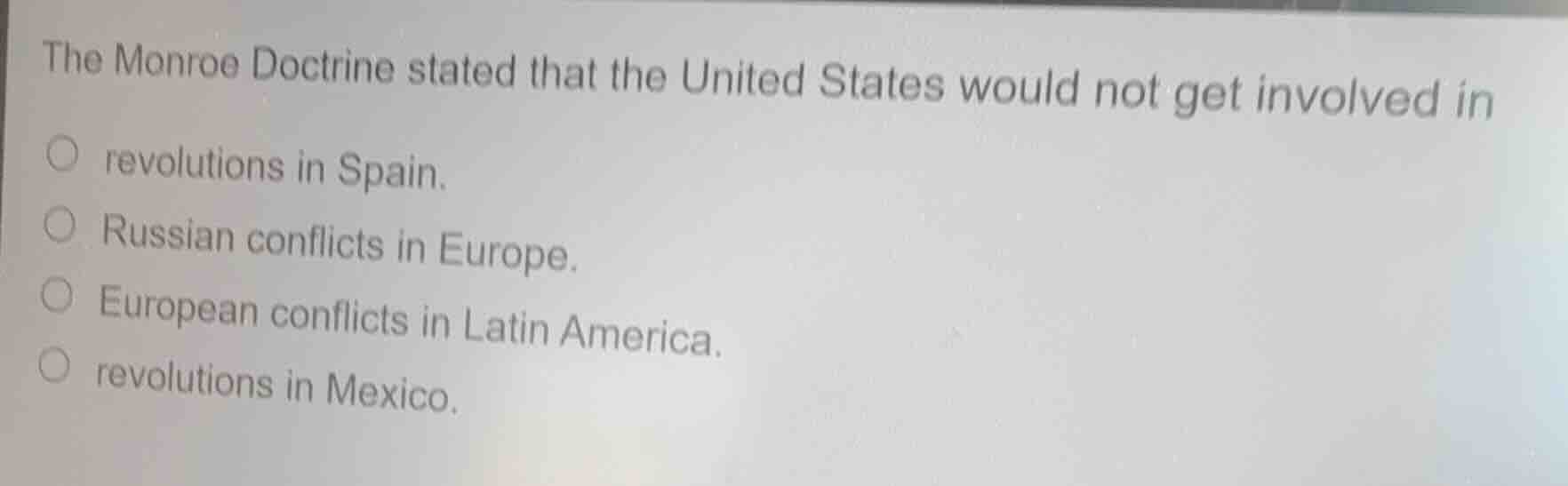
the monroe doctrine stated that the united states would not get involved in
revolutions in spain.
russian conflicts in europe.
european conflicts in latin america.
revolutions in mexico.
Analyze the Monroe Doctrine core principles
The Monroe Doctrine was a cornerstone of US Foreign Policy introduced in 1823. It declared that the Western Hemisphere was closed to further European colonization. It also stated that any attempt by European powers to oppress or control newly independent nations in the Americas would be viewed as a hostile act against the United States.
Examine the non-intervention pledge
In exchange for European non-interference in the Americas, the United States pledged a policy of reciprocity. Specifically, President James Monroe declared that the United States would not interfere in the internal affairs, wars, or ongoing conflicts of European powers, which included domestic European struggles.
Evaluate the given options
- revolutions in Spain: This represents an internal European conflict. Under the doctrine, the U.S. pledged not to meddle in domestic European affairs, such as internal Spanish political revolutions.
- Russian conflicts in Europe: While the U.S. wanted to avoid European wars, the doctrine specifically addressed the broader principle of non-interference in existing European affairs, but "revolutions in Spain" directly aligns with the historical context of Spain's internal struggles and its relation to its former colonies. Let's re-verify the exact standard curriculum question. The standard historical text of the Monroe Doctrine states: "In the wars of the European powers in matters relating to themselves we have never taken any part, nor does it comport with our policy to do so." Spain was experiencing internal revolutionary turmoil (the Liberal Triennium) and considering reclaiming its lost American colonies. The U.S. declared it would not interfere in Spain's internal revolutions, but would oppose Spanish intervention in Latin America. Thus, "revolutions in Spain" is the correct choice.
- European conflicts in Latin America: The doctrine explicitly stated the U.S. would get involved or view it as a threat if European powers interfered in Latin America.
- revolutions in Mexico: The U.S. supported Latin American independence movements and did not pledge to ignore them, but rather sought to protect these new republics from European recolonization.

Snap & solve any problem in the app
Get step-by-step solutions on Sovi AI
Photo-based solutions with guided steps
Explore more problems and detailed explanations
- (A) revolutions in Spain. (Correct answer)
- (B) Russian conflicts in Europe.
- (C) European conflicts in Latin America.
- (D) revolutions in Mexico.