QUESTION IMAGE
Question
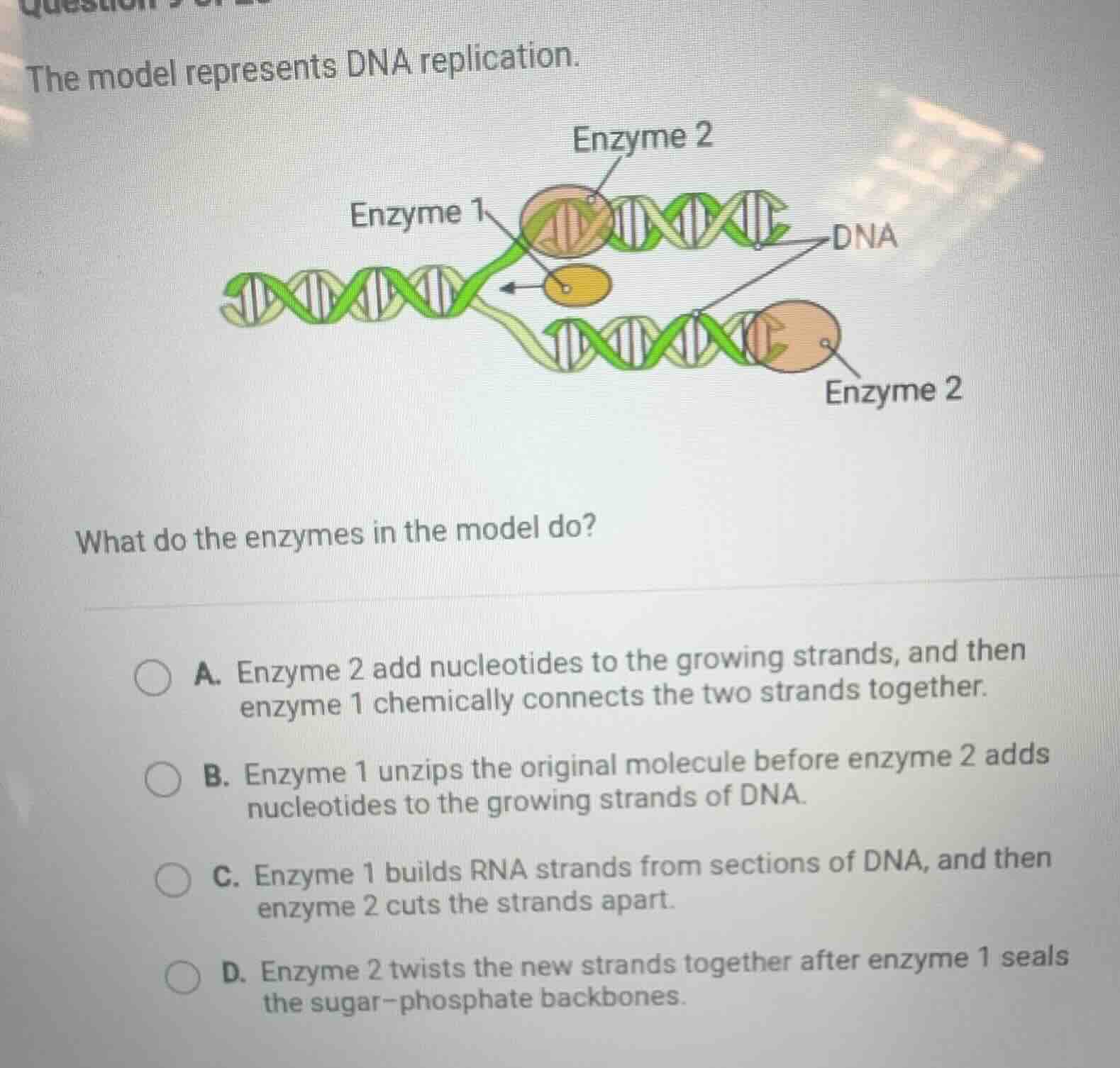
the model represents dna replication.
what do the enzymes in the model do?
a. enzyme 2 add nucleotides to the growing strands, and then enzyme 1 chemically connects the two strands together.
b. enzyme 1 unzips the original molecule before enzyme 2 adds nucleotides to the growing strands of dna.
c. enzyme 1 builds rna strands from sections of dna, and then enzyme 2 cuts the strands apart.
d. enzyme 2 twists the new strands together after enzyme 1 seals the sugar-phosphate backbones.
Identify the roles of Enzyme 1 and Enzyme 2
Enzyme 1 is positioned at the replication fork where the double-stranded DNA molecule is separating into single strands. This indicates Enzyme 1 is helicase, which unwinds and unzips the double helix. Enzyme 2 is positioned on each of the newly forming strands, synthesizing the complementary strands by adding nucleotides. This indicates Enzyme 2 is DNA polymerase.
Evaluate the given options
- Option A states Enzyme 1 chemically connects the two strands together, which is incorrect.
- Option B states Enzyme 1 unzips the original molecule before Enzyme 2 adds nucleotides to the growing strands, which correctly describes the functions of helicase and DNA polymerase.
- Option C states Enzyme 1 builds RNA strands, which is incorrect for DNA replication.
- Option D states Enzyme 1 seals the backbones and Enzyme 2 twists the strands, which is incorrect.

Snap & solve any problem in the app
Get step-by-step solutions on Sovi AI
Photo-based solutions with guided steps
Explore more problems and detailed explanations
- A. Enzyme 2 add nucleotides to the growing strands, and then enzyme 1 chemically connects the two strands together.
- B. Enzyme 1 unzips the original molecule before enzyme 2 adds nucleotides to the growing strands of DNA. (Correct answer)
- C. Enzyme 1 builds RNA strands from sections of DNA, and then enzyme 2 cuts the strands apart.
- D. Enzyme 2 twists the new strands together after enzyme 1 seals the sugar-phosphate backbones.