QUESTION IMAGE
Question
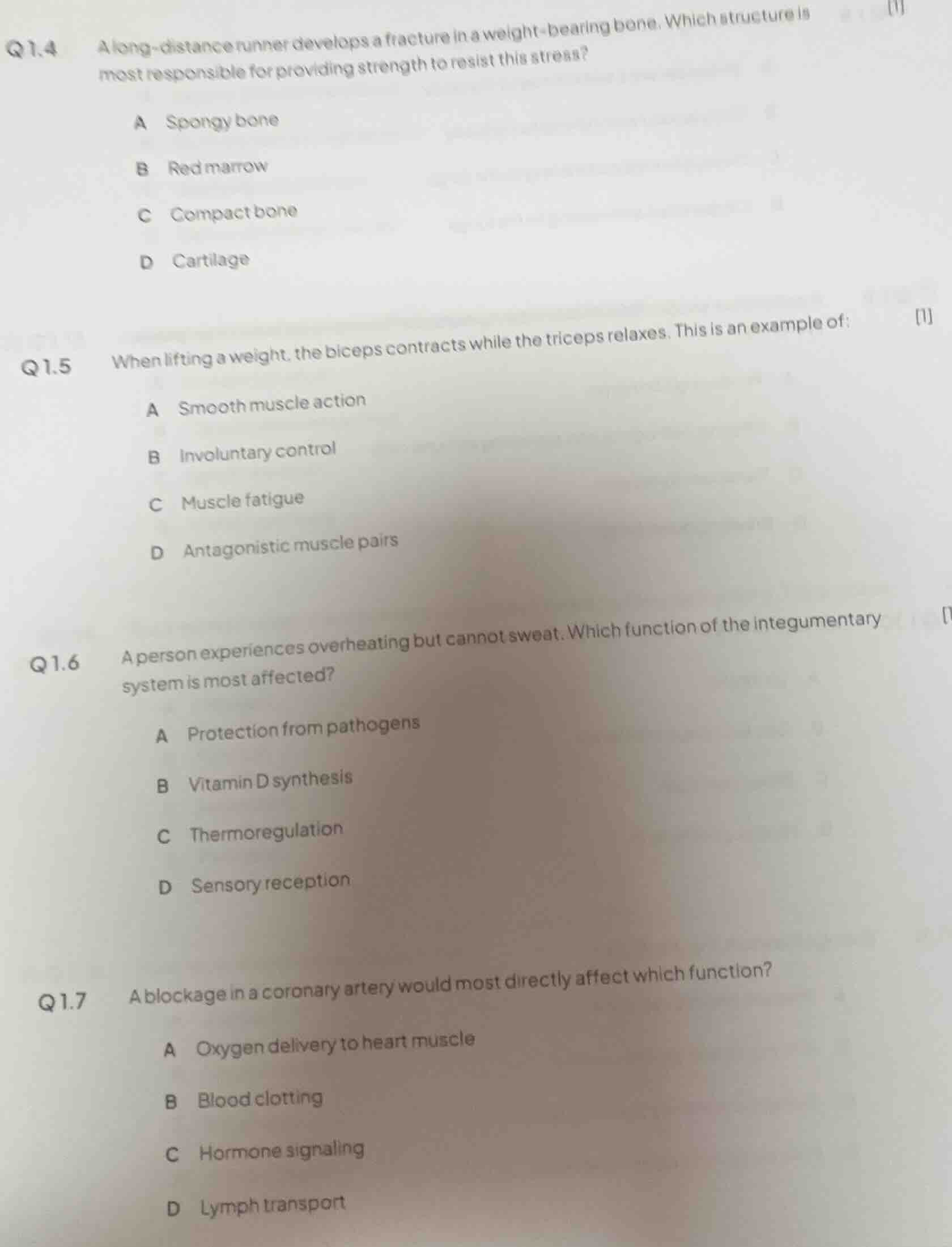
q 1.4 a long-distance runner develops a fracture in a weight-bearing bone. which structure is most responsible for providing strength to resist this stress?
a spongy bone
b red marrow
c compact bone
d cartilage
q 1.5 when lifting a weight, the biceps contracts while the triceps relaxes. this is an example of:
a smooth muscle action
b involuntary control
c muscle fatigue
d antagonistic muscle pairs
q 1.6 a person experiences overheating but cannot sweat. which function of the integumentary system is most affected?
a protection from pathogens
b vitamin d synthesis
c thermoregulation
d sensory reception
q 1.7 a blockage in a coronary artery would most directly affect which function?
a oxygen delivery to heart muscle
b blood clotting
c hormone signaling
d lymph transport
Analyze Q1.4: Bone structure resisting stress
Compact bone is the dense, hard outer layer of bone that provides strength and resists mechanical stress, whereas spongy bone is porous and red marrow produces blood cells.
Analyze Q1.5: Biceps and triceps action
The biceps and triceps work in opposition to control movement around a joint; when one contracts, the other relaxes, which is the definition of antagonistic muscle pairs.
Analyze Q1.6: Overheating and sweating
Sweating is a primary mechanism for releasing heat to maintain a stable body temperature, which directly falls under the function of thermoregulation.
Analyze Q1.7: Coronary artery blockage
Coronary arteries supply oxygenated blood directly to the heart muscle (myocardium); a blockage directly restricts this oxygen delivery.

Snap & solve any problem in the app
Get step-by-step solutions on Sovi AI
Photo-based solutions with guided steps
Explore more problems and detailed explanations
Question 1.4
- (A) Spongy bone
- (B) Red marrow
- (C) Compact bone (Correct answer)
- (D) Cartilage
Question 1.5
- (A) Smooth muscle action
- (B) Involuntary control
- (C) Muscle fatigue
- (D) Antagonistic muscle pairs (Correct answer)
Question 1.6
- (A) Protection from pathogens
- (B) Vitamin D synthesis
- (C) Thermoregulation (Correct answer)
- (D) Sensory reception
Question 1.7
- (A) Oxygen delivery to heart muscle (Correct answer)
- (B) Blood clotting
- (C) Hormone signaling
- (D) Lymph transport