QUESTION IMAGE
Question
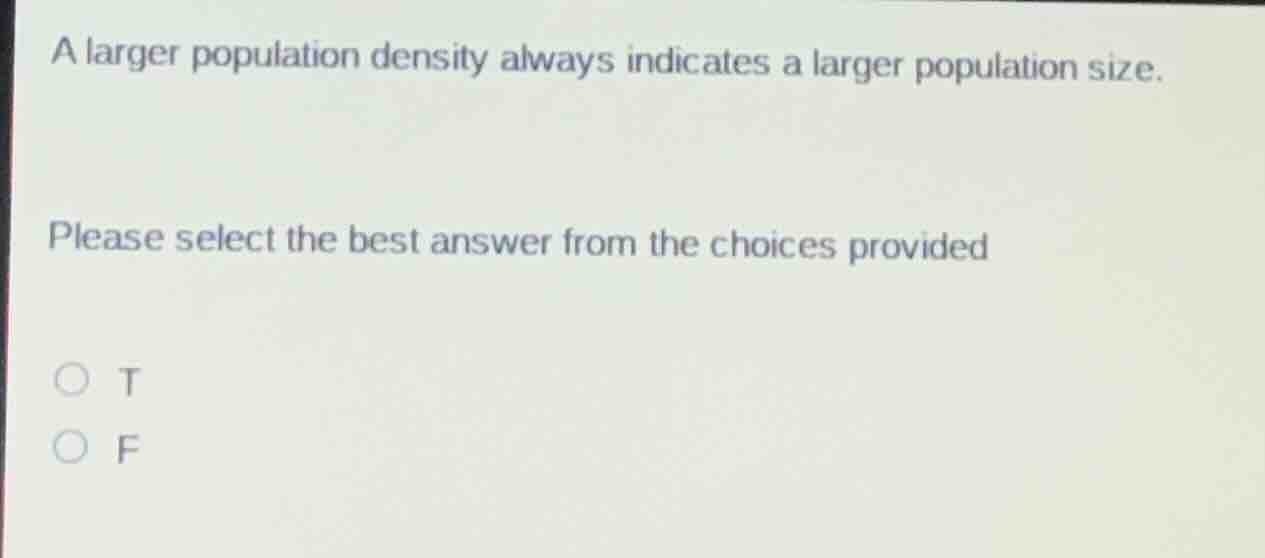
a larger population density always indicates a larger population size.
please select the best answer from the choices provided
o t
o f
🆕 New Concept Discovered: Population Density vs. Population Size
How crowded a space is versus the total count of individuals.
Step 1: Define the terms
To evaluate the statement, we need to understand the relationship between population size, land area, and population density:
- Population Size: The total number of individuals in a population.
- Population Density: The number of individuals living per unit of area. It is calculated using the formula:
Step 2: Analyze the relationship
Because population density depends on both the population size and the land area, a high density does not automatically mean a large total population.
For example, consider two regions:
- Region A: A small island with a population of \( 100 \) people living in an area of \( 1 \text{ km}^2 \).
- Region B: A large country with a population of \( 10,000 \) people living in an area of \( 1,000 \text{ km}^2 \).
Even though Region A has a much higher population density (\( 100 \) vs. \( 10 \)), its total population size is much smaller (\( 100 \) vs. \( 10,000 \)). Therefore, a larger population density does not always indicate a larger population size.

Snap & solve any problem in the app
Get step-by-step solutions on Sovi AI
Photo-based solutions with guided steps
Explore more problems and detailed explanations
F