QUESTION IMAGE
Question
introduction
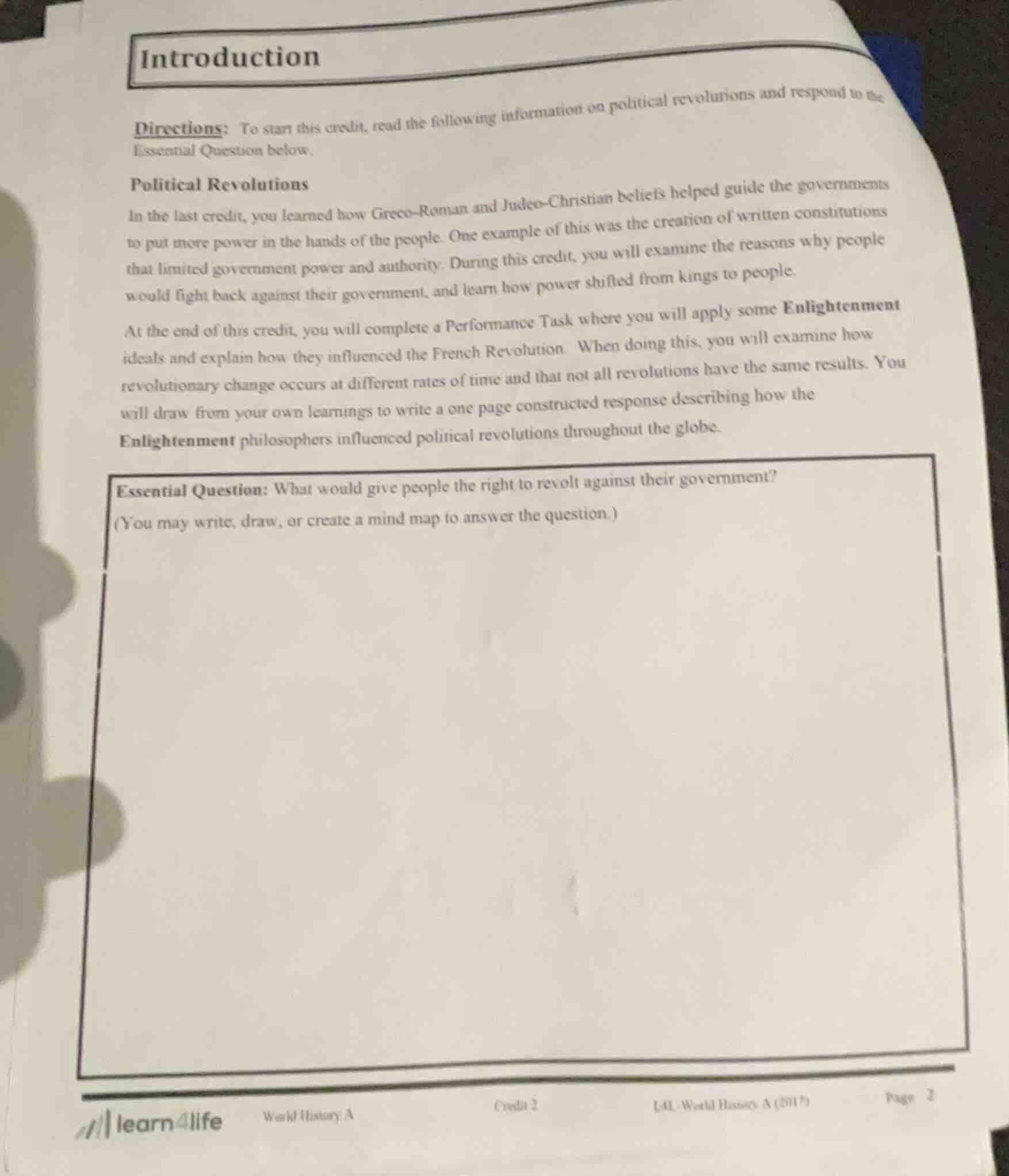
directions: to start this credit, read the following information on political revolutions and respond to the essential question below.
political revolutions
in the last credit, you learned how greco-roman and judeo-christian beliefs helped guide the governments to put more power in the hands of the people. one example of this was the creation of written constitutions that limited government power and authority. during this credit, you will examine the reasons why people would fight back against their government, and learn how power shifted from kings to people.
at the end of this credit, you will complete a performance task where you will apply some enlightenment ideals and explain how they influenced the french revolution. when doing this, you will examine how revolutionary change occurs at different rates of time and that not all revolutions have the same results. you will draw from your own learnings to write a one page constructed response describing how the enlightenment philosophers influenced political revolutions throughout the globe.
essential question: what would give people the right to revolt against their government?
(you may write, draw, or create a mind map to answer the question.)
Analyze the essential question
The prompt asks: "What would give people the right to revolt against their government?" This is a foundational question of political philosophy, heavily discussed by Enlightenment thinkers.
Identify core Enlightenment concepts
To answer this, we look at the ideas of John Locke and Jean-Jacques Rousseau. Locke argued that individuals possess fundamental Natural Rights (life, liberty, and property).
Explain the social contract
Governments are established through a Social Contract where people consent to be governed in exchange for the protection of their natural rights.
Define the right to revolt
If a government fails to protect these rights, becomes tyrannical, or abuses its power, it breaches the social contract. This breach legitimizes the Right to Revolution, giving citizens the moral authority to overthrow and replace it.

Snap & solve any problem in the app
Get step-by-step solutions on Sovi AI
Photo-based solutions with guided steps
Explore more problems and detailed explanations
Based on Enlightenment political philosophy, people have the right to revolt against their government when the government breaches the Social Contract by failing to protect their Natural Rights (life, liberty, and property) or by actively abusing its power through tyranny. Under these conditions, the government loses its legitimacy, and the citizens have the moral authority to overthrow it and establish a new system that secures their safety and freedom.