Sovi.AI - AI Math Tutor

Scan to solve math questions

QUESTION IMAGE

identify the terms described by selecting the correct word from the dro…

Question

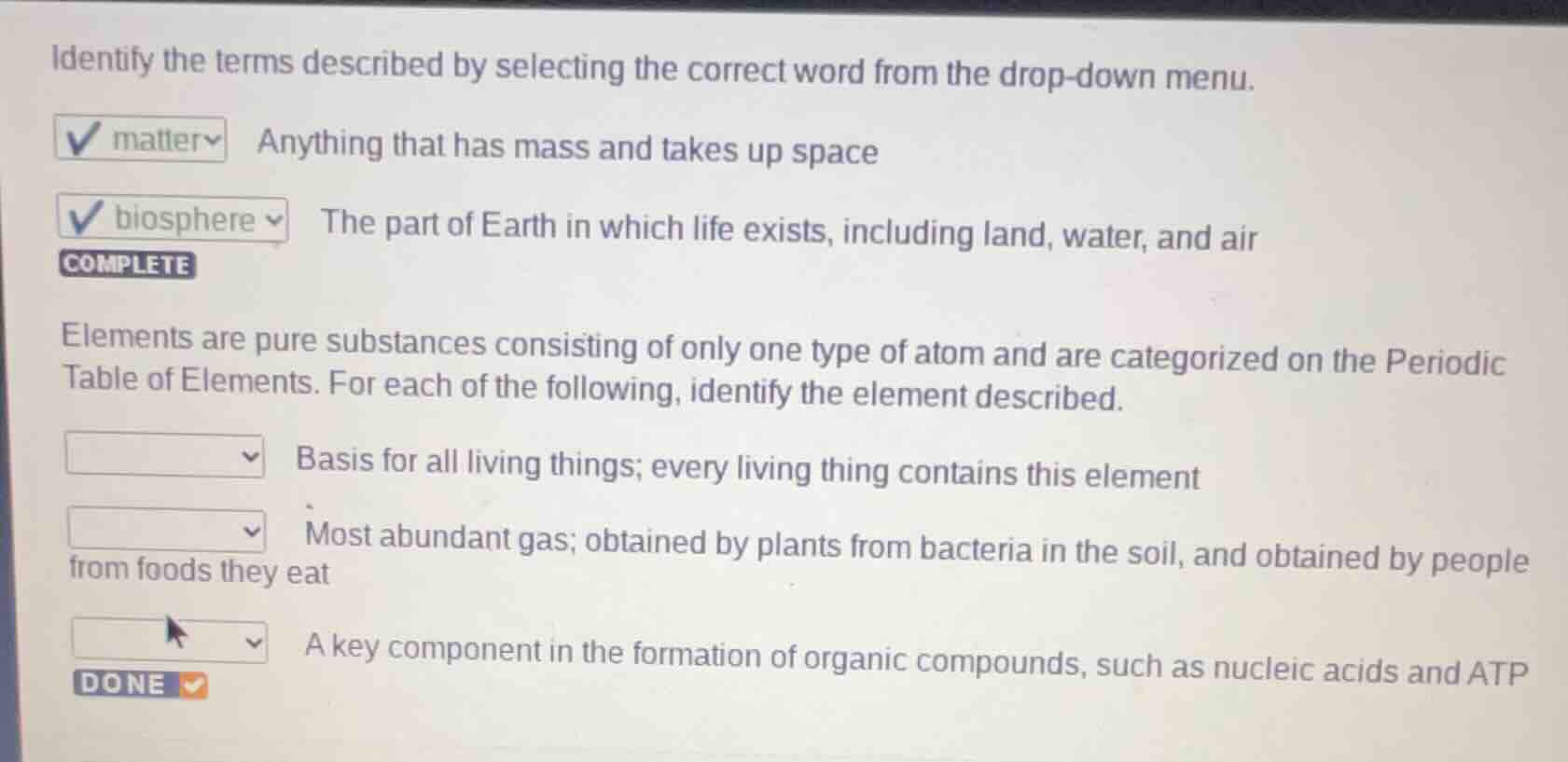
identify the terms described by selecting the correct word from the drop-down menu.

matter: anything that has mass and takes up space
biosphere: the part of earth in which life exists, including land, water, and air

elements are pure substances consisting of only one type of atom and are categorized on the periodic table of elements. for each of the following, identify the element described.

: basis for all living things; every living thing contains this element
: most abundant gas; obtained by plants from bacteria in the soil, and obtained by people from foods they eat
: a key component in the formation of organic compounds, such as nucleic acids and atp

Explanation:

Response

<pre_analysis>
{
"quality": "clear",
"question_count": 3,
"skills_matched": [
"direct_cot",
"blank_filling_formatter",
"explain_then_answer",
"tutor"
],
"needs_drawing": false,
"concepts_used": [],
"new_concepts": [
"Biogeochemical Cycles",
"Organic Chemistry Elements"
],
"current_concepts": [
"Definition of Matter",
"Definition of Biosphere",
"Carbon Cycle",
"Nitrogen Cycle",
"Phosphorus Cycle"
]
}
</pre_analysis>

<reasoning>

Identify the basis for all living things

The first prompt describes an element that is the "Basis for all living things; every living thing contains this element." Carbon is the fundamental element of organic chemistry and forms the backbone of all organic molecules (proteins, lipids, carbohydrates, and nucleic acids) essential to life.

Identify the most abundant gas

The second prompt describes the "Most abundant gas; obtained by plants from bacteria in the soil, and obtained by people from foods they eat." Nitrogen gas (\(\text{N}_2\)) makes up about 78% of Earth's atmosphere, making it the most abundant gas. Nitrogen-fixing bacteria in the soil convert atmospheric nitrogen into forms that plants can absorb, which then enter the food chain for humans.

Identify the key component of nucleic acids and ATP

The third prompt describes "A key component in the formation of organic compounds, such as nucleic acids and ATP." Phosphorus is a critical structural component of the sugar-phosphate backbone in DNA and RNA (nucleic acids) and is the central element in adenosine triphosphate (ATP), which stores and transfers energy in cells.
</reasoning>

<answer>

Question 1

<blank>Carbon</blank> Basis for all living things; every living thing contains this element

Question 2

<blank>Nitrogen</blank> Most abundant gas; obtained by plants from bacteria in the soil, and obtained by people from foods they eat

Question 3

<blank>Phosphorus</blank> A key component in the formation of organic compounds, such as nucleic acids and ATP
</answer>

<post_analysis>
{
"subject": "Natural Science",
"question_type": "Fill-in-the-blank",
"knowledge_point": [
"Natural Science",
"Biology",
"Biogeochemical Cycles"
]
}
</post_analysis>

Answer:

<pre_analysis>
{
"quality": "clear",
"question_count": 3,
"skills_matched": [
"direct_cot",
"blank_filling_formatter",
"explain_then_answer",
"tutor"
],
"needs_drawing": false,
"concepts_used": [],
"new_concepts": [
"Biogeochemical Cycles",
"Organic Chemistry Elements"
],
"current_concepts": [
"Definition of Matter",
"Definition of Biosphere",
"Carbon Cycle",
"Nitrogen Cycle",
"Phosphorus Cycle"
]
}
</pre_analysis>

<reasoning>

Identify the basis for all living things

The first prompt describes an element that is the "Basis for all living things; every living thing contains this element." Carbon is the fundamental element of organic chemistry and forms the backbone of all organic molecules (proteins, lipids, carbohydrates, and nucleic acids) essential to life.

Identify the most abundant gas

The second prompt describes the "Most abundant gas; obtained by plants from bacteria in the soil, and obtained by people from foods they eat." Nitrogen gas (\(\text{N}_2\)) makes up about 78% of Earth's atmosphere, making it the most abundant gas. Nitrogen-fixing bacteria in the soil convert atmospheric nitrogen into forms that plants can absorb, which then enter the food chain for humans.

Identify the key component of nucleic acids and ATP

The third prompt describes "A key component in the formation of organic compounds, such as nucleic acids and ATP." Phosphorus is a critical structural component of the sugar-phosphate backbone in DNA and RNA (nucleic acids) and is the central element in adenosine triphosphate (ATP), which stores and transfers energy in cells.
</reasoning>

<answer>

Question 1

<blank>Carbon</blank> Basis for all living things; every living thing contains this element

Question 2

<blank>Nitrogen</blank> Most abundant gas; obtained by plants from bacteria in the soil, and obtained by people from foods they eat

Question 3

<blank>Phosphorus</blank> A key component in the formation of organic compounds, such as nucleic acids and ATP
</answer>

<post_analysis>
{
"subject": "Natural Science",
"question_type": "Fill-in-the-blank",
"knowledge_point": [
"Natural Science",
"Biology",
"Biogeochemical Cycles"
]
}
</post_analysis>