QUESTION IMAGE
Question
Question was provided via image upload.
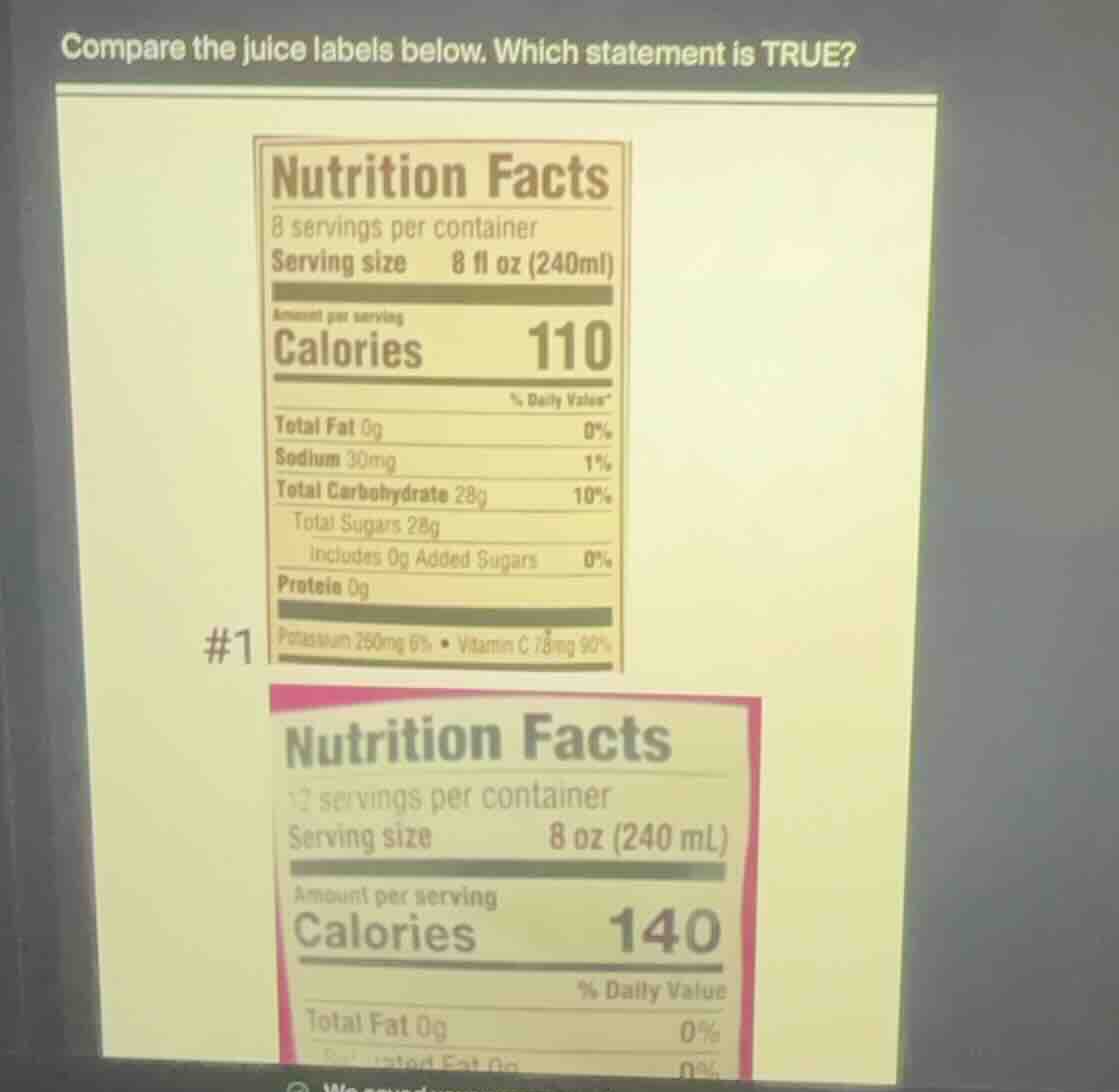
Analyze Label #1
- Serving size: \(8\text{ fl oz } (240\text{ mL})\)
- Calories per serving: \(110\)
- Servings per container: \(8\)
- Total Calories per container: \(110 \times 8 = 880\)
- Total Carbohydrate: \(28\text{ g } (10\% \text{ DV})\)
- Total Sugars: \(28\text{ g}\) (Includes \(0\text{ g}\) Added Sugars, \(0\% \text{ DV}\))
- Sodium: \(30\text{ mg } (1\% \text{ DV})\)
- Potassium: \(260\text{ mg } (6\% \text{ DV})\)
- Vitamin C: \(78\text{ mg } (90\% \text{ DV})\)
Analyze Label #2
- Serving size: \(8\text{ oz } (240\text{ mL})\)
- Calories per serving: \(140\)
- Servings per container: \(12\)
- Total Calories per container: \(140 \times 12 = 1680\)
- Total Fat: \(0\text{ g } (0\% \text{ DV})\)
Compare Key Metrics
- Serving sizes are identical: \(240\text{ mL}\).
- Label #1 has fewer calories per serving (\(110\) vs. \(140\)).
- Label #1 contains \(0\text{ g}\) of added sugars.
- Label #2 has more total servings per container (\(12\) vs. \(8\)).

Snap & solve any problem in the app
Get step-by-step solutions on Sovi AI
Photo-based solutions with guided steps
Explore more problems and detailed explanations
- (A) Juice #1 has fewer calories per serving than Juice #2. (Correct answer)
- (B) Juice #1 has more servings per container than Juice #2.
- (C) Juice #1 contains more added sugars than Juice #2.
- (D) Juice #1 has a larger serving size than Juice #2.