QUESTION IMAGE
Question
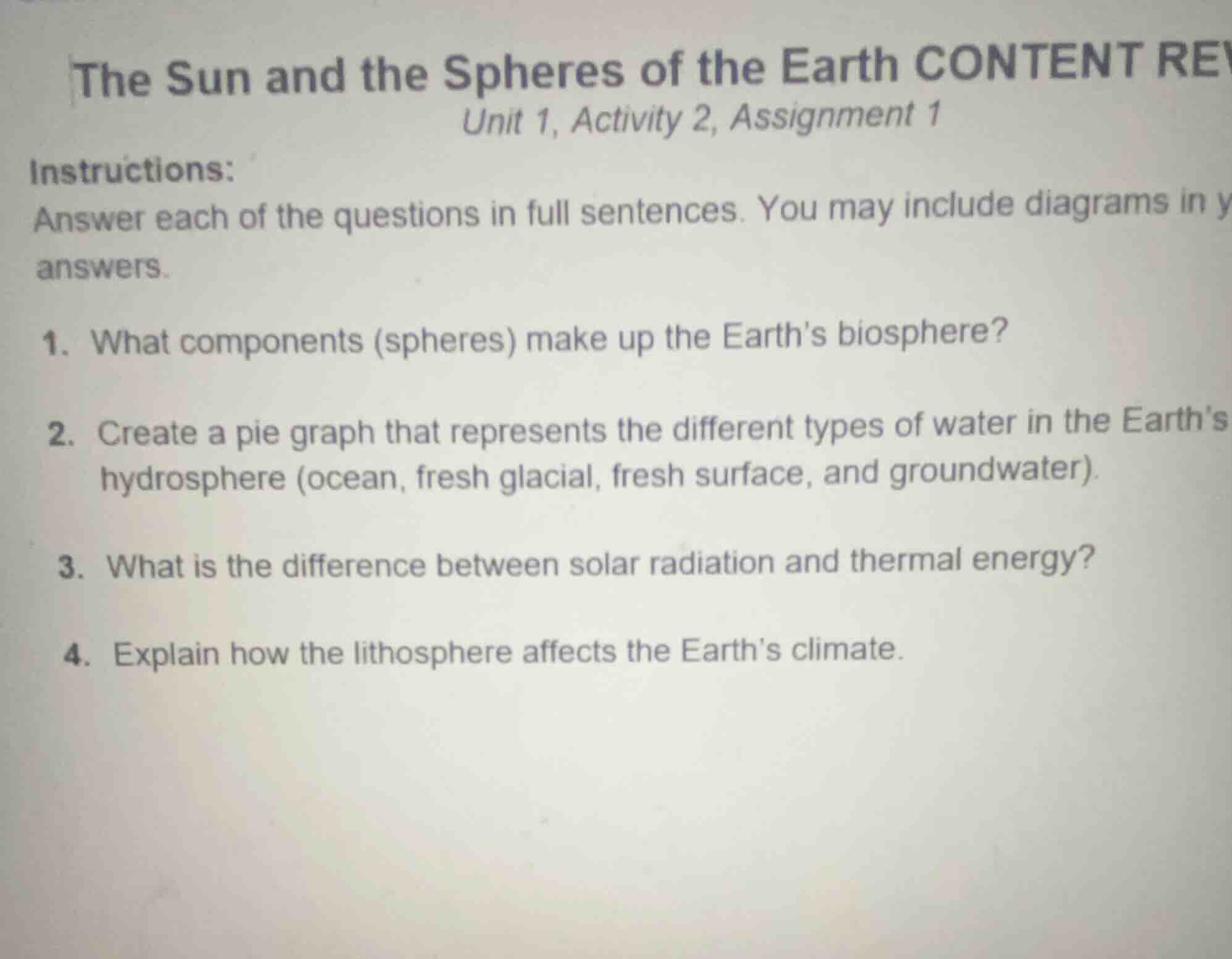
the sun and the spheres of the earth content review
unit 1, activity 2, assignment 1
instructions:
answer each of the questions in full sentences. you may include diagrams in your answers.
- what components (spheres) make up the earths biosphere?
- create a pie graph that represents the different types of water in the earths hydrosphere (ocean, fresh glacial, fresh surface, and groundwater).
- what is the difference between solar radiation and thermal energy?
- explain how the lithosphere affects the earths climate.
Identify components of the biosphere
The biosphere is the global ecological system integrating all living beings and their relationships. It is made up of the regions of the atmosphere (air), hydrosphere (water), and lithosphere (land) where living organisms exist.
Determine hydrosphere water distribution for pie chart
The Earth's hydrosphere consists of approximately:
- Oceans (saline water): ~97.2%
- Fresh glacial (glaciers and ice caps): ~2.15%
- Groundwater: ~0.62%
- Fresh surface water (lakes, rivers, atmosphere): ~0.03%
Differentiate solar radiation and thermal energy
- Solar radiation is electromagnetic radiation emitted by the Sun, traveling through space as waves or photons.
- Thermal energy is the internal kinetic energy of atoms and molecules within a substance, representing its heat content.
Explain lithospheric effects on climate
The lithosphere affects climate through:
- Topography: Mountain ranges block wind and create rain shadows.
- Albedo: Land cover (rock, soil, vegetation) determines how much solar radiation is absorbed or reflected.
- Volcanic activity: Eruptions release greenhouse gases (\(\text{CO}_2\)) and aerosols that block sunlight.
- Plate tectonics: Changing positions of continents alters ocean currents and atmospheric circulation over millions of years.

Snap & solve any problem in the app
Get step-by-step solutions on Sovi AI
Photo-based solutions with guided steps
Explore more problems and detailed explanations
Question 1
The Earth's biosphere is made up of the atmosphere (air), the hydrosphere (water), and the lithosphere (land/crust) in the regions where life exists.
Question 2
The distribution of water in the Earth's hydrosphere is approximately:
- Oceans (Saline): 97.2%
- Fresh Glacial (Glaciers and Ice Caps): 2.15%
- Groundwater: 0.62%
- Fresh Surface Water (Lakes, Rivers, Atmosphere): 0.03%
Question 3
Solar radiation is electromagnetic energy emitted by the Sun that travels through space, whereas thermal energy is the internal kinetic energy of particles within a substance, experienced as heat.
Question 4
The lithosphere affects the Earth's climate through landforms like mountains that redirect wind and precipitation, surface albedo which determines how much solar energy is absorbed or reflected, and volcanic eruptions that release greenhouse gases and cooling aerosols into the atmosphere.