QUESTION IMAGE
Question
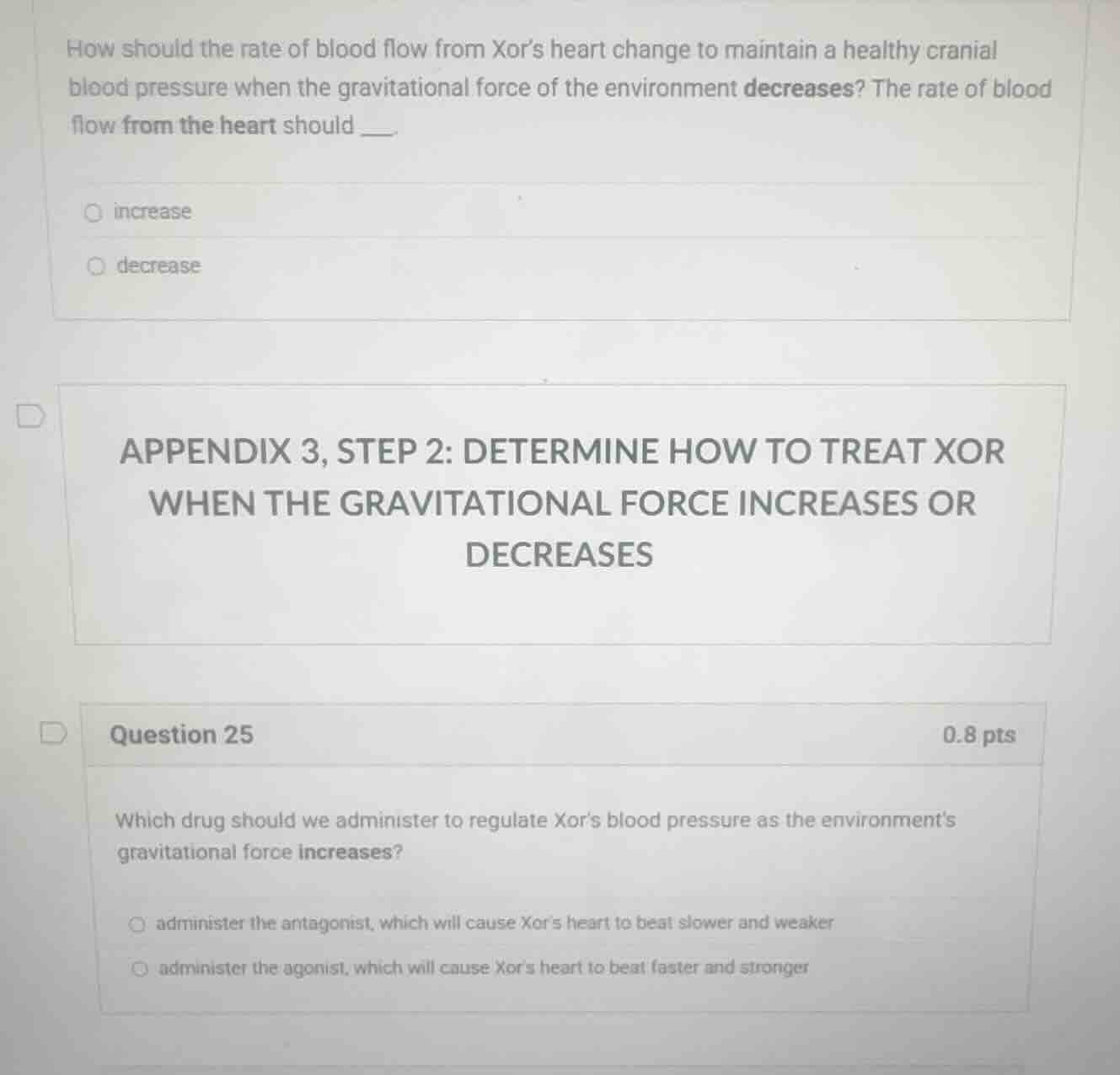
how should the rate of blood flow from xors heart change to maintain a healthy cranial blood pressure when the gravitational force of the environment decreases? the rate of blood flow from the heart should ___
- increase
- decrease
appendix 3, step 2: determine how to treat xor when the gravitational force increases or decreases
question 25
0.8 pts
which drug should we administer to regulate xors blood pressure as the environments gravitational force increases?
- administer the antagonist, which will cause xors heart to beat slower and weaker
- administer the agonist, which will cause xors heart to beat faster and stronger
Analyze the effect of decreased gravity on cranial blood pressure
When the environmental gravitational force decreases, the hydrostatic pressure gradient opposing blood flow from the heart to the brain is reduced. Consequently, more blood naturally pools in or flows toward the upper body and head, which increases cranial blood pressure. To maintain a healthy, stable cranial blood pressure (homeostasis) and prevent it from rising too high, the body must compensate. Using the Cranial Blood Pressure and Gravitational Physiology concepts, the rate of blood flow from the heart (cardiac output) must decrease to offset this effect.
Analyze the physiological response to increased gravity
When the environmental gravitational force increases, the hydrostatic pressure gradient opposing upward blood flow increases. This causes blood to pool in the lower extremities, leading to a drop in cranial blood pressure. To counteract this drop and maintain adequate perfusion to the brain, the body needs to increase cardiac output. This requires increasing both the heart rate and the strength of cardiac contractions.
Determine the appropriate pharmacological intervention
Using the Cardiac Output Regulation concept, to help the body compensate for increased gravity, we must administer a drug that increases cardiac output.
- An agonist (such as a beta-adrenergic agonist) mimics or enhances the sympathetic nervous system, causing the heart to beat faster and stronger.
- An antagonist (such as a beta-blocker) would inhibit this response, causing the heart to beat slower and weaker, which would worsen the hypotension caused by increased gravity.
Therefore, to regulate blood pressure as gravity increases, we should administer the agonist to make the heart beat faster and stronger.

Snap & solve any problem in the app
Get step-by-step solutions on Sovi AI
Photo-based solutions with guided steps
Explore more problems and detailed explanations
Question 1
How should the rate of blood flow from Xor’s heart change to maintain a healthy cranial blood pressure when the gravitational force of the environment decreases? The rate of blood flow from the heart should \_\_\_\_.
- increase
- decrease (Correct answer)
Question 2
Which drug should we administer to regulate Xor's blood pressure as the environment's gravitational force increases?
- administer the antagonist, which will cause Xor's heart to beat slower and weaker
- administer the agonist, which will cause Xor's heart to beat faster and stronger (Correct answer)