QUESTION IMAGE
Question
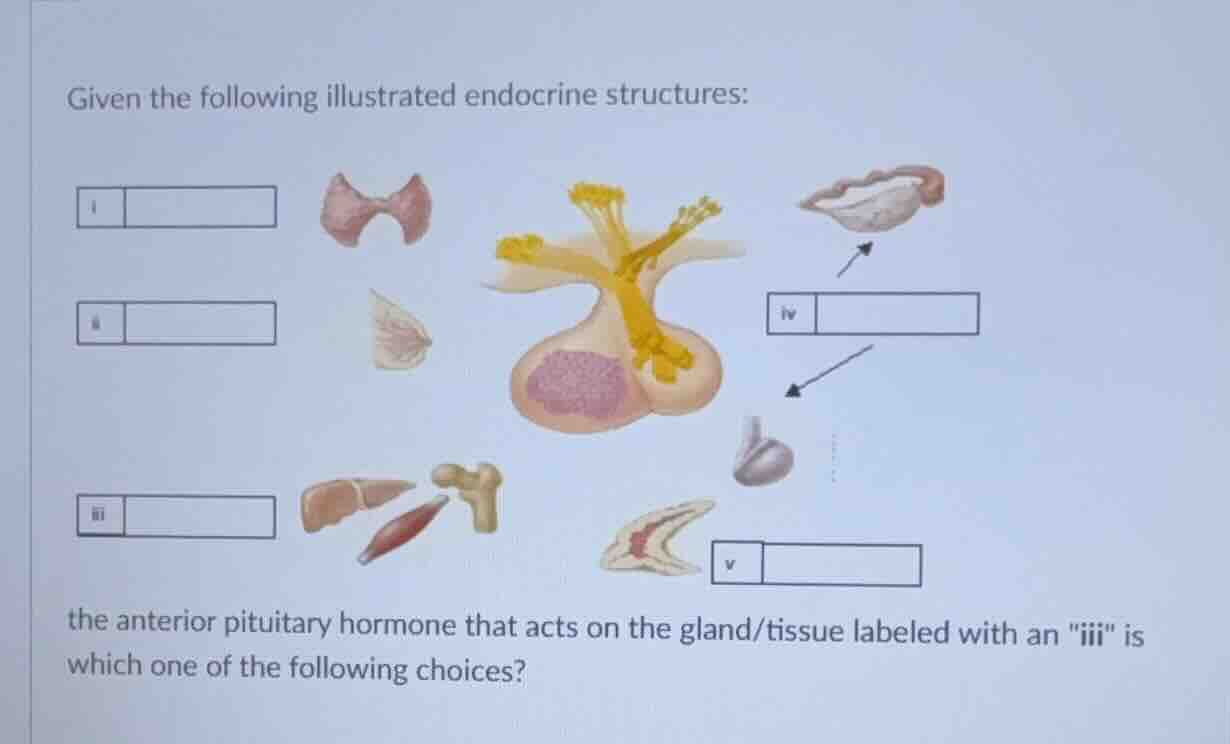
given the following illustrated endocrine structures:
the anterior pituitary hormone that acts on the gland/tissue labeled with an \iii\ is which one of the following choices?
<pre_analysis>
{
"quality": "clear",
"question_count": 1,
"skills_matched": [
"direct_cot",
"explain_then_answer",
"tutor"
],
"needs_drawing": false,
"concepts_used": [
"Endocrine System"
],
"new_concepts": [
"Anterior Pituitary Hormones",
"Hypothalamic-Pituitary Axis"
],
"current_concepts": [
"Endocrine System",
"Anterior Pituitary Hormones",
"Hypothalamic-Pituitary Axis"
]
}
</pre_analysis>
<reasoning>
Identify the central structure
The central diagram shows the hypothalamus and pituitary gland, which regulate other endocrine glands.
Identify the target structures
Using our understanding of the Endocrine System, we identify the peripheral targets:
- i points to the thyroid gland.
- ii points to the adrenal gland (specifically the cortex/medulla).
- iii points to non-endocrine targets of growth hormone: liver, muscle, and bone.
- iv points to the gonads (testis and ovary).
- v points to the mammary gland.
Determine the hormone for label iii
The structures labeled with iii are the liver, skeletal muscle, and bone. The anterior pituitary hormone that directly acts on these tissues to stimulate growth and metabolic effects is Growth Hormone (GH).
</reasoning>
<answer>
Growth Hormone (GH)
</answer>
<post_analysis>
{
"subject": "Natural Science",
"question_type": "Free Response",
"knowledge_point": [
"Natural Science",
"Biology",
"Endocrine System"
]
}
</post_analysis>
Snap & solve any problem in the app
Get step-by-step solutions on Sovi AI
Photo-based solutions with guided steps
Explore more problems and detailed explanations
<pre_analysis>
{
"quality": "clear",
"question_count": 1,
"skills_matched": [
"direct_cot",
"explain_then_answer",
"tutor"
],
"needs_drawing": false,
"concepts_used": [
"Endocrine System"
],
"new_concepts": [
"Anterior Pituitary Hormones",
"Hypothalamic-Pituitary Axis"
],
"current_concepts": [
"Endocrine System",
"Anterior Pituitary Hormones",
"Hypothalamic-Pituitary Axis"
]
}
</pre_analysis>
<reasoning>
Identify the central structure
The central diagram shows the hypothalamus and pituitary gland, which regulate other endocrine glands.
Identify the target structures
Using our understanding of the Endocrine System, we identify the peripheral targets:
- i points to the thyroid gland.
- ii points to the adrenal gland (specifically the cortex/medulla).
- iii points to non-endocrine targets of growth hormone: liver, muscle, and bone.
- iv points to the gonads (testis and ovary).
- v points to the mammary gland.
Determine the hormone for label iii
The structures labeled with iii are the liver, skeletal muscle, and bone. The anterior pituitary hormone that directly acts on these tissues to stimulate growth and metabolic effects is Growth Hormone (GH).
</reasoning>
<answer>
Growth Hormone (GH)
</answer>
<post_analysis>
{
"subject": "Natural Science",
"question_type": "Free Response",
"knowledge_point": [
"Natural Science",
"Biology",
"Endocrine System"
]
}
</post_analysis>