QUESTION IMAGE
Question
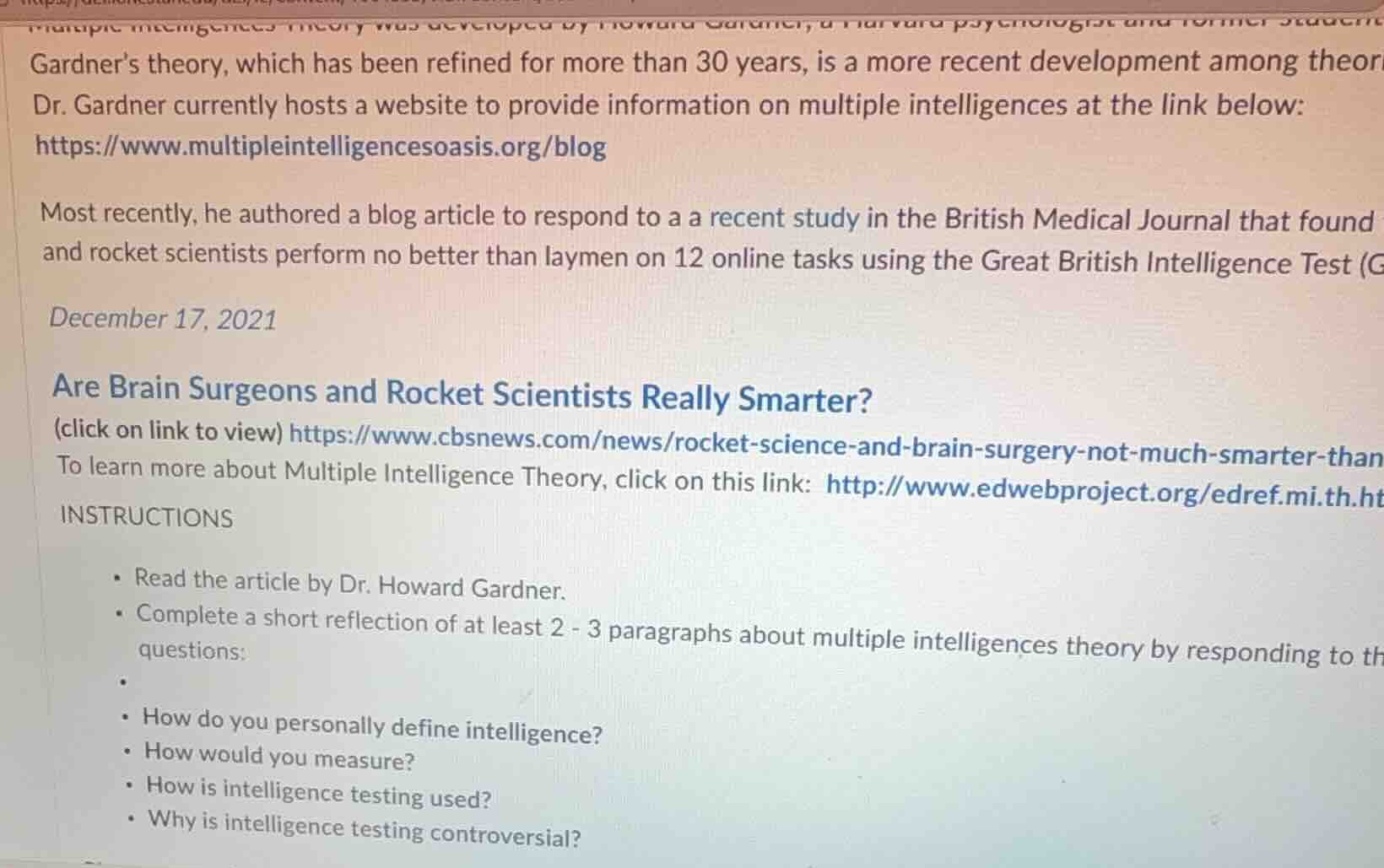
gardners theory, which has been refined for more than 30 years, is a more recent development among theor
dr. gardner currently hosts a website to provide information on multiple intelligences at the link below:
https://www.multipleintelligencesoasis.org/blog
most recently, he authored a blog article to respond to a recent study in the british medical journal that found and rocket scientists perform no better than laymen on 12 online tasks using the great british intelligence test (g
december 17, 2021
are brain surgeons and rocket scientists really smarter?
(click on link to view) https://www.cbsnews.com/news/rocket-science-and-brain-surgery-not-much-smarter-than
to learn more about multiple intelligence theory, click on this link: http://www.edwebproject.org/edref.mi.th.ht
instructions
- read the article by dr. howard gardner.
- complete a short reflection of at least 2 - 3 paragraphs about multiple intelligences theory by responding to th
*
- how do you personally define intelligence?
- how would you measure?
- how is intelligence testing used?
- why is intelligence testing controversial?
Define personal intelligence
Intelligence is a multifaceted capacity. It encompasses problem-solving, adaptation, and learning.
Propose measurement methods
Traditional IQ tests measure specific cognitive skills. A broader assessment includes practical portfolios.
Explain testing applications
Schools use intelligence tests for placement. Clinical psychologists use them to diagnose learning differences.
Analyze testing controversies
Standardized tests often carry cultural bias. They can also limit a student's perceived potential.

Snap & solve any problem in the app
Get step-by-step solutions on Sovi AI
Photo-based solutions with guided steps
Explore more problems and detailed explanations
Reflection on Multiple Intelligences and Intelligence Testing
Intelligence is best defined as a dynamic, multifaceted capacity to adapt to one's environment, learn from experiences, and solve diverse problems. Rather than being a single, fixed general ability (often referred to as the "g factor"), intelligence is a collection of distinct modalities. This aligns closely with Dr. Howard Gardner's Multiple Intelligences Theory, which suggests that individuals possess varying strengths across different domains, such as linguistic, logical-mathematical, spatial, musical, bodily-kinesthetic, interpersonal, intrapersonal, and naturalistic intelligences.
To measure such a broad spectrum of abilities, traditional standardized testing is insufficient. A comprehensive measurement approach should combine standardized cognitive assessments with authentic, performance-based portfolios. For instance, instead of relying solely on a written exam to gauge logical or spatial reasoning, educators and psychologists can observe how an individual solves real-world problems, creates projects, or collaborates with others in natural settings. This multi-dimensional assessment provides a more holistic and accurate representation of an individual's unique intellectual profile.
Historically, intelligence testing has been used to categorize students for academic placement, identify giftedness, and diagnose specific learning disabilities or cognitive impairments. However, these tests remain highly controversial. Critics point out that standardized IQ tests often exhibit cultural and socioeconomic biases, favoring individuals from backgrounds similar to the test creators. Furthermore, relying on a single numerical score can lead to harmful labeling, creating self-fulfilling prophecies that limit a student's academic and personal growth by ignoring their strengths in non-traditional areas.