QUESTION IMAGE
Question
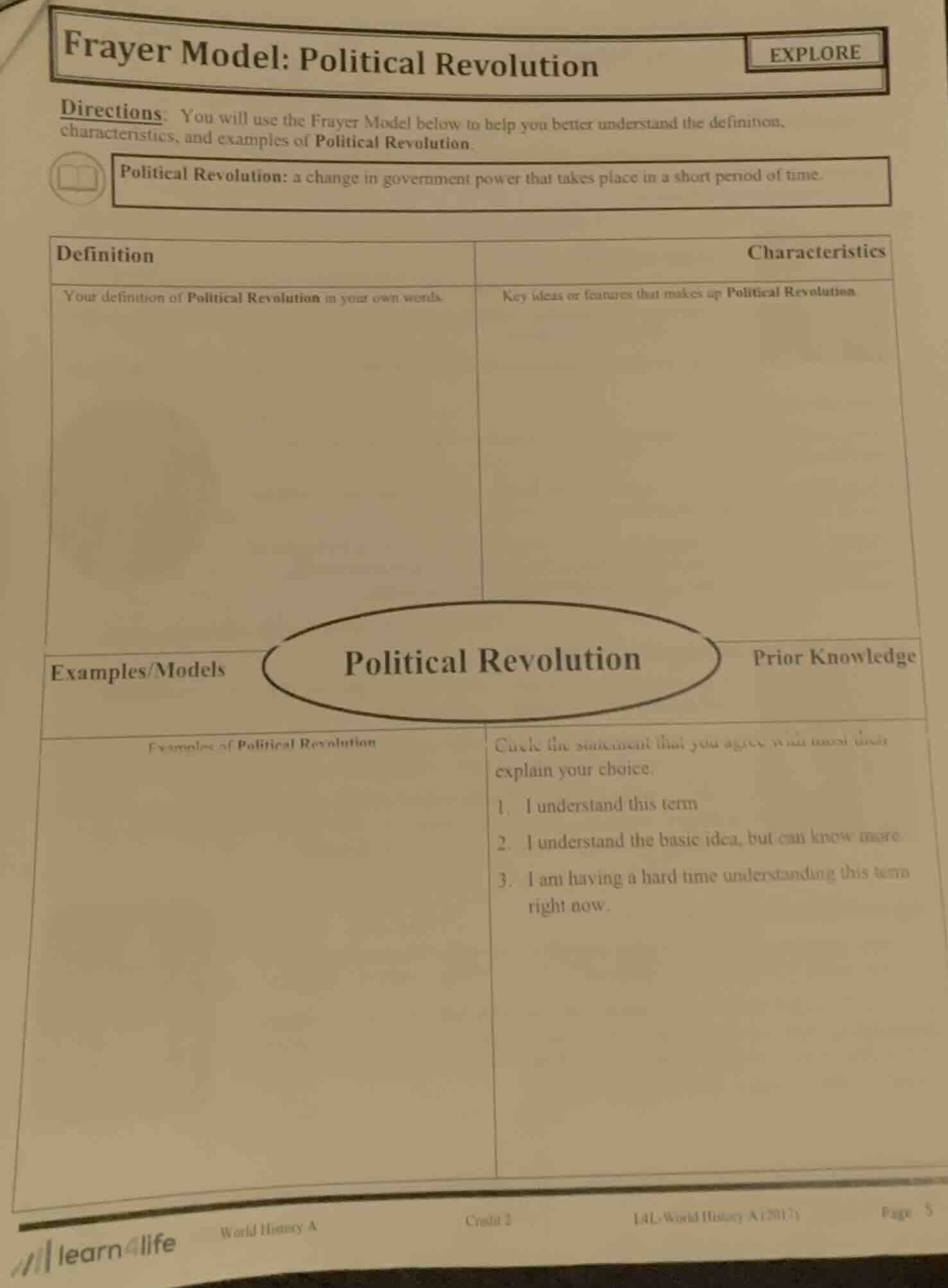
frayer model: political revolution
explore
directions: you will use the frayer model below to help you better understand the definition, characteristics, and examples of political revolution.
political revolution: a change in government power that takes place in a short period of time.
definition
your definition of political revolution in your own words.
characteristics
key ideas or features that makes up political revolution.
examples/models
examples of political revolution
prior knowledge
circle the statement that you agree with most then explain your choice.
- i understand this term
- i understand the basic idea, but can know more.
- i am having a hard time understanding this term right now.
Analyze the Frayer Model prompt
The worksheet asks to complete a Frayer Model for the term "Political Revolution". The provided definition is: "a change in government power that takes place in a short period of time." We need to fill in the four quadrants: Definition (in own words), Characteristics, Examples/Models, and Prior Knowledge (self-assessment).
Define in own words
Using the concept of Right to Revolution, we can define a political revolution as a rapid, fundamental transformation of a nation's state authority and political systems, typically driven by citizens reclaiming their natural rights when a government fails them.
Identify key characteristics
Key features of a political revolution include:
- Rapid and sudden shift in power.
- Overthrow of the existing constitutional or governing order.
- High level of popular mobilization or citizen participation.
- Reorganization of political institutions and leadership.
Provide historical examples
Clear historical examples of political revolutions include:
- The American Revolution (1775–1783)
- The French Revolution (1789–1799)
- The Russian Revolution (1917)
Assess prior knowledge
For the "Prior Knowledge" quadrant, we select a standard self-assessment statement (e.g., Statement 1: "I understand this term") and explain it by connecting it to the foundational ideas of political philosophy.
I understand this term because a political revolution represents the practical application of the Right to Revolution**, where citizens collectively act to replace a government that no longer protects their fundamental rights or represents their interests.
</answer>

Snap & solve any problem in the app
Get step-by-step solutions on Sovi AI
Photo-based solutions with guided steps
Explore more problems and detailed explanations
Definition (Your definition in your own words)
A rapid, fundamental transformation of a nation's governing system and political authority, occurring when citizens overthrow an existing government to establish a new political order.
---
Characteristics (Key ideas or features)
- Rapid Pace: The transfer of power occurs over a relatively short period.
- Systemic Change: It completely replaces the existing constitutional or institutional structure rather than just changing individual leaders.
- Popular Mobilization: It involves significant participation, collective action, or support from the general population.
- Altered Sovereignty: It shifts the ultimate source of political authority and power to a new group or system.
---
Examples/Models
- The American Revolution (1775–1783): Overthrew British colonial rule to establish a democratic republic.
- The French Revolution (1789–1799): Abolished the absolute monarchy and feudal privileges, introducing radical social and political reforms.
- The Russian Revolution (1917): Dismantled the Tsarist autocracy and led to the creation of the Soviet state.
---
Prior Knowledge (Self-Assessment)
Selected Statement: 1. I understand this term.
Explanation: I understand this term because a political revolution represents the practical application of the Right to Revolution, where citizens collectively act to replace a government that no longer protects their fundamental rights or represents their interests.