QUESTION IMAGE
Question
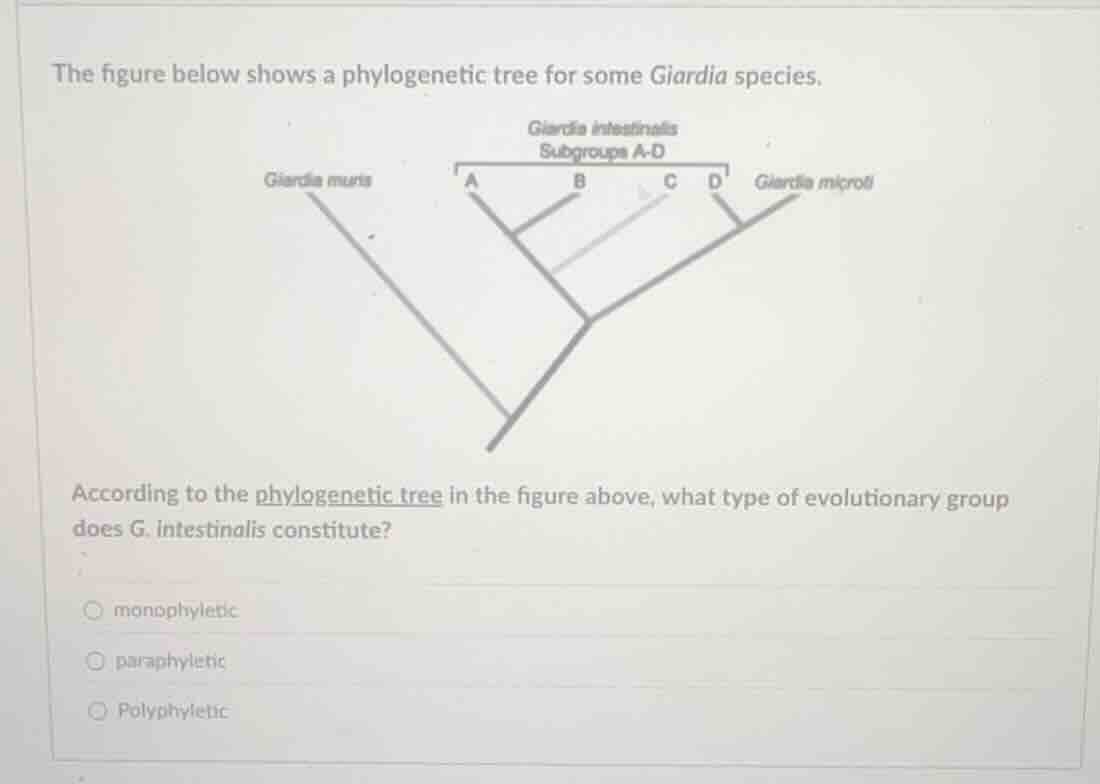
the figure below shows a phylogenetic tree for some giardia species.
according to the phylogenetic tree in the figure above, what type of evolutionary group does g. intestinalis constitute?
monophyletic
paraphyletic
polyphyletic
Analyze the phylogenetic tree structure
Using the Phylogenetic Trees knowledge point, we trace the common ancestors of the groups.
- The tree shows evolutionary relationships among Giardia muris, Giardia intestinalis (subgroups A, B, C, D), and Giardia microti.
- Subgroups A, B, C, and D are designated as G. intestinalis.
- The most recent common ancestor (MRCA) of all G. intestinalis subgroups (A-D) is located at the node where the lineage leading to A/B/C and the lineage leading to D/G. microti diverge.
Identify the descendants of the common ancestor
- The MRCA of subgroups A, B, C, and D also has Giardia microti as a direct descendant.
- Specifically, subgroup D shares a more recent common ancestor with G. microti than it does with subgroups A, B, or C.
Classify the evolutionary group
- A monophyletic group (clade) must consist of an ancestral species and all of its descendants.
- The group G. intestinalis (subgroups A-D) includes their common ancestor but excludes Giardia microti, which is also a descendant of that same common ancestor.
- A group that consists of a common ancestor and some, but not all, of its descendants is defined as paraphyletic.

Snap & solve any problem in the app
Get step-by-step solutions on Sovi AI
Photo-based solutions with guided steps
Explore more problems and detailed explanations
- monophyletic
- paraphyletic (Correct answer)
- Polyphyletic