QUESTION IMAGE
Question
experimental inquiry: does dna replication follow the conservative, semiconservative, or dispersive model?
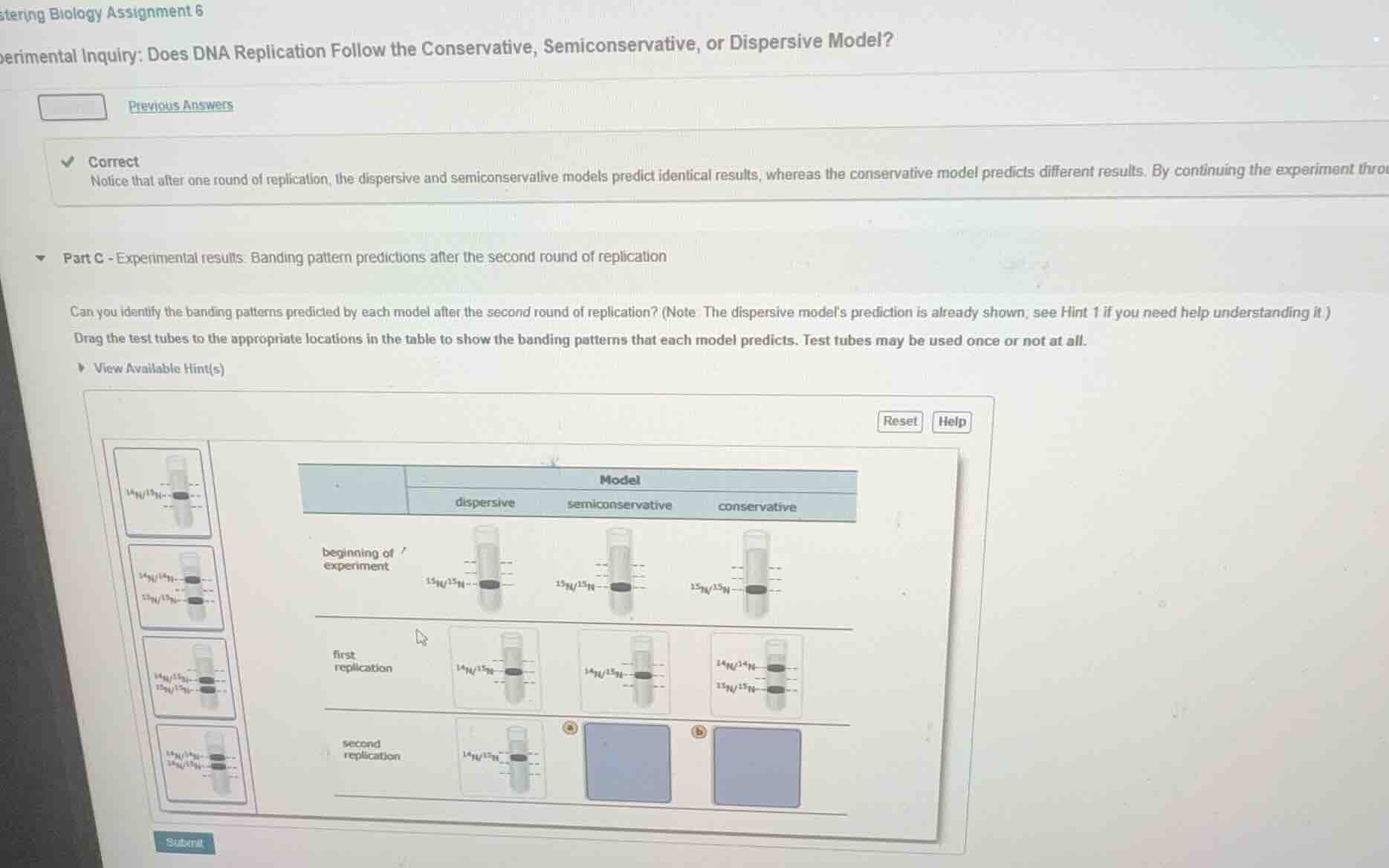
part c - experimental results: banding pattern predictions after the second round of replication
can you identify the banding patterns predicted by each model after the second round of replication? (note: the dispersive models prediction is already shown; see hint 1 if you need help understanding it.)
drag the test tubes to the appropriate locations in the table to show the banding patterns that each model predicts. test tubes may be used once or not at all.
Analyze Semiconservative Model (a)
In the semiconservative model, after the first replication in $^{14}\text{N}$, all DNA molecules are hybrid $^{14}\text{N}/^{15}\text{N}$ (one intermediate band).
During the second replication in $^{14}\text{N}$, each hybrid molecule separates and replicates using $^{14}\text{N}$ nucleotides, yielding:
- 50% light DNA ($^{14}\text{N}/^{14}\text{N}$)
- 50% hybrid DNA ($^{14}\text{N}/^{15}\text{N}$)
This corresponds to a test tube showing two distinct bands: one at the light position ($^{14}\text{N}/^{14}\text{N}$) and one at the intermediate position ($^{14}\text{N}/^{15}\text{N}$).
Analyze Conservative Model (b)
In the conservative model, after the first replication, there is one fully heavy molecule ($^{15}\text{N}/^{15}\text{N}$) and one fully light molecule ($^{14}\text{N}/^{14}\text{N}$).
During the second replication in $^{14}\text{N}$:
- The heavy molecule ($^{15}\text{N}/^{15}\text{N}$) replicates to produce one heavy ($^{15}\text{N}/^{15}\text{N}$) and one light ($^{14}\text{N}/^{14}\text{N}$) molecule.
- The light molecule ($^{14}\text{N}/^{14}\text{N}$) replicates to produce two light ($^{14}\text{N}/^{14}\text{N}$) molecules.
This yields 75% light DNA ($^{14}\text{N}/^{14}\text{N}$) and 25% heavy DNA ($^{15}\text{N}/^{15}\text{N}$).
This corresponds to a test tube showing two distinct bands: one at the light position ($^{14}\text{N}/^{14}\text{N}$) and one at the heavy position ($^{15}\text{N}/^{15}\text{N}$).

Snap & solve any problem in the app
Get step-by-step solutions on Sovi AI
Photo-based solutions with guided steps
Explore more problems and detailed explanations
Question a
The test tube with two bands: one at the $^{14}\text{N}/^{14}\text{N}$ (light) position and one at the $^{14}\text{N}/^{15}\text{N}$ (hybrid/intermediate) position.
Question b
The test tube with two bands: one at the $^{14}\text{N}/^{14}\text{N}$ (light) position and one at the $^{15}\text{N}/^{15}\text{N}$ (heavy) position.