QUESTION IMAGE
Question
exercises
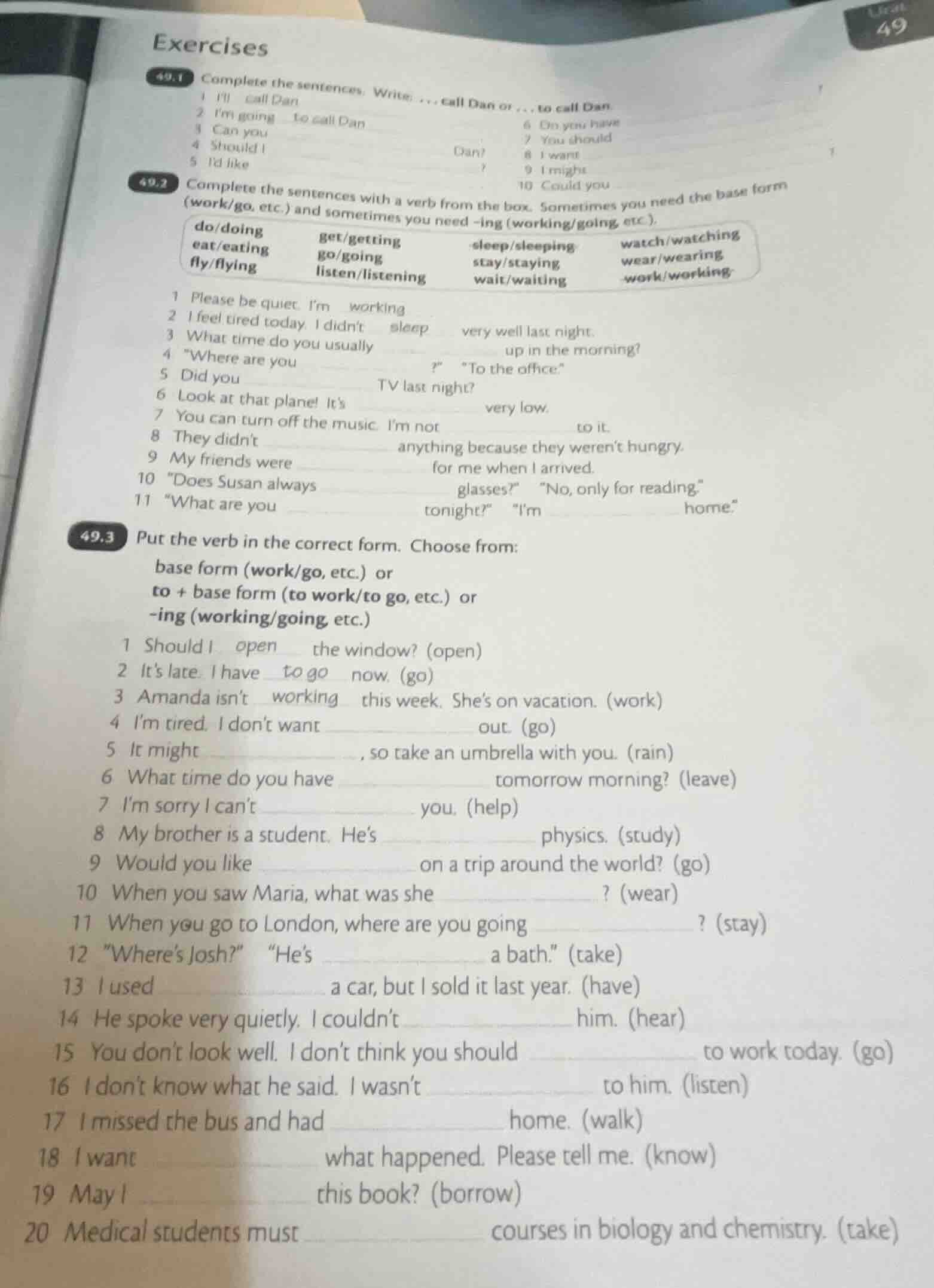
49.1 complete the sentences. write ... call dan or ... to call dan.
1 ill call dan.
2 im going to call dan.
3 can you ... dan?
4 should i ...?
5 id like ...
6 do you have ...
7 you should ...
8 i want ...
9 i might ...
10 could you ...
49.2 complete the sentences with a verb from the box. sometimes you need the base form (work/go, etc.) and sometimes you need -ing (working/going, etc.).
do/doing, get/getting, sleep/sleeping, watch/watching, eat/eating, go/going, stay/staying, wear/wearing, fly/flying, listen/listening, wait/waiting, work/working
1 please be quiet. im working.
2 i feel tired today. i didnt sleep very well last night.
3 what time do you usually ... up in the morning?
4 \where are you ...?\ \to the office.\
5 did you ... tv last night?
6 look at that plane! its ... very low.
7 you can turn off the music. im not ... to it.
8 they didnt ... anything because they werent hungry.
9 my friends were ... for me when i arrived.
10 \does susan always ... glasses?\
o, only for reading.\
11 \what are you ... tonight?\ \im ... home.\
49.3 put the verb in the correct form. choose from:
base form (work/go, etc.) or
to + base form (to work/to go, etc.) or
-ing (working/going, etc.)
1 should i open the window? (open)
2 its late. i have to go now. (go)
3 amanda isnt working this week. shes on vacation. (work)
4 im tired. i dont want ... out. (go)
5 it might ..., so take an umbrella with you. (rain)
6 what time do you have ... tomorrow morning? (leave)
7 im sorry i cant ... you. (help)
8 my brother is a student. hes ... physics. (study)
9 would you like ... on a trip around the world? (go)
10 when you saw maria, what was she ...? (wear)
11 when you go to london, where are you going ...? (stay)
12 \wheres josh?\ \hes ... a bath.\ (take)
13 i used ... a car, but i sold it last year. (have)
14 he spoke very quietly. i couldnt ... him. (hear)
15 you dont look well. i dont think you should ... to work today. (go)
16 i dont know what he said. i wasnt ... to him. (listen)
17 i missed the bus and had ... home. (walk)
18 i want ... what happened. please tell me. (know)
19 may i ... this book? (borrow)
20 medical students must ... courses in biology and chemistry. (take)
Analyze verb form rules
The exercise requires choosing between three verb forms:
- Base form (e.g., work/go): used after modal verbs (should, might, can, could, must).
- to + base form (e.g., to work/to go): used after certain verbs (want, have, would like, used, had).
- -ing form (e.g., working/going): used for continuous tenses after auxiliary verbs (be: am/is/are/was/were).
Determine correct forms for items 1-10
- 1: Should I + base form \(
ightarrow\) open (already filled).
- 2: have + to-infinitive \(
ightarrow\) to go (already filled).
- 3: isn't + -ing form (present continuous) \(
ightarrow\) working (already filled).
- 4: don't want + to-infinitive \(
ightarrow\) to go.
- 5: might + base form \(
ightarrow\) rain.
- 6: have + to-infinitive \(
ightarrow\) to leave.
- 7: can't + base form \(
ightarrow\) help.
- 8: He's (He is) + -ing form (present continuous) \(
ightarrow\) studying.
- 9: Would you like + to-infinitive \(
ightarrow\) to go.
- 10: was she + -ing form (past continuous) \(
ightarrow\) wearing.
Determine correct forms for items 11-20
- 11: are you going + to-infinitive (future plan) \(
ightarrow\) to stay.
- 12: He's (He is) + -ing form (present continuous) \(
ightarrow\) taking.
- 13: used + to-infinitive (past habit) \(
ightarrow\) to have.
- 14: couldn't + base form \(
ightarrow\) hear.
- 15: should + base form \(
ightarrow\) go.
- 16: wasn't + -ing form (past continuous) \(
ightarrow\) listening.
- 17: had + to-infinitive (past obligation) \(
ightarrow\) to walk.
- 18: want + to-infinitive \(
ightarrow\) to know.
- 19: May I + base form \(
ightarrow\) borrow.
- 20: must + base form \(
ightarrow\) take.

Snap & solve any problem in the app
Get step-by-step solutions on Sovi AI
Photo-based solutions with guided steps
Explore more problems and detailed explanations
| No. | Answer |
|---|---|
| 2 | to go |
| 3 | working |
| 4 | to go |
| 5 | rain |
| 6 | to leave |
| 7 | help |
| 8 | studying |
| 9 | to go |
| 10 | wearing |
| 11 | to stay |
| 12 | taking |
| 13 | to have |
| 14 | hear |
| 15 | go |
| 16 | listening |
| 17 | to walk |
| 18 | to know |
| 19 | borrow |
| 20 | take |