QUESTION IMAGE
Question
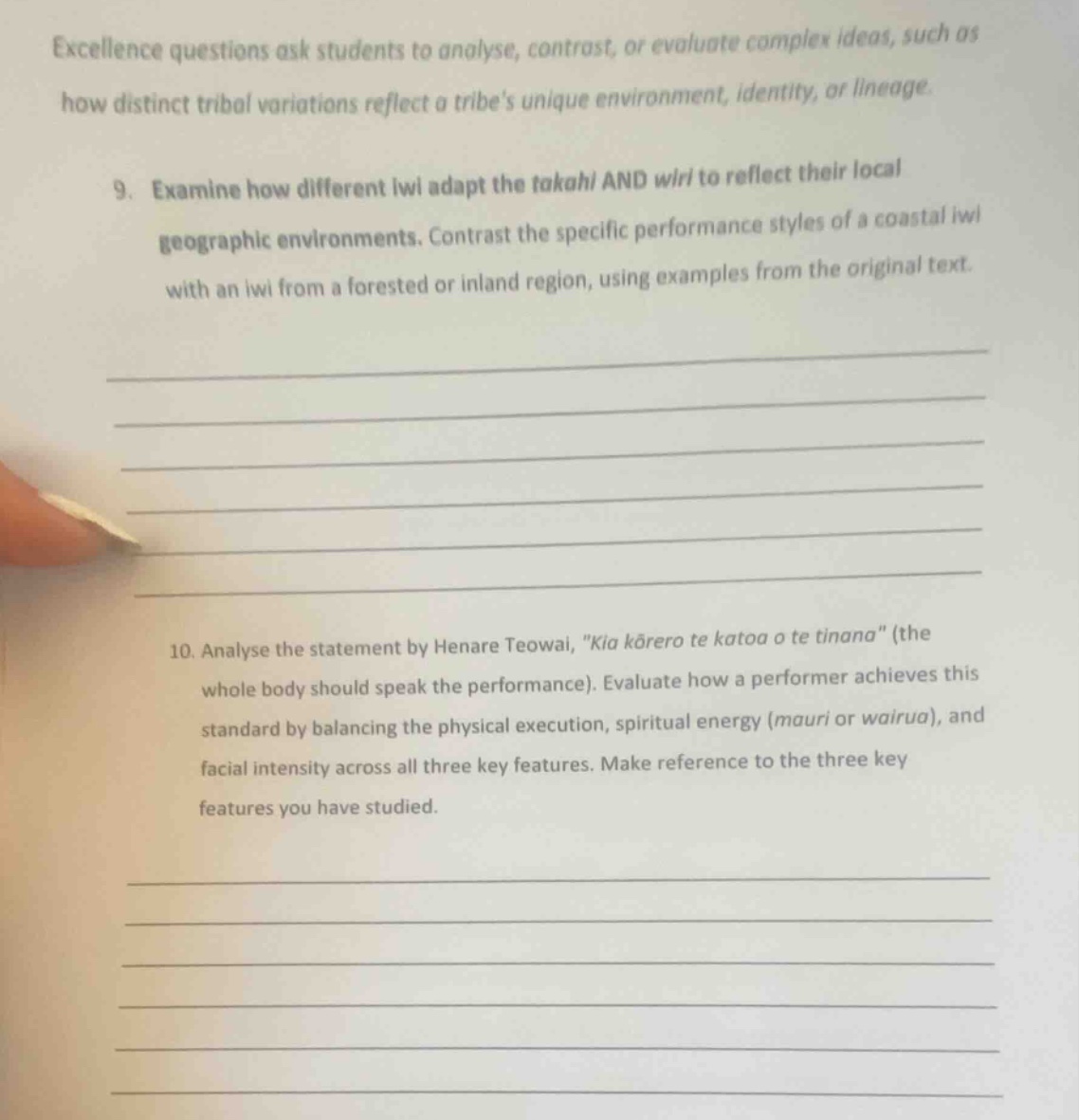
excellence questions ask students to analyse, contrast, or evaluate complex ideas, such as how distinct tribal variations reflect a tribes unique environment, identity, or lineage.
- examine how different iwi adapt the takahi and wiri to reflect their local geographic environments. contrast the specific performance styles of a coastal iwi with an iwi from a forested or inland region, using examples from the original text.
- analyse the statement by henare teowai, \kia kōrero te katoa o te tinana\ (the whole body should speak the performance). evaluate how a performer achieves this standard by balancing the physical execution, spiritual energy (mauri or wairua), and facial intensity across all three key features. make reference to the three key features you have studied.
Question 9
- Coastal iwi adapt takahi (foot stamping) and wiri (hand trembling) to mimic marine environments, using a lighter, fluid, or rapid tempo resembling waves, tides, or coastal winds.
- Inland/forested iwi ground their performance in heavy, solid takahi to reflect the dense forest floor, mountains, and strong, rooted trees, with wiri mimicking the rustling of forest leaves.
Question 10
- "Kia kōrero te katoa o te tinana" requires a unified expression where physical movements (such as takahi, wiri, and pūkana) are not merely mechanical but are driven by internal spiritual energy (mauri or wairua).
- A performer achieves this standard by ensuring that facial intensity (pūkana) is synchronized with the physical rhythm of the limbs, projecting the inner life force to make the entire body a vessel of communication.

Snap & solve any problem in the app
Get step-by-step solutions on Sovi AI
Photo-based solutions with guided steps
Explore more problems and detailed explanations
Question 9
Coastal iwi adapt takahi and wiri to reflect fluid marine environments (e.g., mimicking waves or coastal winds with lighter, rapid movements), whereas inland/forested iwi utilize a heavier, more grounded takahi and a distinct wiri to represent the solid forest floor, mountains, and rustling foliage.
Question 10
To achieve "Kia kōrero te katoa o te tinana," a performer must integrate physical execution (takahi and wiri) with facial intensity (pūkana), channeling mauri (life force) and wairua (spirit) so that every movement is spiritually charged rather than purely mechanical, allowing the entire body to speak.