QUESTION IMAGE
Question
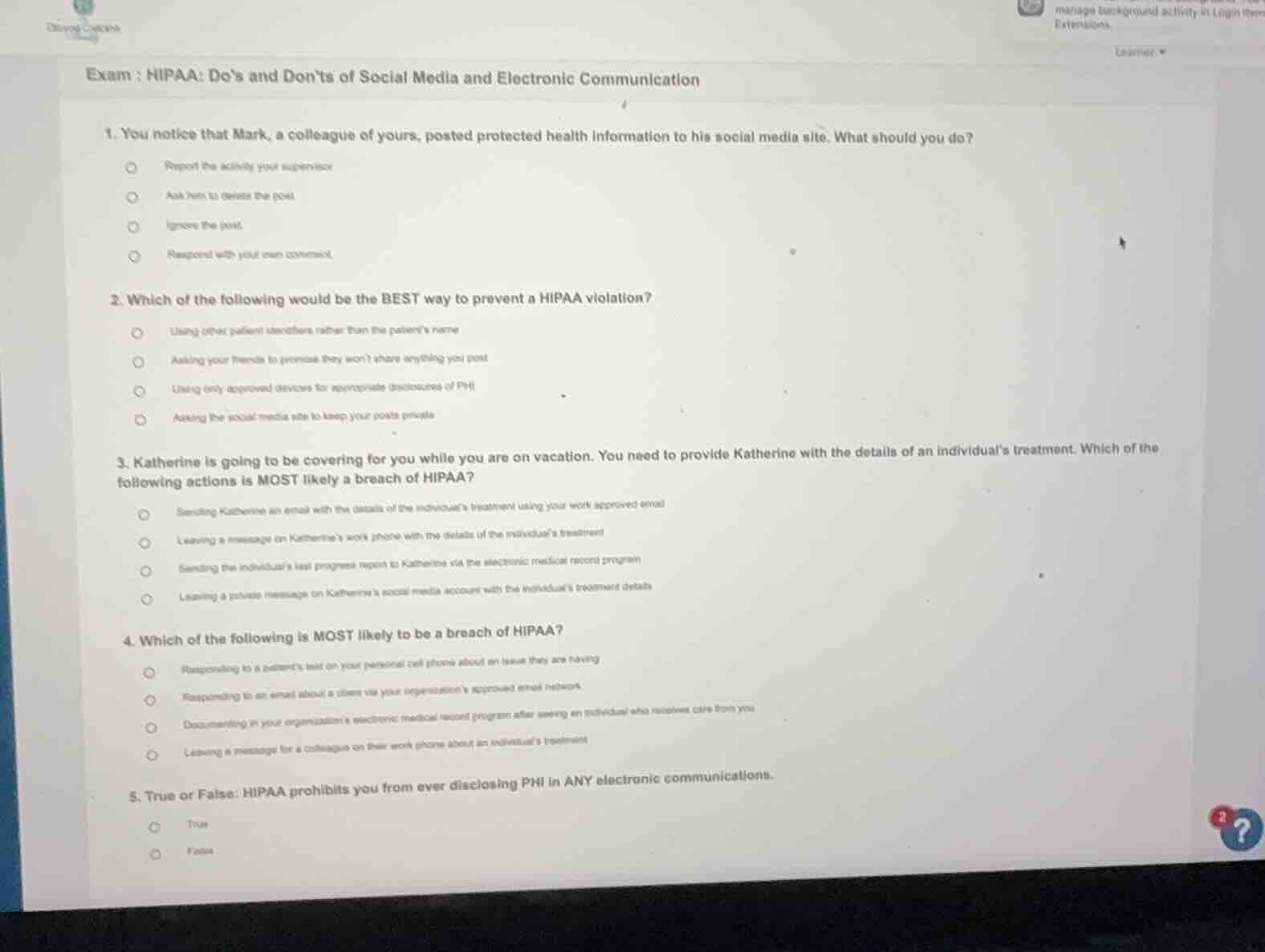
exam: hipaa: dos and donts of social media and electronic communication
- you notice that mark, a colleague of yours, posted protected health information to his social media site. what should you do?
- report the activity to your supervisor
- ask him to delete the post
- ignore the post
- respond with your own comment
- which of the following would be the best way to prevent a hipaa violation?
- using other patient identifiers rather than the patients name
- asking your friends to promise they wont share anything you post
- using only approved devices for appropriate disclosures of phi
- asking the social media site to keep your posts private
- katherine is going to be covering for you while you are on vacation. you need to provide katherine with the details of an individuals treatment. which of the following actions is most likely a breach of hipaa?
- sending katherine an email with the details of the individuals treatment using your work approved email
- leaving a message on katherines work phone with the details of the individuals treatment
- sending the individuals last progress report to katherine via the electronic medical record program
- leaving a private message on katherines social media account with the individuals treatment details
- which of the following is most likely to be a breach of hipaa?
- responding to a patients text on your personal cell phone about an issue they are having
- responding to an email about a client via your organizations approved email network
- documenting in your organizations electronic medical record program after seeing an individual who receives care from you
- leaving a message for a colleague on their work phone about an individuals treatment
- true or false: hipaa prohibits you from ever disclosing phi in any electronic communications.
- true
- false
Analyze Question 1
The question asks what to do if a colleague (Mark) posts protected health information (PHI) on his social media site. Under HIPAA regulations and standard healthcare compliance protocols, any suspected or known breach of PHI must be reported immediately to a supervisor or the designated privacy officer so that corrective action can be taken and the breach can be mitigated. Asking him directly, ignoring it, or commenting on it are incorrect and do not fulfill compliance obligations.
Analyze Question 2
The question asks for the BEST way to prevent a HIPAA violation among the given choices.
- Using other identifiers still risks re-identification.
- Asking friends not to share does not secure the data.
- Using only approved devices for appropriate disclosures of PHI ensures that transmission channels are secure, encrypted, and compliant with organizational policies.
- Asking social media sites to keep posts private is unreliable and insecure.
Therefore, using approved devices is the best preventive measure.
Analyze Question 3
The question asks which action is MOST likely a breach of HIPAA when sharing treatment details with a colleague covering a shift.
- Sending work-approved emails, leaving work voicemail, or using the electronic medical record (EMR) system are standard, secure channels.
- Leaving a private message on a colleague's personal social media account transmits PHI over an unsecure, third-party public platform, which is a direct breach of HIPAA.
Analyze Question 4
The question asks which of the following is MOST likely to be a breach of HIPAA.
- Responding to a patient's text on a personal cell phone involves using an unsecure, unencrypted personal device to transmit health information, which is a significant security risk and a likely HIPAA breach.
- Responding via organization email, documenting in the EMR, and leaving a work voicemail are generally secure, authorized methods of communication.
Analyze Question 5
The statement is: "True or False: HIPAA prohibits you from ever disclosing PHI in ANY electronic communications."
This statement is false. HIPAA does not prohibit electronic disclosure of PHI entirely; rather, it regulates electronic disclosures to ensure they are done securely (e.g., via encrypted email, secure EMR portals, and authorized secure networks) to protect patient privacy.

Snap & solve any problem in the app
Get step-by-step solutions on Sovi AI
Photo-based solutions with guided steps
Explore more problems and detailed explanations
Question 1
- (A) Report the activity your supervisor (Correct answer)
- (B) Ask him to delete the post
- (C) Ignore the post
- (D) Respond with your own comment
Question 2
- (A) Using other patient identifiers rather than the patient's name
- (B) Asking your friends to promise they won't share anything you post
- (C) Using only approved devices for appropriate disclosures of PHI (Correct answer)
- (D) Asking the social media site to keep your posts private
Question 3
- (A) Sending Katherine an email with the details of the individual's treatment using your work approved email
- (B) Leaving a message on Katherine's work phone with the details of the individual's treatment
- (C) Sending the individual's last progress report to Katherine via the electronic medical record program
- (D) Leaving a private message on Katherine's social media account with the individual's treatment details (Correct answer)
Question 4
- (A) Responding to a patient's text on your personal cell phone about an issue they are having (Correct answer)
- (B) Responding to an email about a client via your organization's approved email network
- (C) Documenting in your organization's electronic medical record program after seeing an individual who receives care from you
- (D) Leaving a message for a colleague on their work phone about an individual's treatment
Question 5
- (A) True
- (B) False (Correct answer)