Sovi.AI - AI Math Tutor

Scan to solve math questions

QUESTION IMAGE

on election evening, a congresswoman is found dead in her home, the vic…

Question

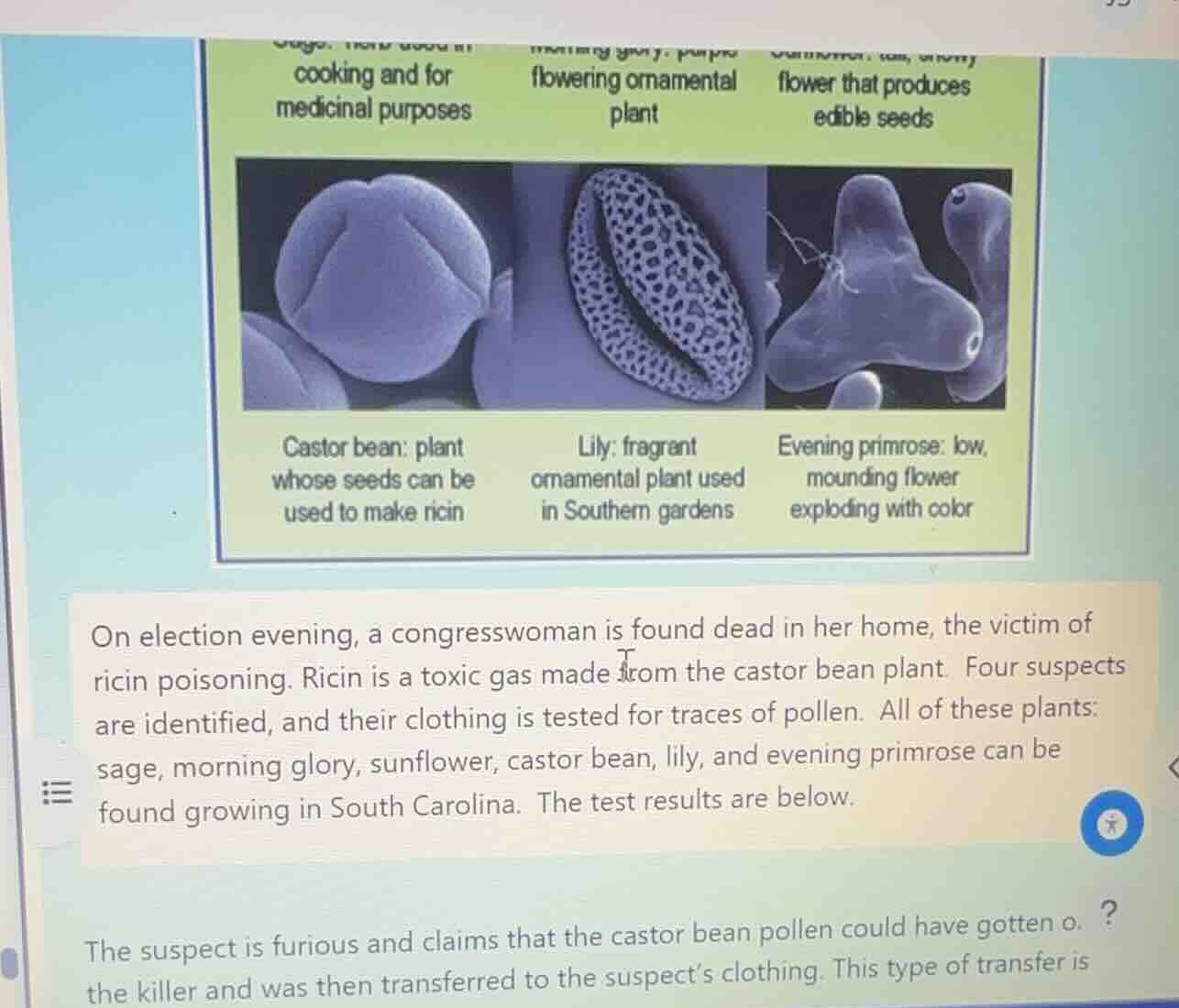
on election evening, a congresswoman is found dead in her home, the victim of ricin poisoning. ricin is a toxic gas made from the castor bean plant. four suspects are identified, and their clothing is tested for traces of pollen. all of these plants: sage, morning glory, sunflower, castor bean, lily, and evening primrose can be found growing in south carolina. the test results are below.

the suspect is furious and claims that the castor bean pollen could have gotten o... ? the killer and was then transferred to the suspects clothing. this type of transfer is

Explanation:

Response

<pre_analysis>
{
"quality": "clear",
"question_count": 1,
"skills_matched": [
"direct_cot",
"explain_then_answer",
"quick"
],
"needs_drawing": false,
"concepts_used": [
"Forensic Botany",
"Forensic Palynology"
],
"new_concepts": [
"Locard's Exchange Principle",
"Secondary Transfer"
],
"current_concepts": [
"Forensic Botany",
"Forensic Palynology",
"Locard's Exchange Principle",
"Secondary Transfer"
]
}
</pre_analysis>

<reasoning>

Identify the transfer mechanism

The suspect claims that the castor bean pollen was first transferred to the killer, and then subsequently transferred from the killer to the suspect's clothing.

Classify the transfer type

A transfer of trace evidence from a source (castor bean plant) to an intermediary (the killer) and then to a final destination (the suspect's clothing) is defined as secondary transfer (or indirect transfer).
</reasoning>

<answer>
secondary transfer
</answer>

<post_analysis>
{
"subject": "Natural Science",
"question_type": "Fill-in-the-blank",
"knowledge_point": [
"Natural Science",
"Forensic Science",
"Trace Evidence Transfer"
]
}
</post_analysis>

Answer:

<pre_analysis>
{
"quality": "clear",
"question_count": 1,
"skills_matched": [
"direct_cot",
"explain_then_answer",
"quick"
],
"needs_drawing": false,
"concepts_used": [
"Forensic Botany",
"Forensic Palynology"
],
"new_concepts": [
"Locard's Exchange Principle",
"Secondary Transfer"
],
"current_concepts": [
"Forensic Botany",
"Forensic Palynology",
"Locard's Exchange Principle",
"Secondary Transfer"
]
}
</pre_analysis>

<reasoning>

Identify the transfer mechanism

The suspect claims that the castor bean pollen was first transferred to the killer, and then subsequently transferred from the killer to the suspect's clothing.

Classify the transfer type

A transfer of trace evidence from a source (castor bean plant) to an intermediary (the killer) and then to a final destination (the suspect's clothing) is defined as secondary transfer (or indirect transfer).
</reasoning>

<answer>
secondary transfer
</answer>

<post_analysis>
{
"subject": "Natural Science",
"question_type": "Fill-in-the-blank",
"knowledge_point": [
"Natural Science",
"Forensic Science",
"Trace Evidence Transfer"
]
}
</post_analysis>