QUESTION IMAGE
Question
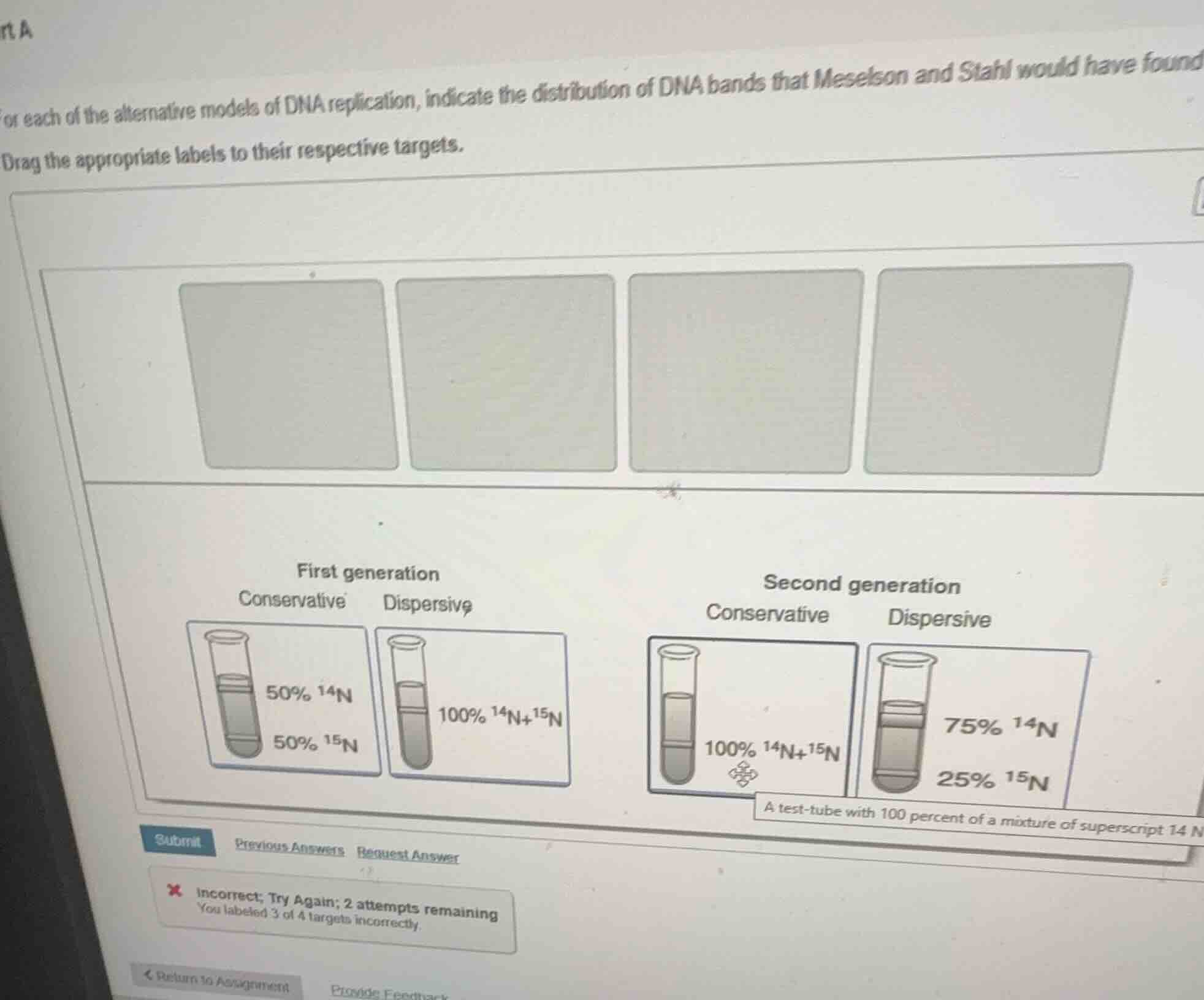
for each of the alternative models of dna replication, indicate the distribution of dna bands that meselson and stahl would have found.
drag the appropriate labels to their respective targets.
first generation
conservative
dispersive
50% \\(^{14}\text{n}\\)
50% \\(^{15}\text{n}\\)
100% \\(^{14}\text{n} + ^{15}\text{n}\\)
second generation
conservative
dispersive
100% \\(^{14}\text{n} + ^{15}\text{n}\\)
75% \\(^{14}\text{n}\\)
25% \\(^{15}\text{n}\\)
Analyze the alternative replication models
To determine the correct placement of the labels, we must analyze how DNA molecules distribute their nitrogen isotopes (\(^{14}\text{N}\) and \(^{15}\text{N}\)) under the conservative and dispersive models of replication. We will apply our understanding of DNA Replication Models and the Meselson-Stahl Experiment to trace the density of DNA across generations.
First generation predictions
In the first generation (one round of replication in \(^{14}\text{N}\) medium starting from pure \(^{15}\text{N}\) parent DNA):
- Conservative model: The original heavy parent molecule remains entirely intact (\(100\%\) \(^{15}\text{N}\)), and an entirely new light daughter molecule is synthesized (\(100\%\) \(^{14}\text{N}\)). This results in two distinct bands: \(50\%\) of the DNA is light (\(^{14}\text{N}\)) and \(50\%\) is heavy (\(^{15}\text{N}\)).
- Dispersive model: Every resulting DNA strand contains a mixture of parental and newly synthesized DNA. Thus, all molecules are hybrid, resulting in a single intermediate band: \(100\%\) hybrid (\(^{14}\text{N}\)-\(^{15}\text{N}\) intermediate density).
Second generation predictions
In the second generation (two rounds of replication in \(^{14}\text{N}\) medium):
- Conservative model: The single heavy parent molecule (\(100\%\) \(^{15}\text{N}\)) still remains intact, while all other three newly generated molecules are entirely light (\(100\%\) \(^{14}\text{N}\)). This yields two bands: \(25\%\) heavy (\(^{15}\text{N}\)) and \(75\%\) light (\(^{14}\text{N}\)).
- Dispersive model: The original heavy material is divided equally among four molecules. Each molecule consists of \(25\%\) heavy parental DNA and \(75\%\) newly synthesized light DNA. Because the material is dispersed uniformly, all molecules have the same hybrid density, resulting in a single band: \(100\%\) hybrid (\(^{14}\text{N}\)-\(^{15}\text{N}\) intermediate density, shifted closer to the light position).
Match labels to targets
Based on these physical distributions, we map the four draggable labels to their respective target boxes from left to right:
- First generation - Conservative: \(50\%\) \(^{14}\text{N}\), \(50\%\) \(^{15}\text{N}\)
- First generation - Dispersive: \(100\%\) \(^{14}\text{N}\)+\(^{15}\text{N}\) (hybrid)
- Second generation - Conservative: \(75\%\) \(^{14}\text{N}\), \(25\%\) \(^{15}\text{N}\)
- Second generation - Dispersive: \(100\%\) \(^{14}\text{N}\)+\(^{15}\text{N}\) (hybrid)

Snap & solve any problem in the app
Get step-by-step solutions on Sovi AI
Photo-based solutions with guided steps
Explore more problems and detailed explanations
The correct placement of the labels into the four target boxes (from left to right) is:
- First generation - Conservative:
50% 14N, 50% 15N
- First generation - Dispersive:
100% 14N+15N
- Second generation - Conservative:
75% 14N, 25% 15N
- Second generation - Dispersive:
100% 14N+15N