QUESTION IMAGE
Question
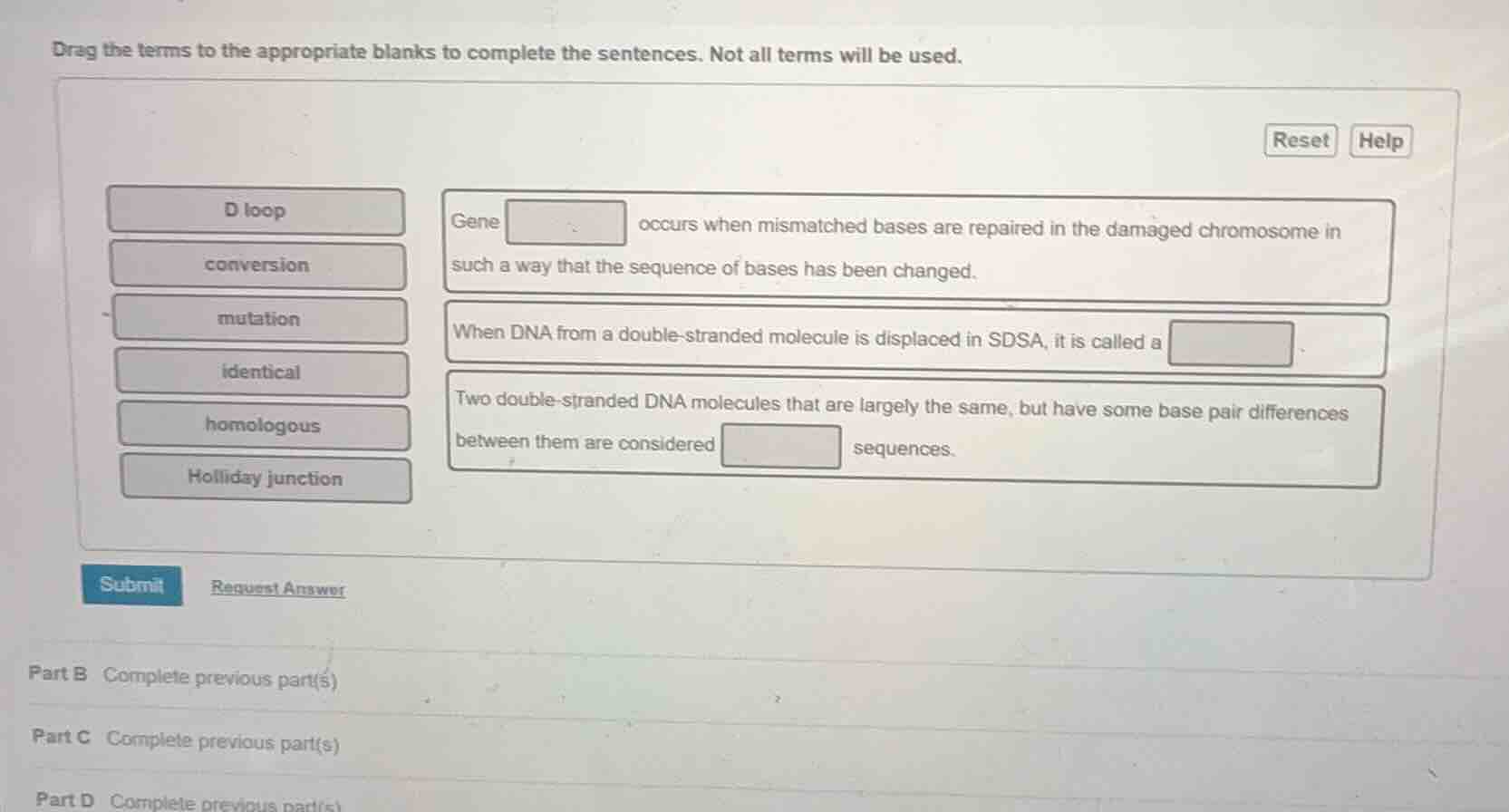
drag the terms to the appropriate blanks to complete the sentences. not all terms will be used.
terms:
d loop
conversion
mutation
identical
homologous
holliday junction
sentences:
gene blank occurs when mismatched bases are repaired in the damaged chromosome in such a way that the sequence of bases has been changed.
when dna from a double-stranded molecule is displaced in sdsa, it is called a blank.
two double-stranded dna molecules that are largely the same, but have some base pair differences between them are considered blank sequences.
Define gene conversion
Gene conversion is a non-reciprocal recombination process. It occurs when mismatched bases are repaired in a heteroduplex DNA region during recombination, resulting in one allele being replaced by another. Thus, "Gene conversion occurs when mismatched bases are repaired in the damaged chromosome in such a way that the sequence of bases has been changed."
Identify the displaced DNA structure
During Synthesis-Dependent Strand Annealing (SDSA), a damaged DNA strand invades a homologous template. This strand invasion displaces one of the strands of the template double helix, forming a characteristic bubble-like single-stranded structure known as a displacement loop, or D-loop.
Classify nearly identical sequences
Two double-stranded DNA molecules that share high sequence similarity but contain minor base-pair differences (such as alleles on maternal and paternal chromosomes) are referred to as homologous sequences.

Snap & solve any problem in the app
Get step-by-step solutions on Sovi AI
Photo-based solutions with guided steps
Explore more problems and detailed explanations
Question 1
Gene <blank>conversion</blank> occurs when mismatched bases are repaired in the damaged chromosome in such a way that the sequence of bases has been changed.
Question 2
When DNA from a double-stranded molecule is displaced in SDSA, it is called a <blank>D loop</blank>.
Question 3
Two double-stranded DNA molecules that are largely the same, but have some base pair differences between them are considered <blank>homologous</blank> sequences.