QUESTION IMAGE
Question
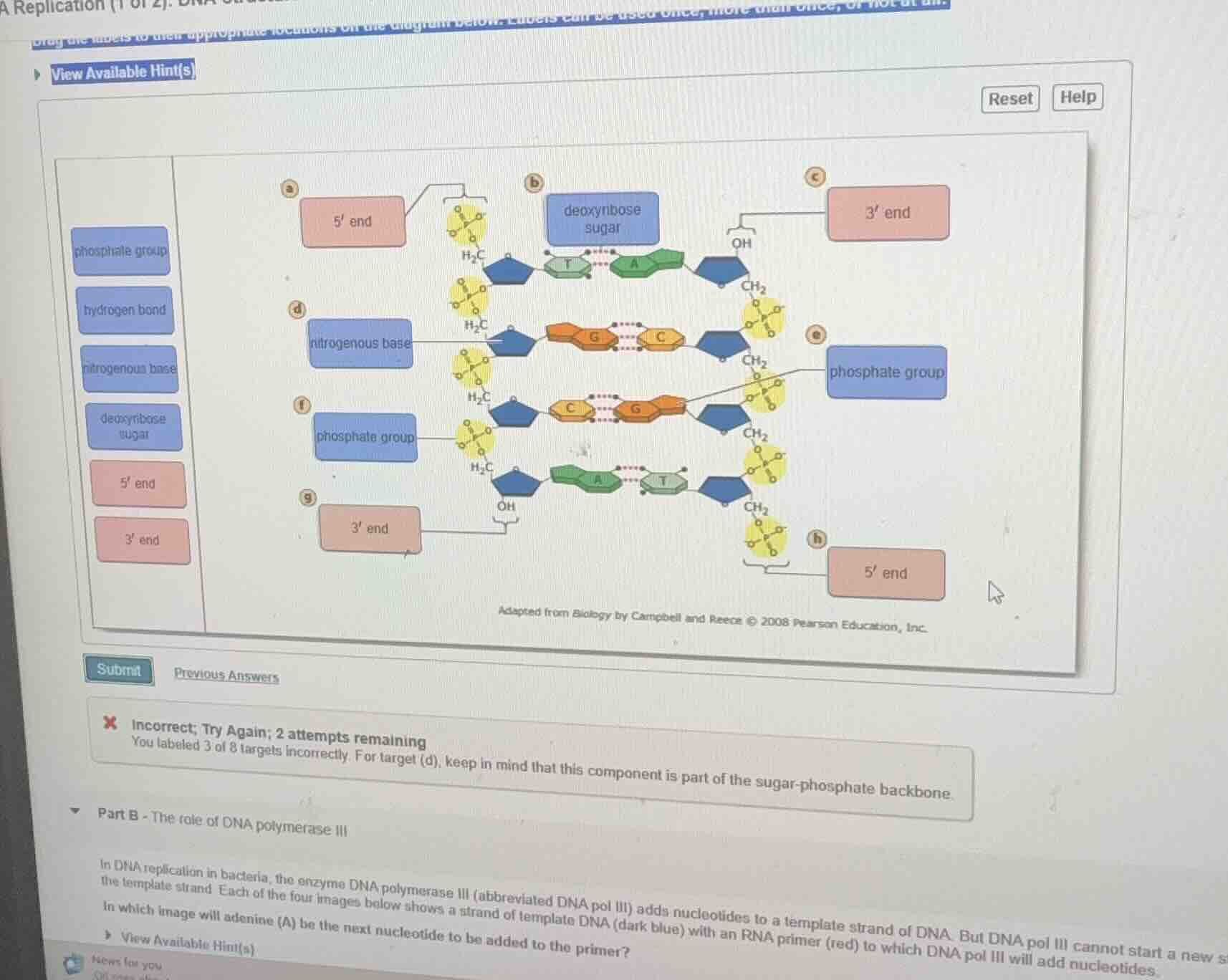
drag the labels to their appropriate locations on the diagram below. labels can be used once, more than once, or not at all.
part b - the role of dna polymerase iii
in dna replication in bacteria, the enzyme dna polymerase iii (abbreviated dna pol iii) adds nucleotides to a template strand of dna. but dna pol iii cannot start a new strand; it can only add nucleotides to an existing strand, the template strand. each of the four images below shows a strand of template dna (dark blue) with an rna primer (red) to which dna pol iii will add nucleotides.
in which image will adenine (a) be the next nucleotide to be added to the primer?
Identify the 5' and 3' ends of the left strand
The left strand has a free phosphate group at the top, which is attached to the 5' carbon of the deoxyribose sugar. Therefore, label (a) at the top left is the 5' end. At the bottom of the left strand, there is a free hydroxyl group (\(-\text{OH}\)) attached to the 3' carbon of the deoxyribose sugar. Therefore, label (g) at the bottom left is the 3' end.
Identify the 5' and 3' ends of the right strand
DNA strands run antiparallel to each other. The right strand runs in the opposite direction of the left strand. At the top right, there is a free hydroxyl group (\(-\text{OH}\)) on the 3' carbon of the sugar. Therefore, label (c) at the top right is the 3' end. At the bottom right, there is a free phosphate group attached to the 5' carbon of the sugar. Therefore, label (h) at the bottom right is the 5' end.
Identify the chemical components of the nucleotides
Label (b) points to the pentagon-shaped sugar molecule in the backbone, which is the deoxyribose sugar.
Label (d) points to the blue pentagon-hexagon linked structure in the backbone. The feedback states: "For target (d), keep in mind that this component is part of the sugar-phosphate backbone." This component is the phosphate group linking the sugars together.
Label (e) points to the yellow circular group containing phosphorus, which is the phosphate group.
Label (f) points to the blue pentagon-hexagon linked structure on the left side of the backbone, which is the phosphate group linking the sugars.
Let's re-verify the backbone components:
The backbone consists of alternating phosphate groups and deoxyribose sugars.
- The yellow circles with 'P' inside are phosphate groups.
- The blue pentagons are deoxyribose sugars.
- The nitrogenous bases are the colored shapes in the middle (green, orange, etc.).
Let's re-examine the pointers:
- (b) points to a blue pentagon, which is deoxyribose sugar.
- (d) points to a yellow circle with 'P' in the backbone, which is phosphate group.
- (e) points to a yellow circle with 'P' in the backbone, which is phosphate group.
- (f) points to a yellow circle with 'P' in the backbone, which is phosphate group.
- The nitrogenous bases are in the center (A, T, C, G).
Let's list the correct labels for all targets (a) through (h):
- (a): 5' end
- (b): deoxyribose sugar
- (c): 3' end
- (d): phosphate group
- (e): phosphate group
- (f): phosphate group
- (g): 3' end
- (h): 5' end

Snap & solve any problem in the app
Get step-by-step solutions on Sovi AI
Photo-based solutions with guided steps
Explore more problems and detailed explanations
The correct labels for the diagram are:
- a: 5' end
- b: deoxyribose sugar
- c: 3' end
- d: phosphate group
- e: phosphate group
- f: phosphate group
- g: 3' end
- h: 5' end