QUESTION IMAGE
Question
drag each tile to the correct location.
match each organism with the correct type of body cavity.
pseudocoelom
coelom
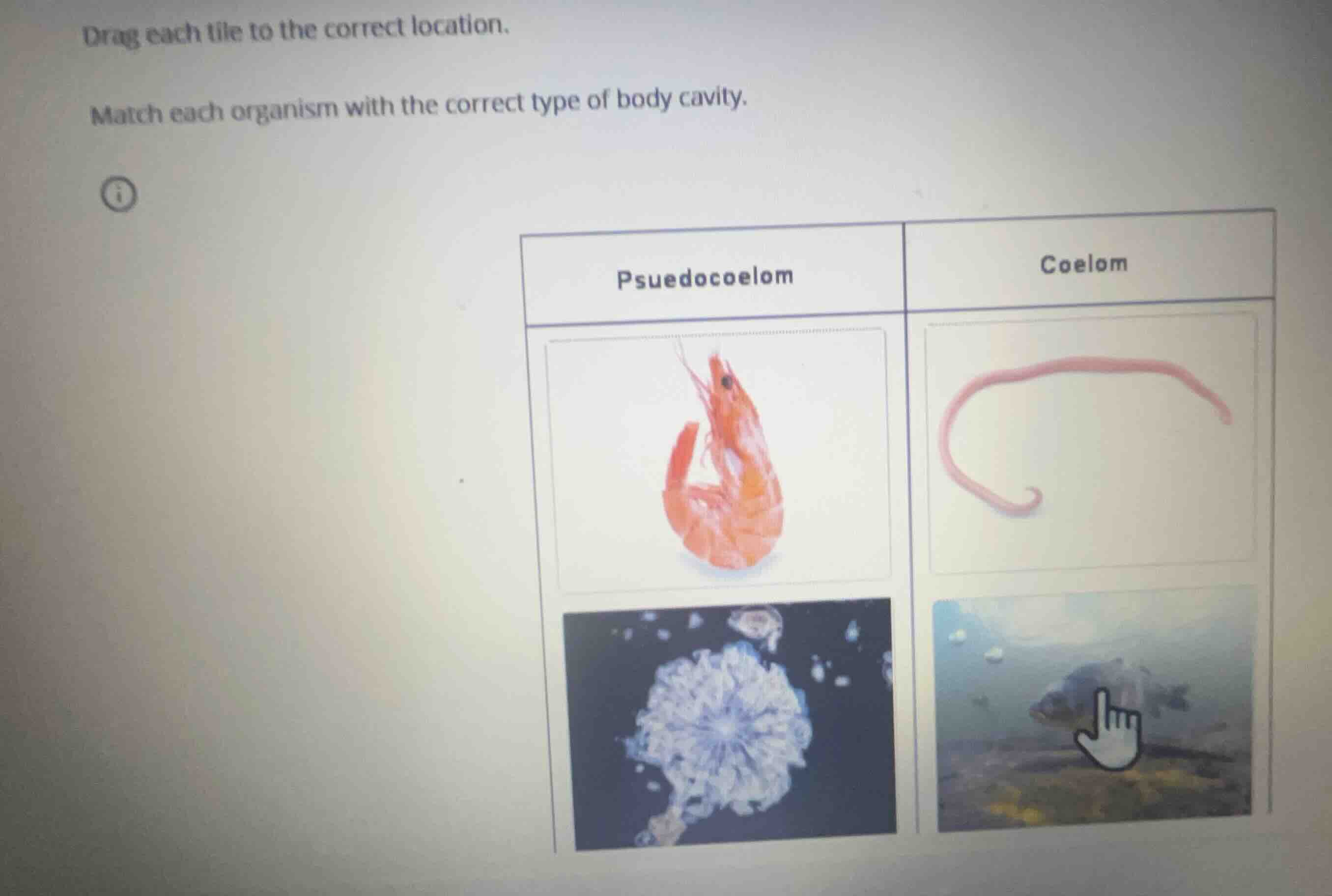
Identify the organisms shown in the image
The image displays four different organisms that need to be categorized by their type of body cavity:
- Shrimp (top-left): An arthropod.
- Roundworm (top-right): A nematode.
- Jellyfish (bottom-left): A cnidarian.
- Fish (bottom-right): A chordate (vertebrate).
Understand body cavity classifications
Animal body plans are classified based on the presence and nature of a fluid-filled body cavity (coelom):
- Coelomates (Coelom): Possess a true coelom, a fluid-filled body cavity completely lined by tissue derived from the mesoderm.
- Pseudocoelomates (Pseudocoelom): Possess a body cavity that is only partially lined by tissue derived from mesoderm (between the mesoderm and endoderm).
- Acoelomates: Lack a body cavity between the digestive tract and outer body wall altogether.
Classify each organism
- Roundworm (Nematoda): Nematodes are classic examples of pseudocoelomates. Their body cavity is a pseudocoelom.
- Shrimp (Arthropoda): Arthropods are coelomates. Although their coelom is reduced in adults to form a hemocoel, they phylogenetically and developmentally possess a true coelom.
- Fish (Chordata): Chordates are true coelomates with a well-developed coelom containing internal organs.
- Jellyfish (Cnidaria): Cnidarians are diploblastic (having only ectoderm and endoderm, lacking mesoderm) and do not have a body cavity (coelom or pseudocoelom) at all; they are acoelomate.
Determine correct matching locations
Based on standard biology curricula for this drag-and-drop interface:
- Pseudocoelom: Roundworm (Nematode).
- Coelom: Shrimp (Arthropod) and Fish (Chordate).
(Note: Jellyfish, being a cnidarian, lacks a coelom/pseudocoelom entirely, but in simplified classification tasks, only the matching pairs for the categories are submitted).
Let's organize the final matching:
- Pseudocoelom: Roundworm
- Coelom: Shrimp, Fish
(Note: The jellyfish is an acoelomate and does not belong to either category).

Snap & solve any problem in the app
Get step-by-step solutions on Sovi AI
Photo-based solutions with guided steps
Explore more problems and detailed explanations
The correct matching of each organism to its body cavity type is:
- Pseudocoelom:
- Roundworm (top-right image)
- Coelom:
- Shrimp (top-left image)
- Fish (bottom-right image)
(Note: The jellyfish in the bottom-left image is a cnidarian, which is diploblastic and lacks a body cavity entirely, meaning it does not belong in either category).