QUESTION IMAGE
Question
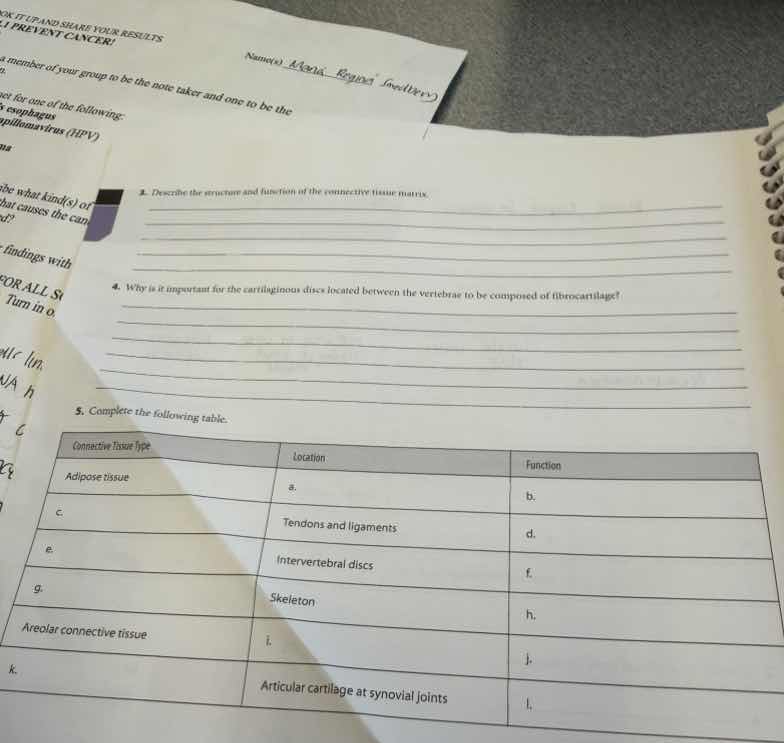
- describe the structure and function of the connective tissue matrix.
- why is it important for the cartilaginous discs located between the vertebrae to be composed of fibrocartilage?
- complete the following table.
\
🆕 New Concept Discovered: Structure and Function of Connective Tissues
How the extracellular matrix and specialized cells determine tissue properties.
Step 1: Structure and Function of the Connective Tissue Matrix
Connective tissue is unique because its cells are widely spaced and suspended within a non-living material called the extracellular matrix (ECM).
- Structure: The matrix is composed of two main elements:
- Ground substance: A fluid, semi-solid, or hard gel-like material made of water, adhesion proteins, and large polysaccharide molecules. It acts as a molecular sieve allowing nutrients to diffuse between blood vessels and cells.
- Fibers: Embedded in the ground substance are three types of proteins:
- Collagen fibers: Provide high tensile strength (resistance to pulling forces).
- Elastic fibers: Allow the tissue to stretch and recoil.
- Reticular fibers: Form fine, supportive networks for organs.
- Function: The matrix determines the physical properties of each connective tissue type. It allows tissues to bear weight, withstand great mechanical tension, endure physical trauma, and bind/support other body structures.
Step 2: Importance of Fibrocartilage in Intervertebral Discs
The cartilaginous discs between your vertebrae experience immense pressure, compression, and shear forces during daily movement.
- Why Fibrocartilage? Fibrocartilage contains dense, parallel rows of thick collagen fibers. This structural design gives it exceptional compressibility and extreme tensile strength.
- Importance: It acts as an efficient shock absorber for the spine, preventing bone-on-bone friction between vertebrae and protecting the spinal cord from impact during activities like walking, jumping, and running.
Step 3: Complete the Connective Tissue Table
Let's fill in the missing blanks (a through l) in the table based on the structural and functional properties of different connective tissues:
- Adipose tissue:
- a. Location: Under the skin (subcutaneous layer), around kidneys, behind eyeballs, and within the abdomen/breasts.
- b. Function: Energy storage (fat), thermal insulation, and mechanical cushioning/protection of organs.
- Tendons and ligaments:
- c. Connective Tissue Type: Dense regular connective tissue.
- d. Function: Attaches muscles to bones (tendons) and bones to bones (ligaments); withstands great pulling force in one direction.
- Intervertebral discs:
- e. Connective Tissue Type: Fibrocartilage.
- f. Function: Shock absorption, cushioning, and providing strong support under high pressure.
- Skeleton:
- g. Connective Tissue Type: Bone (Osseous tissue).
- h. Function: Supports and protects body structures, provides a lever system for muscles to act on, stores calcium, and houses blood-forming tissue.
- Areolar connective tissue:
- i. Location: Widely distributed under epithelia (e.g., lamina propria), surrounding capillaries, and packaging organs.
- j. Function: Wraps and cushions organs, holds tissue fluid, and plays an important role in inflammation and immune defense.
- Articular cartilage at synovial joints:
- k. Connective Tissue Type: Hyaline cartilage.
- l. Function: Provides a smooth, low-friction surface for joint movement and absorbs compressive shock at joint ends.
---

Snap & solve any problem in the app
Get step-by-step solutions on Sovi AI
Photo-based solutions with guided steps
Explore more problems and detailed explanations
Question 3: Structure and Function of the Connective Tissue Matrix
- Structure: Consists of a ground substance (a fluid, gel, or solid medium) and embedded protein fibers (collagen for strength, elastic for flexibility, and reticular for support) that surround widely spaced cells.
- Function: Provides structural support, bears weight, withstands mechanical tension, cushions organs, and binds other tissues together.
Question 4: Importance of Fibrocartilage in Intervertebral Discs
Fibrocartilage is rich in thick collagen fibers, giving it incredible tensile strength and compressibility. This is crucial for intervertebral discs because they must act as heavy-duty shock absorbers to cushion the spine against gravity and physical impact, preventing damage to the vertebrae and spinal cord.
Question 5: Completed Table
| Connective Tissue Type | Location | Function |
|---|---|---|
| c. Dense regular connective tissue | Tendons and ligaments | d. Attaches muscle to bone (tendons) and bone to bone (ligaments); resists pulling forces |
| e. Fibrocartilage | Intervertebral discs | f. Shock absorption and high-pressure support |
| g. Bone (Osseous tissue) | Skeleton | h. Structural support, protection of organs, and calcium storage |
| Areolar connective tissue | i. Under epithelia, surrounding capillaries, packaging organs | j. Cushions organs, holds tissue fluid, and supports immune defense |
| k. Hyaline cartilage | Articular cartilage at synovial joints | l. Reduces friction at joints and absorbs compressive shock |