QUESTION IMAGE
Question
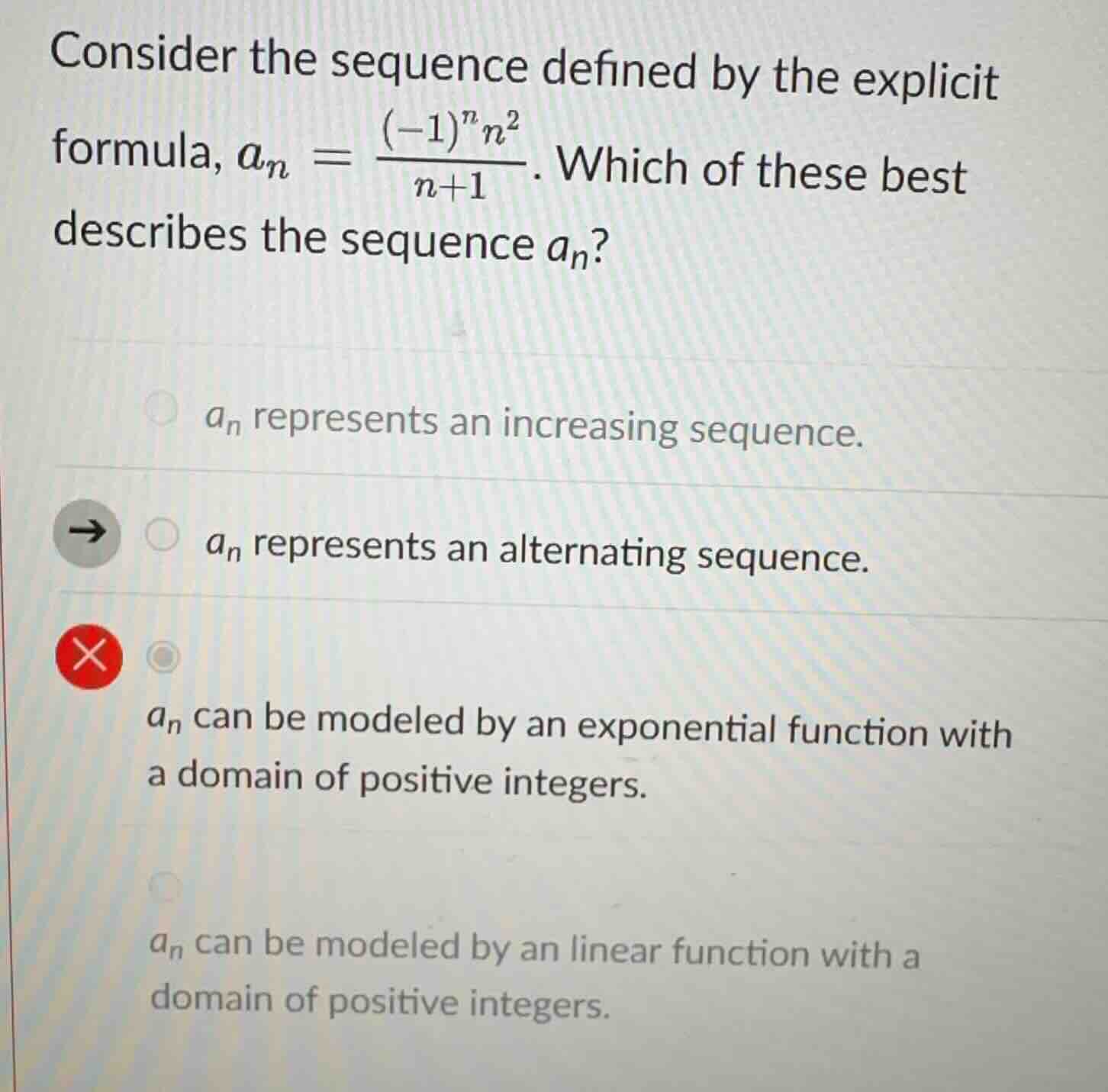
consider the sequence defined by the explicit formula, \\(a_n = \frac{(-1)^n n^2}{n+1}\\). which of these best describes the sequence \\(a_n\\)?
\\(a_n\\) represents an increasing sequence.
\\(a_n\\) represents an alternating sequence.
\\(a_n\\) can be modeled by an exponential function with a domain of positive integers.
\\(a_n\\) can be modeled by an linear function with a domain of positive integers.
Analyze the sequence formula
We examine the given explicit formula for the sequence:
Here, \(n\) represents the term index, typically starting at positive integers \(n = 1, 2, 3, \dots\).
Evaluate the sign behavior
We observe the factor \((-1)^n\) in the numerator.
- For odd \(n\), \((-1)^n = -1\), making the term negative.
- For even \(n\), \((-1)^n = 1\), making the term positive.
Because the signs of consecutive terms alternate between negative and positive, this is an alternating sequence.
Analyze other options
We check why the other choices are incorrect:
- Increasing sequence: Since the terms alternate in sign, they cannot be strictly increasing.
- Exponential function model: The growth is rational/algebraic, not exponential, and the alternating sign cannot be modeled by a standard real exponential function.
- Linear function model: The growth is non-linear due to the quadratic term \(n^2\) in the numerator.

Snap & solve any problem in the app
Get step-by-step solutions on Sovi AI
Photo-based solutions with guided steps
Explore more problems and detailed explanations
- (A) \(a_n\) represents an increasing sequence.
- (B) \(a_n\) represents an alternating sequence. (Correct answer)
- (C) \(a_n\) can be modeled by an exponential function with a domain of positive integers.
- (D) \(a_n\) can be modeled by an linear function with a domain of positive integers.