QUESTION IMAGE
Question
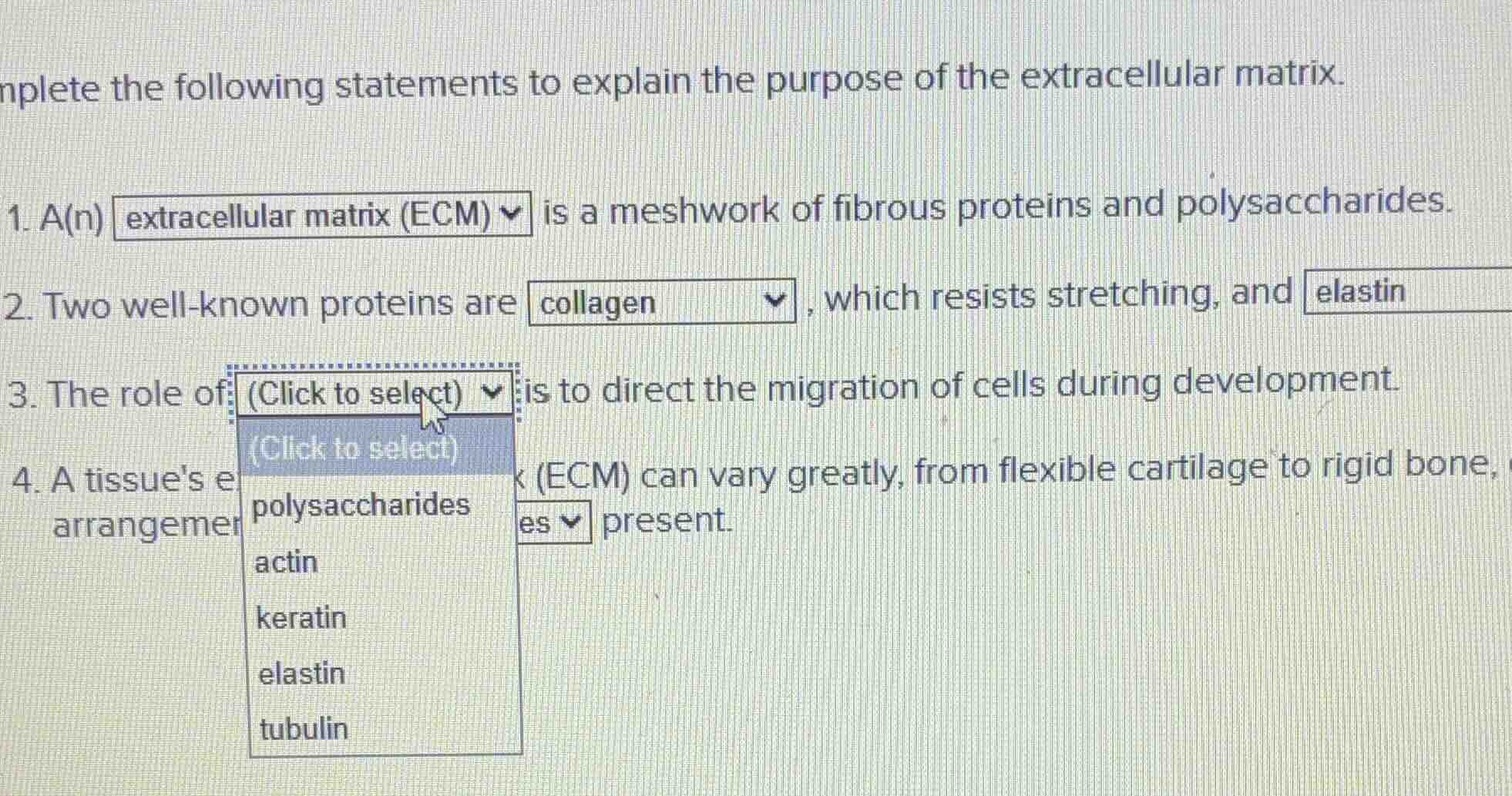
complete the following statements to explain the purpose of the extracellular matrix.
- a(n) extracellular matrix (ecm) is a meshwork of fibrous proteins and polysaccharides.
- two well-known proteins are collagen, which resists stretching, and elastin
- the role of (click to select) is to direct the migration of cells during development.
- a tissues extracellular matrix (ecm) can vary greatly, from flexible cartilage to rigid bone, depending on the arrangement and types of macromolecules present.
Define the Extracellular Matrix
Using the Extracellular Matrix knowledge point
The extracellular matrix (ECM) is an intricate, non-cellular network of macromolecules secreted by cells into the surrounding space. It is primarily composed of fibrous proteins (such as collagen and elastin) and highly hydrated polysaccharides (such as glycosaminoglycans and proteoglycans). This network provides essential structural and biochemical support to surrounding cells.
Identify Structural Proteins
Using the Collagen and Elastin knowledge point
The structural integrity of the ECM relies heavily on key fibrous proteins:
- Collagen is the most abundant protein in the ECM, forming tough, inelastic fibers that provide high tensile strength to resist stretching forces.
- Elastin forms a highly flexible, branching network that allows tissues to stretch and subsequently recoil to their original shape.
Determine the Role of Fibronectin
Using the Fibronectin knowledge point
Fibronectin is a key adhesive glycoprotein in the ECM. It binds to both integrins (membrane-spanning receptor proteins on the cell surface) and other ECM components like collagen. This bridging function allows fibronectin to guide cell attachment, migration, and positioning, which is especially critical during embryonic development and wound healing.
Analyze Tissue Variation and Composition
The physical properties of a tissue's extracellular matrix (ECM) vary depending on its specific function. For example, cartilage is flexible and resilient, whereas bone is rigid and mineralized. This variation is determined by the specific arrangement and quantity of the proteins and polysaccharides present in the matrix.

Snap & solve any problem in the app
Get step-by-step solutions on Sovi AI
Photo-based solutions with guided steps
Explore more problems and detailed explanations
Question 1
A(n) <blank>extracellular matrix (ECM)</blank> is a meshwork of fibrous proteins and polysaccharides.
Question 2
Two well-known proteins are <blank>collagen</blank>, which resists stretching, and <blank>elastin</blank>, which gives the matrix resilience.
Question 3
The role of <blank>fibronectin</blank> is to direct the migration of cells during development.
Question 4
A tissue's extracellular matrix (ECM) can vary greatly, from flexible cartilage to rigid bone, depending on the arrangement and quantity of <blank>proteins</blank> and <blank>polysaccharides</blank> present.