QUESTION IMAGE
Question
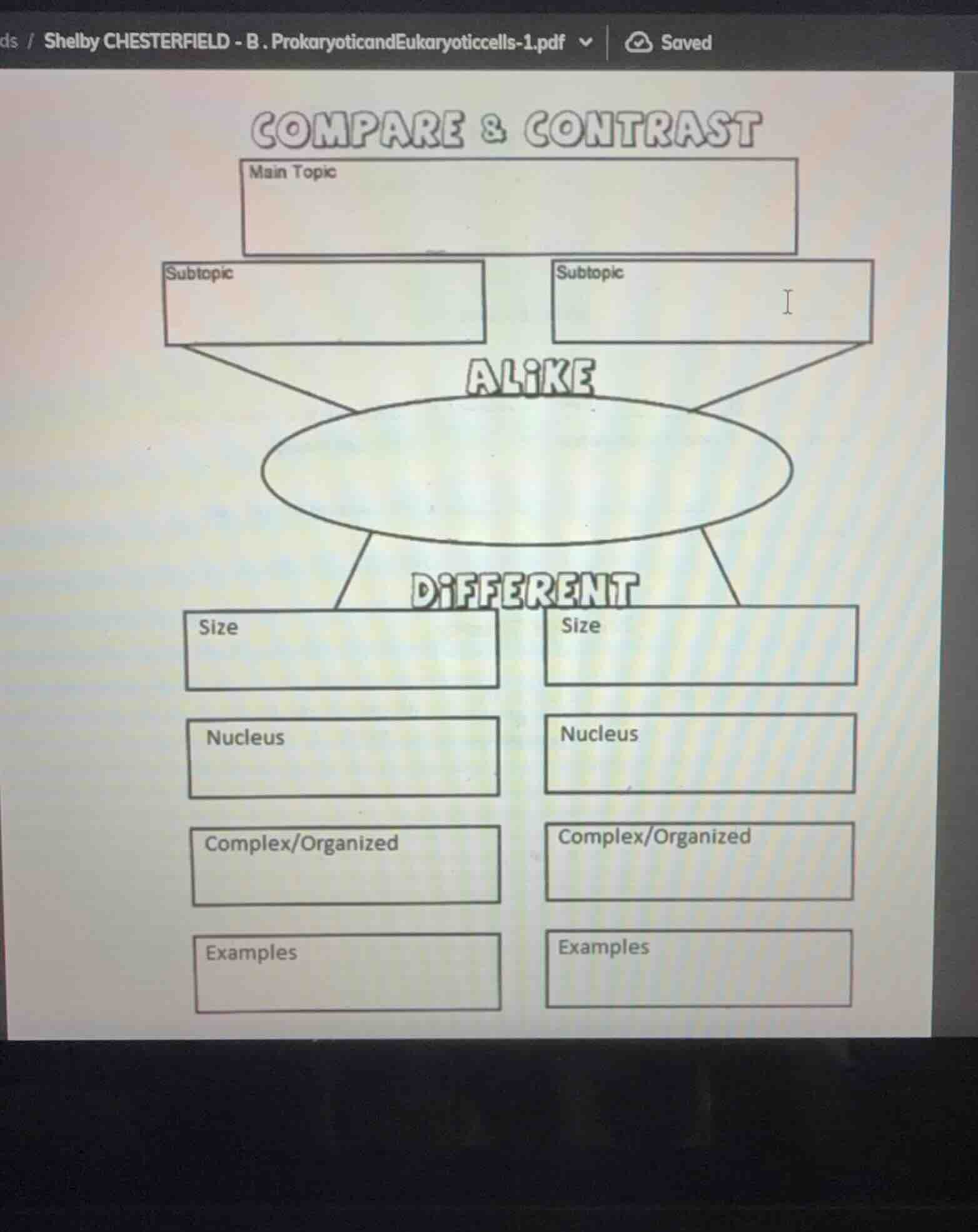
compare & contrast
main topic
subtopic
subtopic
alike
different
size
size
nucleus
nucleus
complex/organized
complex/organized
examples
examples
Identify main topic and subtopics
The worksheet is titled "COMPARE & CONTRAST" and the file name at the top is "ProkaryoticandEukaryoticcells-1.pdf". Therefore, the Main Topic is Cell Types (or Cells), and the two Subtopics are Prokaryotic Cells and Eukaryotic Cells.
Determine shared characteristics (Alike)
Using the Prokaryotic Cells and Eukaryotic Cells knowledge points, we identify what they have in common:
- Both contain DNA as genetic material.
- Both have a cell membrane (plasma membrane).
- Both contain cytoplasm.
- Both contain ribosomes for protein synthesis.
Contrast size and nucleus
Using Cell Classification:
- Size: Prokaryotes are small (typically \(0.1 - 5.0\ \mu\text{m}\)). Eukaryotes are larger (typically \(10 - 100\ \mu\text{m}\)).
- Nucleus: Prokaryotes lack a nucleus (DNA is in the nucleoid). Eukaryotes have a membrane-bound nucleus enclosing DNA.
Contrast complexity and examples
Using Cell Classification:
- Complex/Organized: Prokaryotes are simple, unicellular, and lack membrane-bound organelles. Eukaryotes are highly complex, can be multicellular or unicellular, and contain membrane-bound organelles (like mitochondria, ER, Golgi).
- Examples: Prokaryote examples include Bacteria and Archaea. Eukaryote examples include Animals, Plants, Fungi, and Protists.

Snap & solve any problem in the app
Get step-by-step solutions on Sovi AI
Photo-based solutions with guided steps
Explore more problems and detailed explanations
| Section | Left Column (Prokaryotic Cells) | Right Column (Eukaryotic Cells) |
|---|---|---|
| Subtopic | Prokaryotic Cells | Eukaryotic Cells |
| Alike | <colspan=2>Both have DNA, cell membrane, cytoplasm, and ribosomes.</colspan> | |
| Size | Small (typically \(0.1 - 5\ \mu\text{m}\)) | Large (typically \(10 - 100\ \mu\text{m}\)) |
| Nucleus | Absent (no membrane-bound nucleus; DNA in nucleoid) | Present (membrane-bound nucleus houses DNA) |
| Complex/Organized | Simple, unicellular, lacks membrane-bound organelles | Complex, unicellular or multicellular, contains membrane-bound organelles |
| Examples | Bacteria, Archaea | Animals, Plants, Fungi, Protists |