QUESTION IMAGE
Question
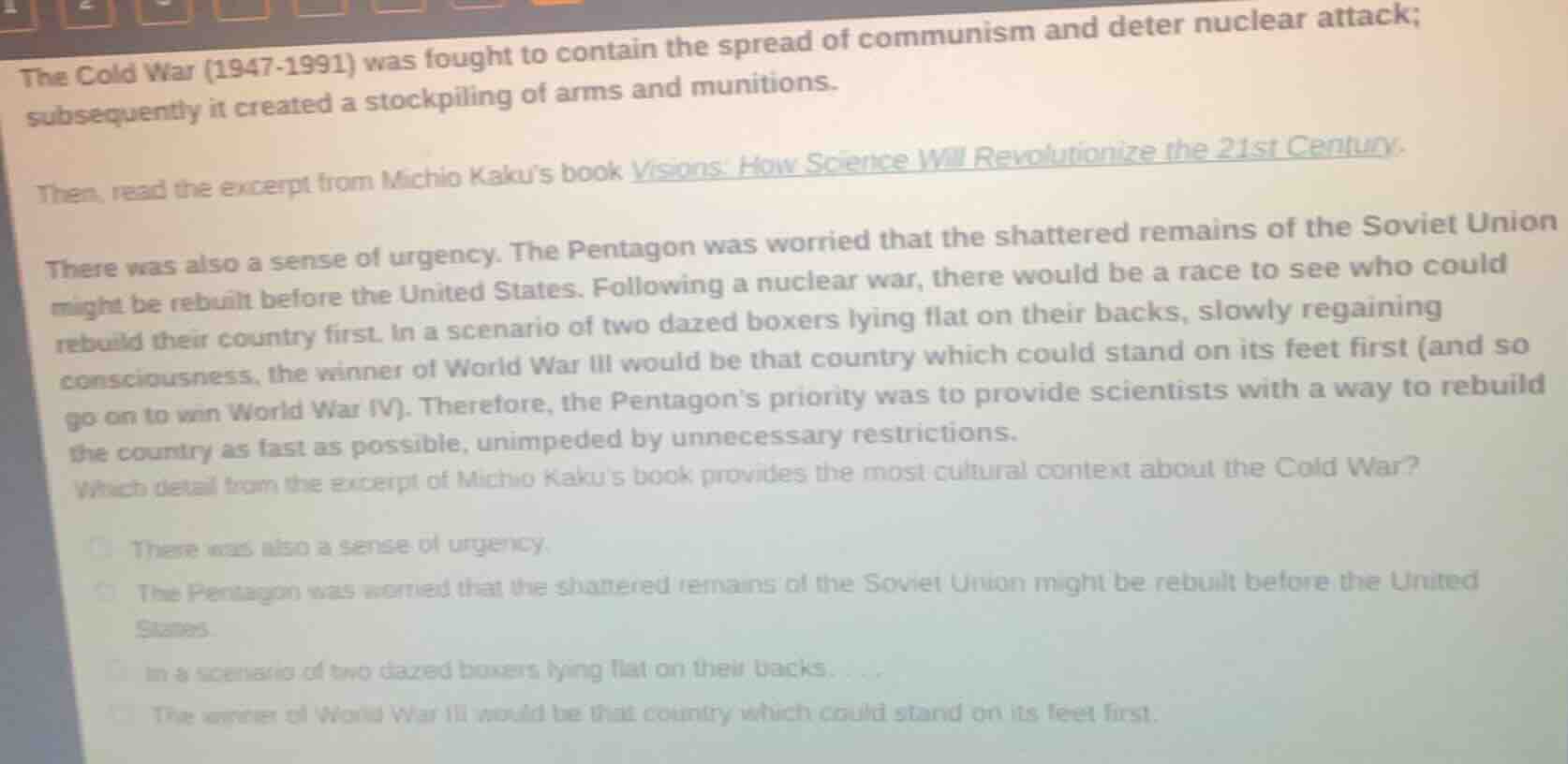
the cold war (1947-1991) was fought to contain the spread of communism and deter nuclear attack; subsequently it created a stockpiling of arms and munitions.
then, read the excerpt from michio kakus book visions: how science will revolutionize the 21st century.
there was also a sense of urgency. the pentagon was worried that the shattered remains of the soviet union might be rebuilt before the united states. following a nuclear war, there would be a race to see who could rebuild their country first. in a scenario of two dazed boxers lying flat on their backs, slowly regaining consciousness, the winner of world war iii would be that country which could stand on its feet first (and so go on to win world war iv). therefore, the pentagons priority was to provide scientists with a way to rebuild the country as fast as possible, unimpeded by unnecessary restrictions.
which detail from the excerpt of michio kakus book provides the most cultural context about the cold war?
there was also a sense of urgency.
the pentagon was worried that the shattered remains of the soviet union might be rebuilt before the united states.
in a scenario of two dazed boxers lying flat on their backs...
the winner of world war iii would be that country which could stand on its feet first.
Analyze the question and target
The question asks which detail from the excerpt of Michio Kaku's book Visions: How Science Will Revolutionize the 21st Century provides the most cultural context about the Cold War.
Evaluate the options based on historical and cultural context
Using the Historical Context in Literature knowledge point:
- Option 1 ("There was also a sense of urgency.") is a general statement about urgency that lacks specific historical or cultural markers of the Cold War era.
- Option 2 ("The Pentagon was worried that the shattered remains of the Soviet Union might be rebuilt before the United States.") directly names the two primary geopolitical rivals of the Cold War: the United States (represented by the Pentagon) and the Soviet Union. This rivalry and the mutual distrust/fear of rebuilding after a nuclear conflict are central to the historical and cultural landscape of the Cold War.
- Option 3 ("In a scenario of two dazed boxers lying flat on their backs...") is a metaphorical analogy used to describe the aftermath of a nuclear war, rather than a direct historical or cultural detail.
- Option 4 ("The winner of World War III would be that country which could stand on its feet first.") describes a hypothetical post-apocalyptic scenario rather than the specific cultural and historical realities of the Cold War itself.
Therefore, Option 2 provides the most direct and specific cultural and historical context regarding the Cold War.

Snap & solve any problem in the app
Get step-by-step solutions on Sovi AI
Photo-based solutions with guided steps
Explore more problems and detailed explanations
- (A) There was also a sense of urgency.
- (B) The Pentagon was worried that the shattered remains of the Soviet Union might be rebuilt before the United States. (Correct answer)
- (C) In a scenario of two dazed boxers lying flat on their backs...
- (D) The winner of World War III would be that country which could stand on its feet first.