QUESTION IMAGE
Question
chapter quiz: processes of evolution
total points: --/100
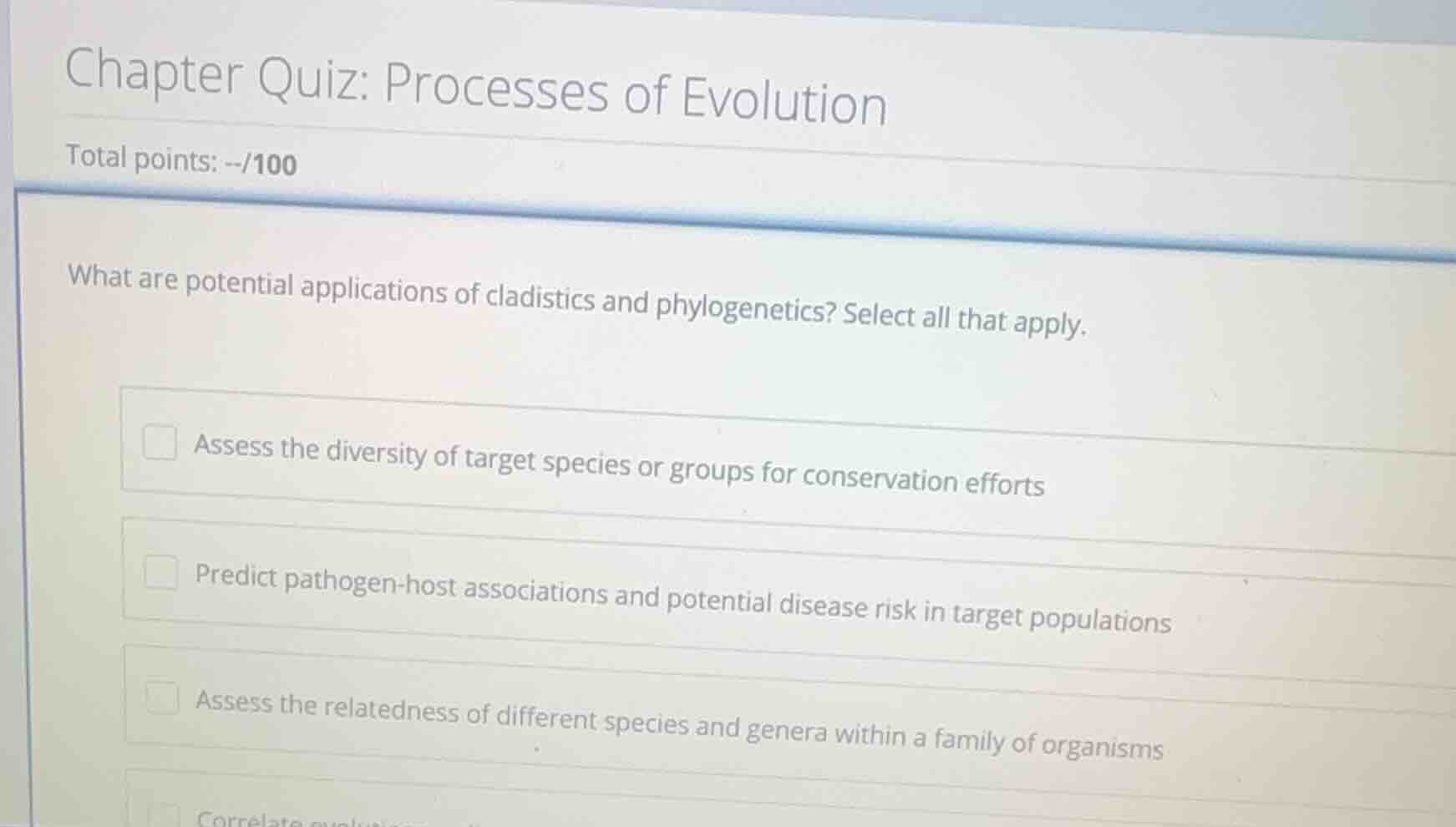
what are potential applications of cladistics and phylogenetics? select all that apply.
assess the diversity of target species or groups for conservation efforts
predict pathogen-host associations and potential disease risk in target populations
assess the relatedness of different species and genera within a family of organisms
Analyze the scope of cladistics and phylogenetics
Cladistics and phylogenetics reconstruct evolutionary relationships (phylogenies) based on shared ancestry. These evolutionary frameworks have diverse practical applications across ecology, medicine, and evolutionary biology.
Evaluate each option against biological applications
- Assess the diversity of target species or groups for conservation efforts: Valid. Conservation biology uses phylogenetic diversity to prioritize which taxa or habitats to protect to preserve evolutionary history.
- Predict pathogen-host associations and potential disease risk in target populations: Valid. Tracking the evolutionary relationships of pathogens (like viruses) helps identify host-switching events and predict emerging infectious diseases.
- Assess the relatedness of different species and genera within a family of organisms: Valid. This is the primary, direct application of cladistics and systematics to determine evolutionary relationships.
- Correlate evolutionary history with geographical distribution (Biogeography): Valid (partially visible at the bottom). Phylogeography combines phylogenetics and geography to understand how historical processes shaped current distributions.
Determine the correct selections
All visible options represent well-established, direct applications of cladistics and phylogenetics.

Snap & solve any problem in the app
Get step-by-step solutions on Sovi AI
Photo-based solutions with guided steps
Explore more problems and detailed explanations
- Assess the diversity of target species or groups for conservation efforts (Correct answer)
- Predict pathogen-host associations and potential disease risk in target populations (Correct answer)
- Assess the relatedness of different species and genera within a family of organisms (Correct answer)
- Correlate evolutionary history with geographical distribution (Correct answer)