QUESTION IMAGE
Question
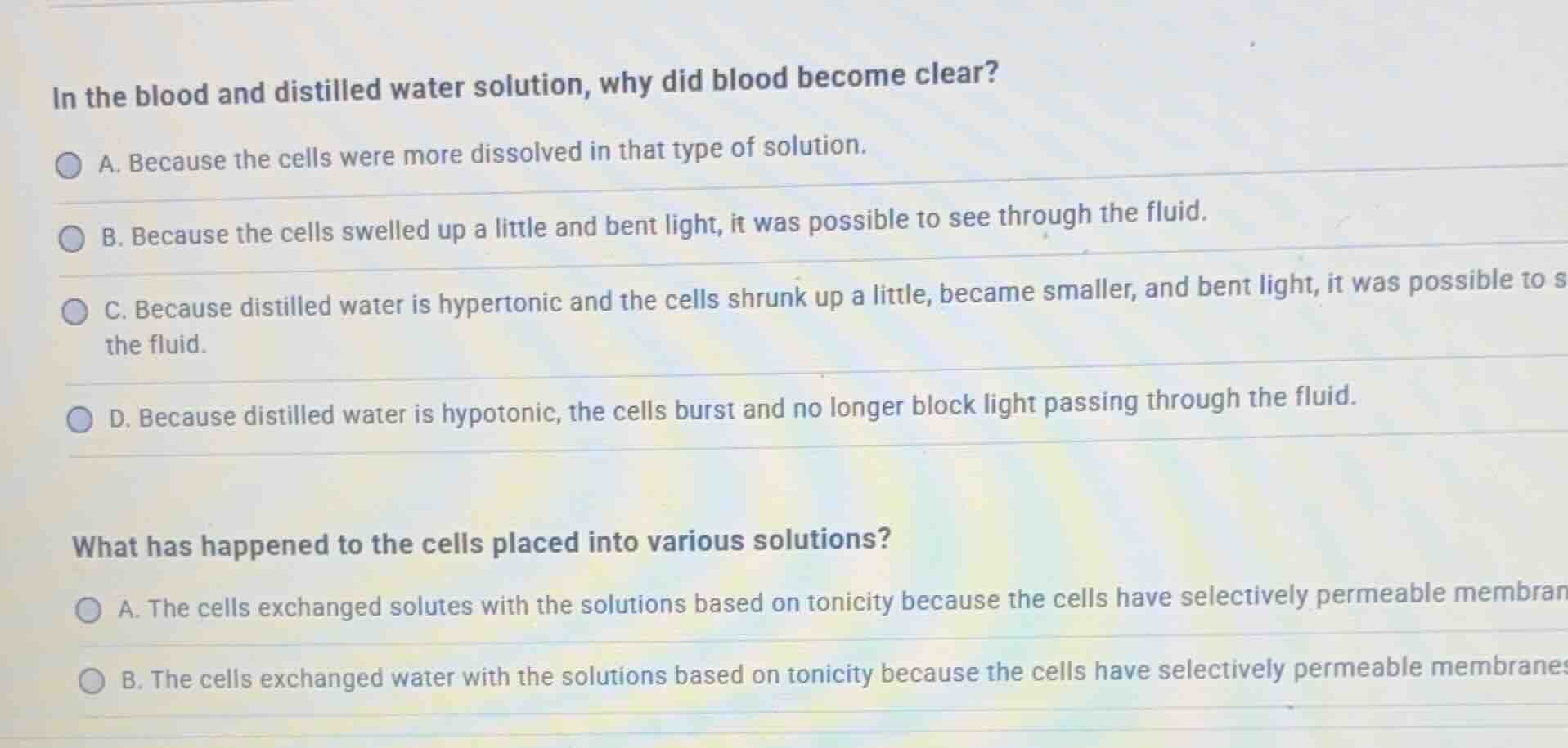
in the blood and distilled water solution, why did blood become clear?
a. because the cells were more dissolved in that type of solution.
b. because the cells swelled up a little and bent light, it was possible to see through the fluid.
c. because distilled water is hypertonic and the cells shrunk up a little, became smaller, and bent light, it was possible to see through the fluid.
d. because distilled water is hypotonic, the cells burst and no longer block light passing through the fluid.
what has happened to the cells placed into various solutions?
a. the cells exchanged solutes with the solutions based on tonicity because the cells have selectively permeable membranes.
b. the cells exchanged water with the solutions based on tonicity because the cells have selectively permeable membranes.
Analyze the effect of distilled water on blood cells
Using the Tonicity Effects and Osmosis Principles knowledge points, we analyze the first question. Distilled water is a hypotonic solution relative to the intracellular fluid of red blood cells. Water enters the cells via osmosis, causing them to swell and eventually burst (hemolysis). Once the cell membranes rupture, the cellular contents disperse, and there are no longer intact cells to scatter or block light, making the solution appear clear.
Evaluate the options for Question 1
Using the Tonicity Effects knowledge point:
- Option A is incorrect because cells do not "dissolve" chemically.
- Option B is incorrect because swelling alone does not make the solution clear; intact swollen cells still scatter light (turbid).
- Option C is incorrect because distilled water is hypotonic, not hypertonic.
- Option D is correct because distilled water is hypotonic, causing the cells to burst (hemolyze), which prevents them from blocking or scattering light.
Analyze cell behavior in various solutions
Using the Selective Permeability and Osmosis Principles knowledge points, we analyze the second question. Cell membranes are selectively permeable, allowing water to pass through easily while restricting many solutes. When placed in solutions of different tonicities, cells primarily exchange water (not solutes) to balance osmotic pressure.
Evaluate the options for Question 2
Using the Selective Permeability knowledge point:
- Option A is incorrect because the primary movement across the membrane that changes cell volume in response to tonicity is water, not solutes.
- Option B is correct because cells exchange water with their environment based on the tonicity gradient due to their selectively permeable membranes.

Snap & solve any problem in the app
Get step-by-step solutions on Sovi AI
Photo-based solutions with guided steps
Explore more problems and detailed explanations
Question 1
- A. Because the cells were more dissolved in that type of solution.
- B. Because the cells swelled up a little and bent light, it was possible to see through the fluid.
- C. Because distilled water is hypertonic and the cells shrunk up a little, became smaller, and bent light, it was possible to s the fluid.
- D. Because distilled water is hypotonic, the cells burst and no longer block light passing through the fluid. (Correct answer)
Question 2
- A. The cells exchanged solutes with the solutions based on tonicity because the cells have selectively permeable membran
- B. The cells exchanged water with the solutions based on tonicity because the cells have selectively permeable membranes (Correct answer)