QUESTION IMAGE
Question
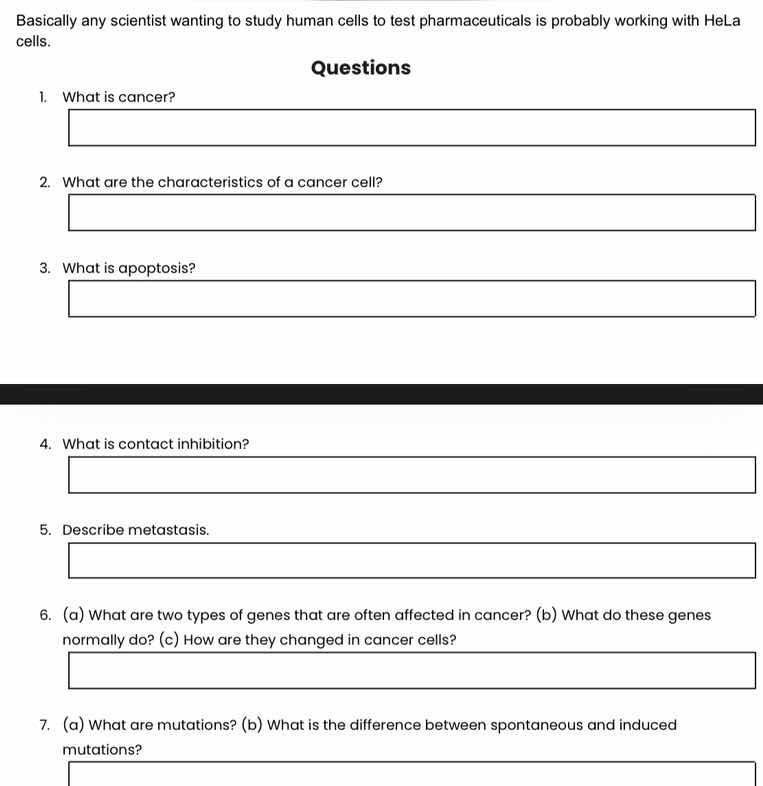
basically any scientist wanting to study human cells to test pharmaceuticals is probably working with hela cells.
questions
- what is cancer?
- what are the characteristics of a cancer cell?
- what is apoptosis?
- what is contact inhibition?
- describe metastasis.
- (a) what are two types of genes that are often affected in cancer? (b) what do these genes normally do? (c) how are they changed in cancer cells?
- (a) what are mutations? (b) what is the difference between spontaneous and induced mutations?
Define cancer and its cellular characteristics
- Cancer: A disease characterized by uncontrolled cell division and growth.
- Characteristics: Rapid proliferation, loss of contact inhibition, evasion of apoptosis, ability to undergo metastasis, and abnormal nuclear structure.
Explain apoptosis and contact inhibition
- Apoptosis: Programmed cell death that eliminates damaged, old, or unnecessary cells.
- Contact inhibition: A regulatory mechanism where cells stop dividing when they come into contact with neighboring cells.
Describe metastasis, cancer-related genes, and mutations
- Metastasis: The spread of cancer cells from the primary site to other parts of the body via blood or lymphatic vessels.
- Genes: Proto-oncogenes (normally promote cell division; mutated into oncogenes that are overactive) and Tumor Suppressor Genes (normally inhibit cell division; inactivated in cancer).
- Mutations: Changes in the DNA sequence. Spontaneous mutations occur naturally due to replication errors, while induced mutations are caused by environmental agents (mutagens).

Snap & solve any problem in the app
Get step-by-step solutions on Sovi AI
Photo-based solutions with guided steps
Explore more problems and detailed explanations
Question 1
What is cancer?
<blank>Cancer is a group of diseases characterized by uncontrolled cell division and growth, leading to the formation of abnormal masses of cells (tumors) that can invade nearby tissues.</blank>
Question 2
What are the characteristics of a cancer cell?
<blank>Cancer cells exhibit rapid and uncontrolled division, lack of contact inhibition, evasion of programmed cell death (apoptosis), abnormal shape and large nuclei, and the ability to trigger blood vessel growth (angiogenesis) and spread to other tissues (metastasis).</blank>
Question 3
What is apoptosis?
<blank>Apoptosis is a process of programmed cell death that serves as a self-destruction mechanism to eliminate damaged, old, or potentially harmful cells without causing inflammation to surrounding tissues.</blank>
Question 4
What is contact inhibition?
<blank>Contact inhibition is a regulatory mechanism that prevents normal cells from dividing further once they come into physical contact with neighboring cells, ensuring they form a single organized layer.</blank>
Question 5
Describe metastasis.
<blank>Metastasis is the process by which cancer cells break away from the primary tumor, travel through the bloodstream or lymphatic system, and establish new secondary tumors in other organs or tissues of the body.</blank>
Question 6
(a) What are two types of genes that are often affected in cancer? (b) What do these genes normally do? (c) How are they changed in cancer cells?
<blank>(a) Proto-oncogenes and tumor suppressor genes. (b) Proto-oncogenes normally stimulate cell division and growth, while tumor suppressor genes normally slow down cell division, repair DNA errors, or tell cells when to die. (c) Proto-oncogenes mutate into overactive oncogenes (gaining function), while tumor suppressor genes are inactivated or deleted (losing function), both leading to uncontrolled cell division.</blank>
Question 7
(a) What are mutations? (b) What is the difference between spontaneous and induced mutations?
<blank>(a) Mutations are permanent alterations in the DNA sequence of a cell's genome. (b) Spontaneous mutations occur naturally due to random errors during DNA replication or cellular metabolic processes, whereas induced mutations are caused by exposure to external environmental agents called mutagens (such as UV radiation, chemicals, or tobacco smoke).</blank>