QUESTION IMAGE
Question
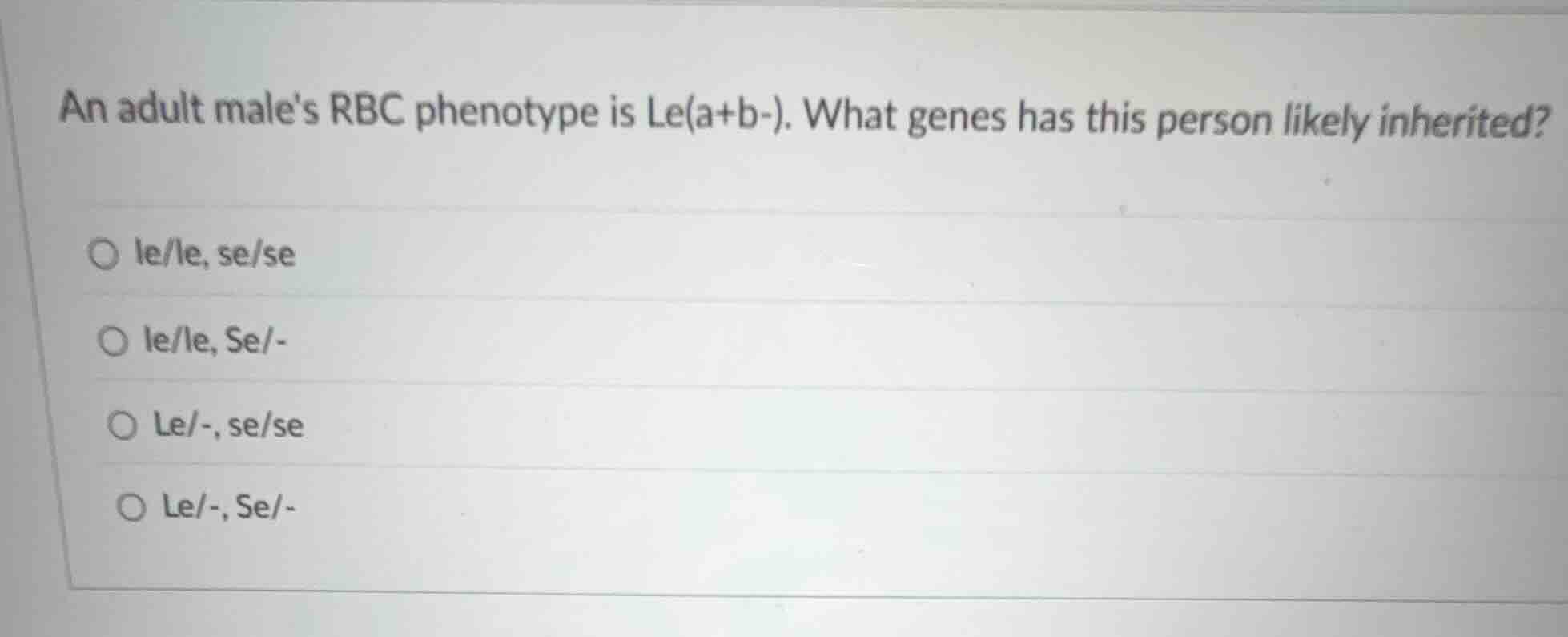
an adult males rbc phenotype is le(a+b-). what genes has this person likely inherited?
le/le, se/se
le/le, se/-
le/-, se/se
le/-, se/-
Analyze the given phenotype
Using the Lewis Phenotypes knowledge point
The adult male's red blood cell (RBC) phenotype is \(Le(a+b-)\). This means his RBCs express the \(Le^a\) antigen but do not express the \(Le^b\) antigen.
Determine the Lewis gene status
Using the Lewis Antigen Biosynthesis knowledge point
To express any Lewis system antigens on RBCs, an individual must inherit at least one functional \(Le\) allele (genotype \(Le/Le\) or \(Le/le\), represented as \(Le/-\)). If they were homozygous recessive (\(le/le\)), they would have the \(Le(a-b-)\) phenotype. Therefore, this person must have inherited the \(Le\) gene:
Determine the Secretor gene status
Using the Lewis Antigen Biosynthesis knowledge point
The \(Le^a\) antigen is converted into the \(Le^b\) antigen by the action of the fucosyltransferase encoded by the Secretor (\(Se\)) gene.
- If a person has the \(Se\) gene (\(Se/-\)), \(Le^a\) is converted to \(Le^b\), resulting in the \(Le(a-b+)\) phenotype.
- If a person is a non-secretor (\(se/se\)), the \(Le^a\) antigen cannot be converted to \(Le^b\). Thus, only \(Le^a\) remains on the RBCs, resulting in the \(Le(a+b-)\) phenotype.
Therefore, this person must be a non-secretor:
Combine the inherited genotypes
Using the Lewis Antigen Biosynthesis and Lewis Phenotypes knowledge points
Combining the requirements for the \(Le(a+b-)\) phenotype:
- Must have inherited the \(Le\) gene: \(Le/-\)
- Must be a non-secretor: \(se/se\)
This corresponds to the genotype combination:

Snap & solve any problem in the app
Get step-by-step solutions on Sovi AI
Photo-based solutions with guided steps
Explore more problems and detailed explanations
- le/le, se/se
- le/le, Se/-
- Le/-, se/se (Correct answer)
- Le/-, Se/-