QUESTION IMAGE
Question
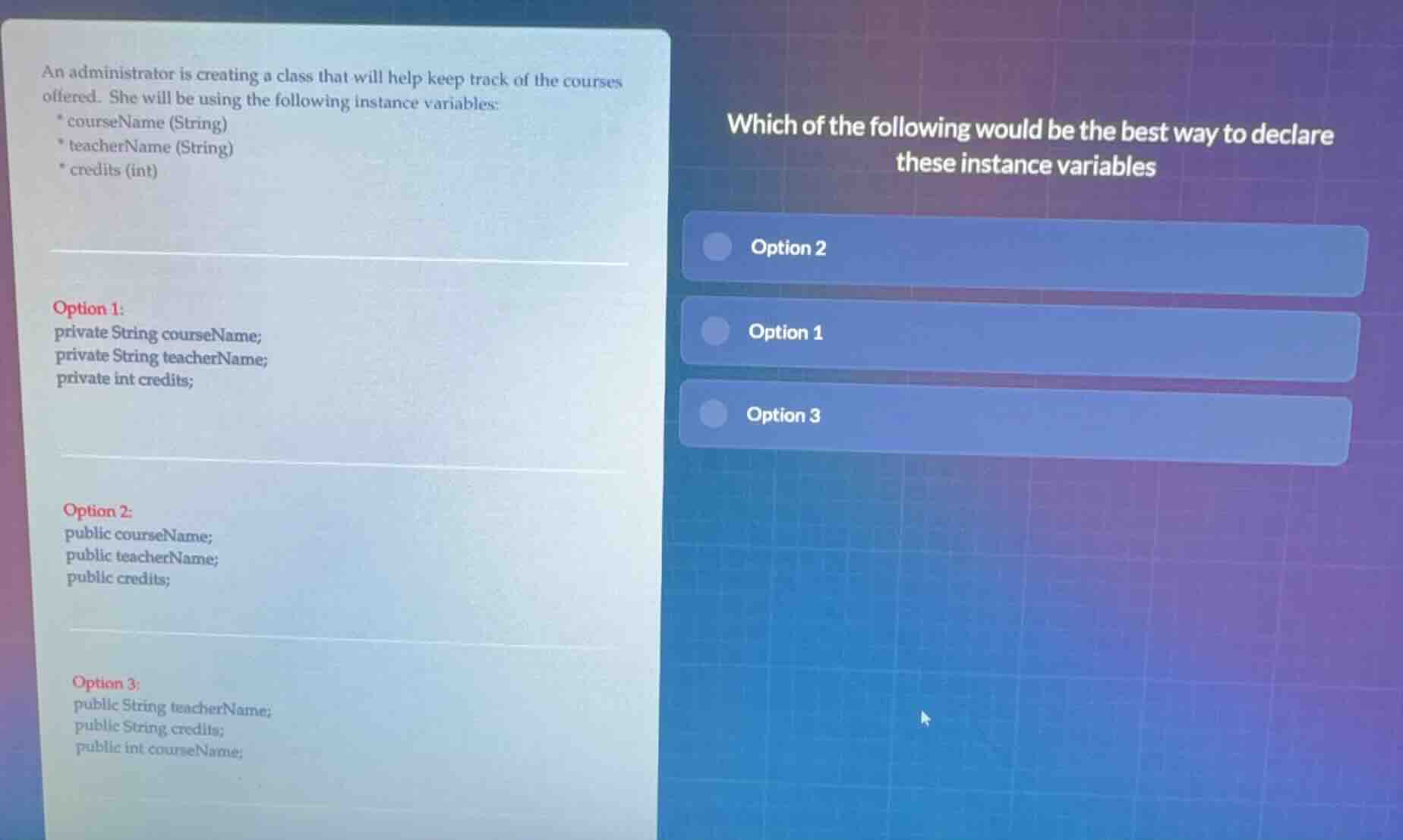
an administrator is creating a class that will help keep track of the courses offered. she will be using the following instance variables:
- coursename (string)
- teachername (string)
- credits (int)
option 1:
private string coursename;
private string teachername;
private int credits;
option 2:
public coursename;
public teachername;
public credits;
option 3:
public string teachername;
public string credits;
public int coursename;
which of the following would be the best way to declare these instance variables
🆕 New Concept Discovered: Object-Oriented Encapsulation and Variable Declaration
Keeping data safe and correctly typed
Step 1: Analyze the required variables and types
The problem asks us to declare three instance variables with specific data types:
courseNameof typeStringteacherNameof typeStringcreditsof typeint
Step 2: Apply encapsulation principles
In object-oriented programming (such as Java), instance variables should almost always be declared as private to restrict direct access from outside the class. This design principle is called encapsulation (or data hiding).
- Option 1 uses the
privateaccess modifier for all three variables. - Option 2 and Option 3 use the
publicaccess modifier, which exposes the internal data directly and is not the best practice.
Step 3: Verify syntax and data types
Let's look at the syntax of Option 1:
private String courseName;
private String teacherName;
private int credits;- Each variable is declared as
private. - The data types match the requirements exactly (
Stringfor names,intfor credits). - The syntax is correct.
Comparing this to the other options:
- Option 2 is missing the data types entirely (e.g.,
public courseName;is invalid syntax in typed languages like Java). - Option 3 assigns the wrong data types to the variables (e.g., declaring
creditsas aStringandcourseNameas anint).
Therefore, Option 1 is the best and most correct way to declare these instance variables.

Snap & solve any problem in the app
Get step-by-step solutions on Sovi AI
Photo-based solutions with guided steps
Explore more problems and detailed explanations
Option 1