QUESTION IMAGE
Question
activators
what triggered me?
behavior
what did i do?
consequence
what happened?
external activators
what?
where?
when?
internal activators
thoughts?
feelings?
action i took
positive consequence (+)
negative consequence (-)
alternative behavior choice showing what you could have done differently and what potential outcomes that could have:
behavior
what did i do?
positive consequence (+)
negative consequence (-)
Identify the purpose of the worksheet
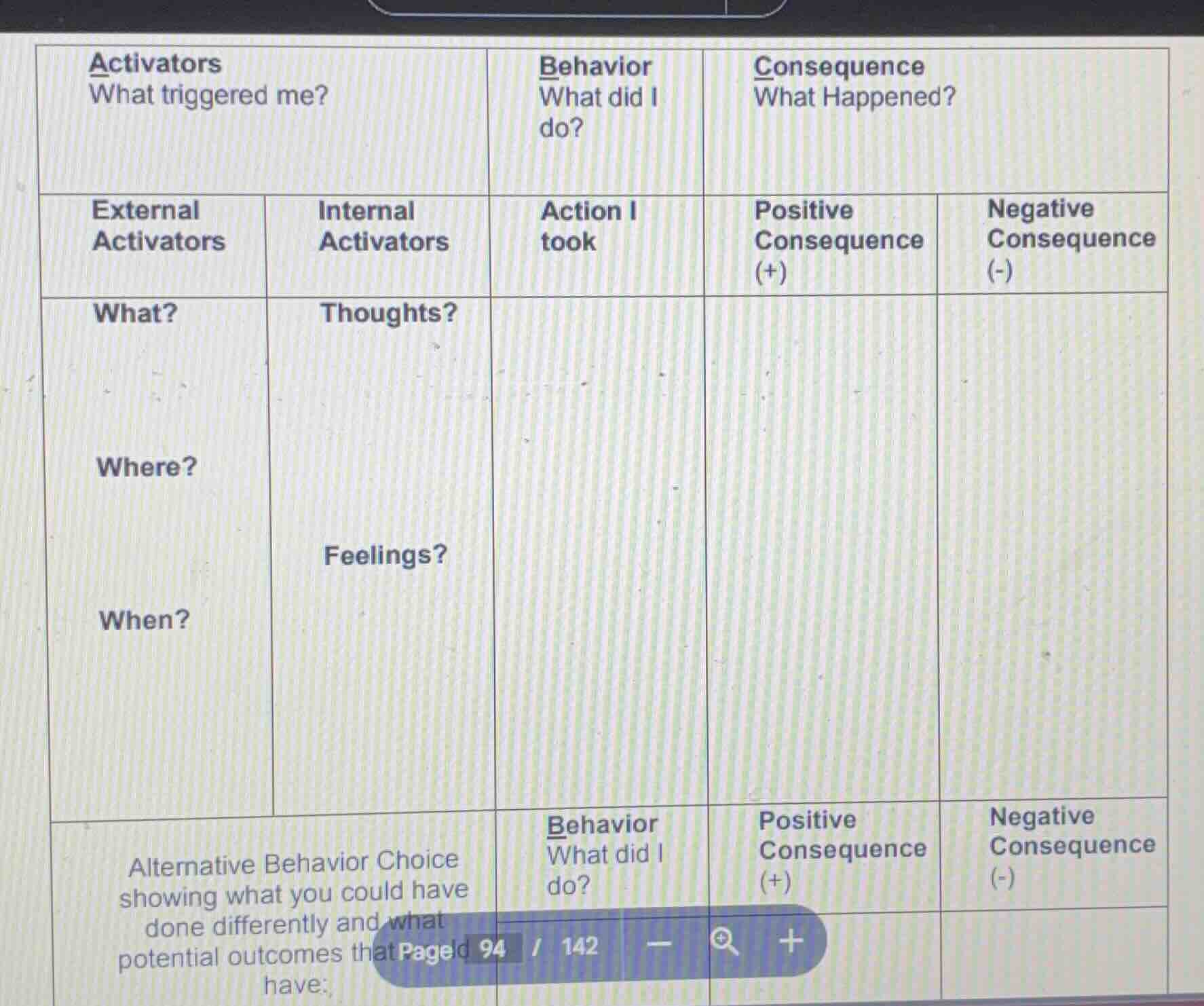
The provided image shows a blank behavioral tracking worksheet structured around the ABC model of behavior analysis. This model is a core tool in Cognitive Behavioral Therapy (CBT) and Applied Behavior Analysis (ABA). It is designed to help individuals identify patterns in their behaviors by breaking down situations into three main components: Activators (Antecedents), Behaviors, and Consequences.
Analyze the "Activators" column
The first column is labeled "Activators: What triggered me?". It is divided into:
- External Activators: These are environmental or situational factors. The worksheet prompts the user to identify:
- What? (The specific event or situation)
- Where? (The physical location or environment)
- When? (The time of day, day of the week, or sequence of events)
- Internal Activators: These are subjective, internal experiences that occur in response to external events or independently. The worksheet prompts for:
- Thoughts? (Cognitive reactions, self-talk, beliefs)
- Feelings? (Emotional states or physical sensations)
Analyze the "Behavior" column
The middle column is labeled "Behavior: What did I do?". It contains a single field:
- Action I took: This is the observable, measurable response or action performed by the individual in response to the activators. It represents the target behavior being analyzed.
Analyze the "Consequence" column
The third column is labeled "Consequence: What Happened?". It is split into two types of outcomes:
- Positive Consequence (+): Immediate or short-term benefits, rewards, or relief obtained from performing the behavior (which often reinforce and maintain the behavior).
- Negative Consequence (-): Long-term costs, drawbacks, or negative outcomes resulting from the behavior.
Analyze the "Alternative Behavior Choice" row
The bottom row of the worksheet is designed for proactive planning and cognitive restructuring:
- Alternative Behavior Choice: Prompts the user to brainstorm what they could have done differently when faced with the same activators.
- Behavior (What did I do?): The proposed alternative action.
- Positive Consequence (+) and Negative Consequence (-): The anticipated outcomes of choosing this healthier alternative behavior, helping the user see the long-term benefits of behavioral change.

Snap & solve any problem in the app
Get step-by-step solutions on Sovi AI
Photo-based solutions with guided steps
Explore more problems and detailed explanations
This image displays a blank ABC (Activators, Behavior, Consequences) Functional Analysis Worksheet, a standard therapeutic tool used in Cognitive Behavioral Therapy (CBT) and behavioral self-monitoring.
Key Components of the Worksheet:
- Activators (Antecedents / Triggers):
- External Activators: The situational context (What happened, Where it happened, and When it occurred).
- Internal Activators: The personal cognitive and emotional state (Thoughts and Feelings) immediately preceding the behavior.
- Behavior:
- Action I took: The specific, observable reaction or behavior performed in response to the triggers.
- Consequences:
- Positive Consequence (+): Short-term rewards or relief (e.g., temporary reduction in anxiety) that tend to reinforce the behavior.
- Negative Consequence (-): Long-term negative impacts or costs of the behavior.
- Alternative Behavior Choice (Bottom Row):
- A planning section to brainstorm healthier alternative actions and evaluate their potential positive and negative outcomes for future situations.