QUESTION IMAGE
Question
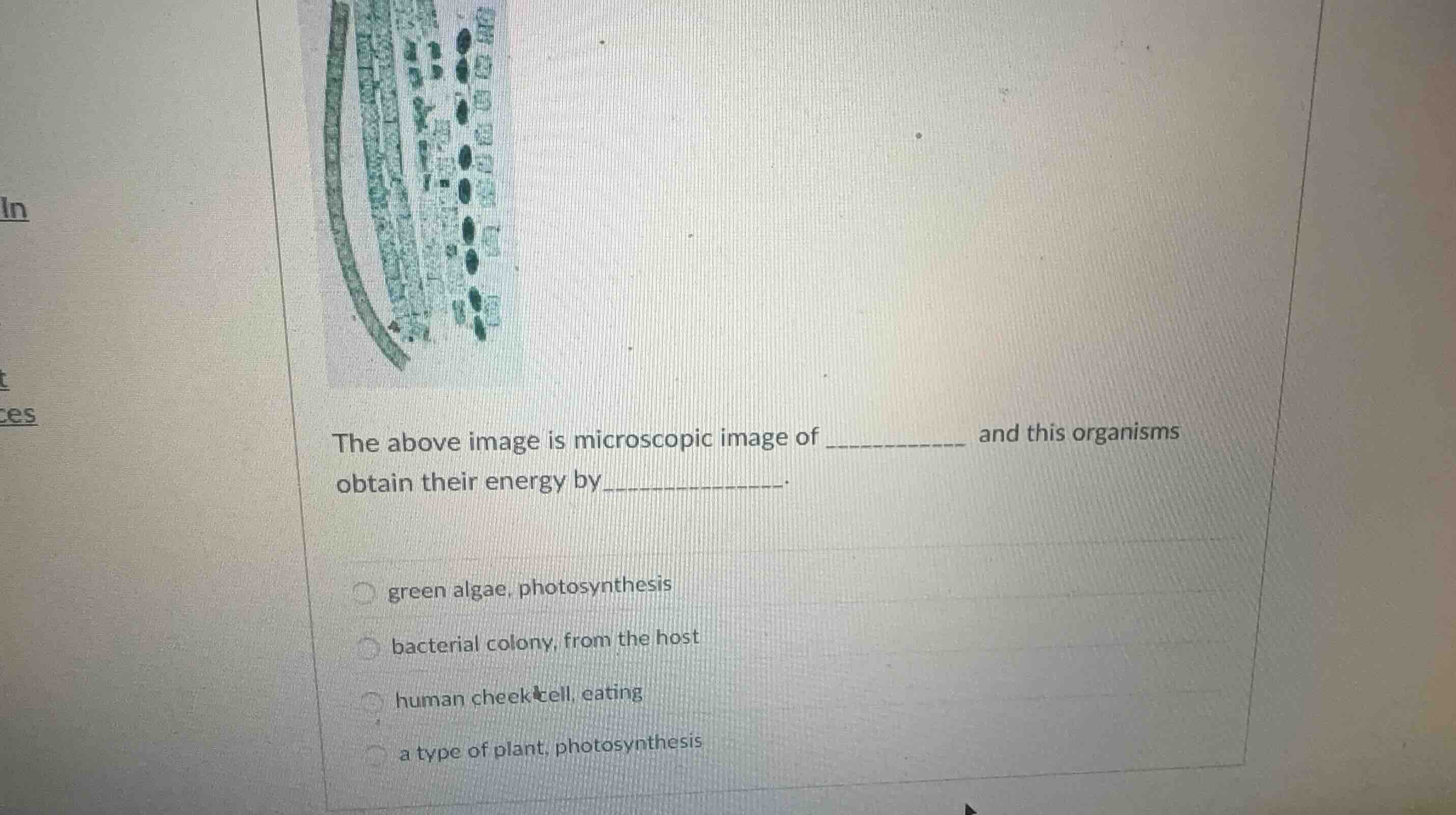
the above image is microscopic image of \\_\\_\\_\\_\\_\\_\\_\\_\\_\\_\\_ and this organisms obtain their energy by \\_\\_\\_\\_\\_\\_\\_\\_\\_\\_\\_.
green algae, photosynthesis
bacterial colony, from the host
human cheek cell, eating
a type of plant, photosynthesis
🆕 New Concept Discovered: Algal Morphology and Nutrition
Identifying photosynthetic protists by their cellular structures.
Step 1: Analyze the Microscopic Image
Looking closely at the image, we see long, filamentous, green strands composed of individual cylindrical cells joined end-to-end. Inside these cells, distinct green structures (chloroplasts) are visible. This characteristic filamentous structure is typical of green algae (such as Spirogyra or Zygnema).
Step 2: Determine the Mode of Nutrition
Green algae are eukaryotic, photosynthetic organisms. They contain chlorophyll within their chloroplasts, which allows them to capture light energy and convert it into chemical energy. Therefore, they obtain their energy through the process of photosynthesis.
Step 3: Evaluate the Options
- green algae, photosynthesis: This matches our analysis perfectly. The image shows filamentous green algae, which are photoautotrophs.
- bacterial colony, from the host: Bacteria are typically much smaller, do not show this complex eukaryotic filamentous cell structure with visible large chloroplasts, and the options do not align with the green, autotrophic nature shown.
- human cheek cell, eating: Human cheek cells are animal cells (flat, irregular squamous epithelial cells) and do not form green filaments, nor do they "eat" to obtain energy in this manner.
- a type of plant, photosynthesis: While plants perform photosynthesis, this specific filamentous, simple cellular arrangement represents green algae rather than a complex plant tissue.

Snap & solve any problem in the app
Get step-by-step solutions on Sovi AI
Photo-based solutions with guided steps
Explore more problems and detailed explanations
green algae, photosynthesis