QUESTION IMAGE
Question
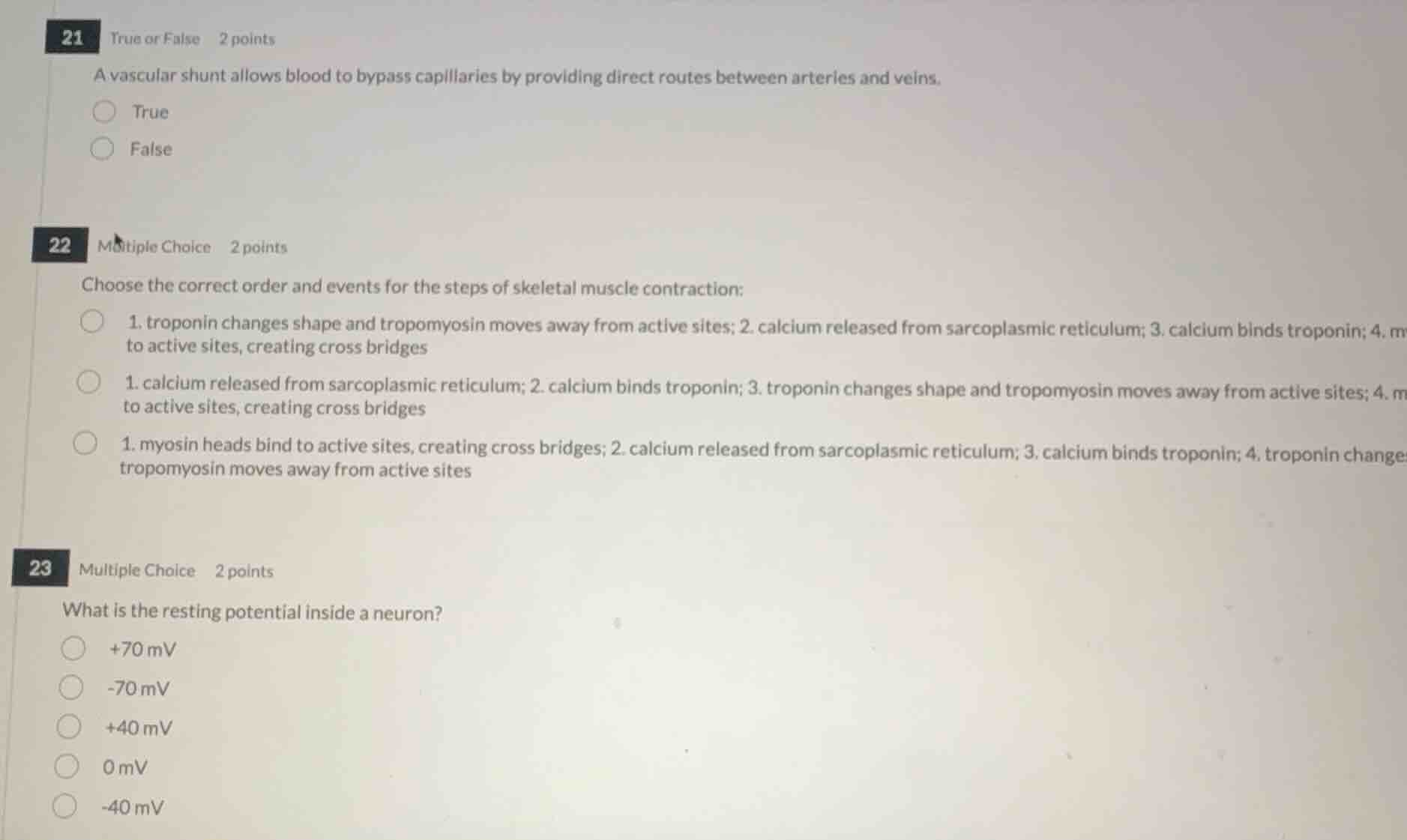
21 true or false 2 points
a vascular shunt allows blood to bypass capillaries by providing direct routes between arteries and veins.
true
false
22 multiple choice 2 points
choose the correct order and events for the steps of skeletal muscle contraction:
- troponin changes shape and tropomyosin moves away from active sites; 2. calcium released from sarcoplasmic reticulum; 3. calcium binds troponin; 4. myosin heads bind to active sites, creating cross bridges
- calcium released from sarcoplasmic reticulum; 2. calcium binds troponin; 3. troponin changes shape and tropomyosin moves away from active sites; 4. myosin heads bind to active sites, creating cross bridges
- myosin heads bind to active sites, creating cross bridges; 2. calcium released from sarcoplasmic reticulum; 3. calcium binds troponin; 4. troponin changes shape and tropomyosin moves away from active sites
23 multiple choice 2 points
what is the resting potential inside a neuron?
+70 mv
-70 mv
+40 mv
0 mv
-40 mv
Analyze Question 21
A vascular shunt (metarteriole–thoroughfare channel) directly connects an arteriole to a venule, bypassing the true capillary bed.
Analyze Question 22
The physiological sequence of skeletal muscle contraction:
- Calcium is released from the sarcoplasmic reticulum.
- Calcium binds to troponin.
- Troponin changes shape, moving tropomyosin away from the active sites on actin.
- Myosin heads bind to the active sites, forming cross-bridges.
Analyze Question 23
The typical resting membrane potential of a neuron is approximately \(-70\text{ mV}\).

Snap & solve any problem in the app
Get step-by-step solutions on Sovi AI
Photo-based solutions with guided steps
Explore more problems and detailed explanations
Question 21
- True (Correct answer)
- False
Question 22
- 1. troponin changes shape and tropomyosin moves away from active sites; 2. calcium released from sarcoplasmic reticulum; 3. calcium binds troponin; 4. myosin heads bind to active sites, creating cross bridges
- 1. calcium released from sarcoplasmic reticulum; 2. calcium binds troponin; 3. troponin changes shape and tropomyosin moves away from active sites; 4. myosin heads bind to active sites, creating cross bridges (Correct answer)
- 1. myosin heads bind to active sites, creating cross bridges; 2. calcium released from sarcoplasmic reticulum; 3. calcium binds troponin; 4. troponin changes shape and tropomyosin moves away from active sites
Question 23
- +70 mV
- -70 mV (Correct answer)
- +40 mV
- 0 mV
- -40 mV