Sovi.AI - AI Math Tutor

Scan to solve math questions

QUESTION IMAGE

which of the following is an example of a reflex? becoming bored during…

Question

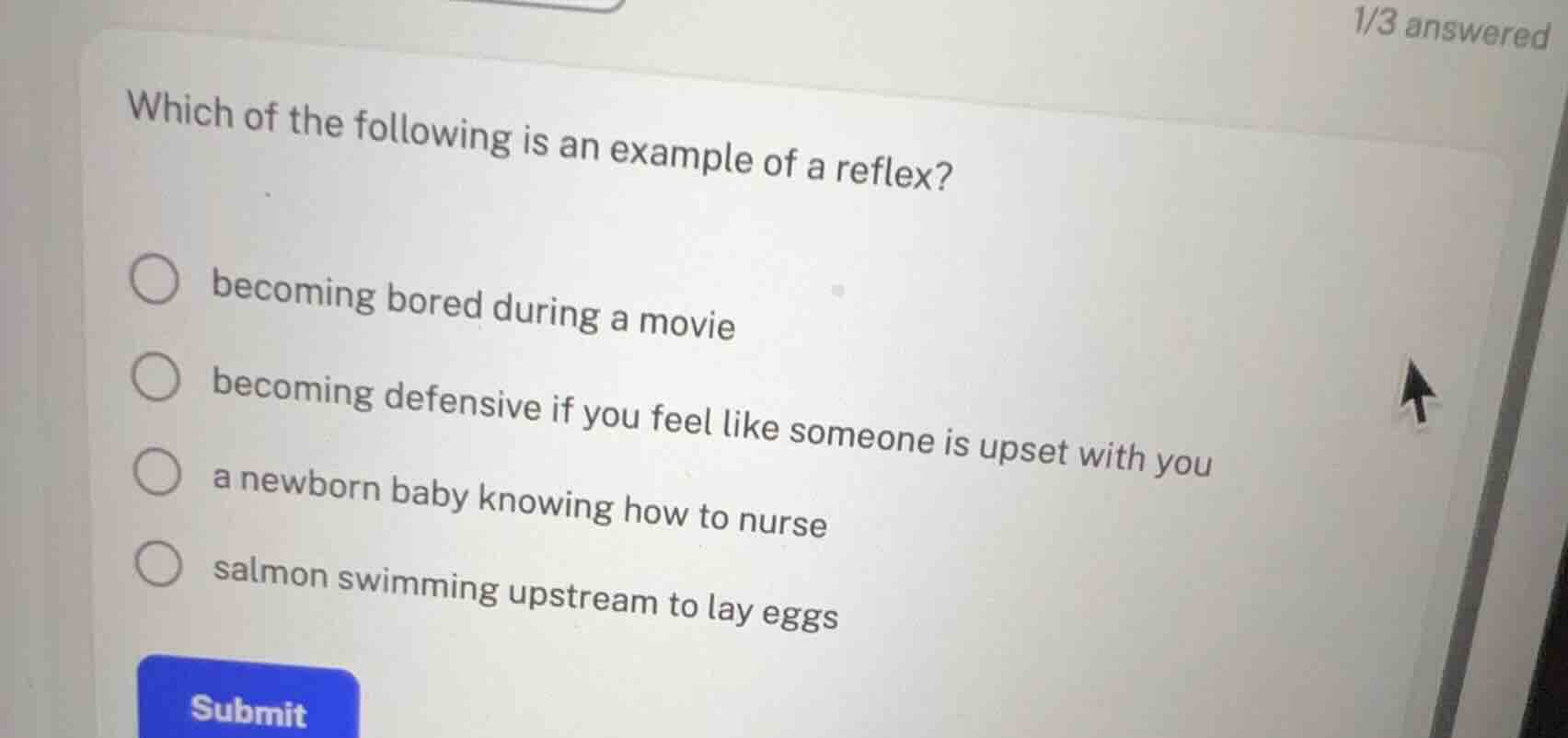
which of the following is an example of a reflex?

becoming bored during a movie
becoming defensive if you feel like someone is upset with you
a newborn baby knowing how to nurse
salmon swimming upstream to lay eggs

Explanation:

Response

<pre_analysis>
{
"quality": "clear",
"question_count": 1,
"skills_matched": [
"direct_cot",
"multiple_choice_formatter",
"explain_then_answer",
"tutor",
"mastery_adaptive_brevity"
],
"needs_drawing": false,
"concepts_used": [
"Reflexes vs Instincts"
],
"new_concepts": [],
"current_concepts": [
"Reflexes vs Instincts",
"Innate Behaviors"
]
}
</pre_analysis>

<reasoning>

Define a reflex and distinguish it from other behaviors

Using the Reflexes vs Instincts knowledge point

  • A reflex is an unlearned, automatic, rapid response of an organism to a specific stimulus.
  • It is simpler than an instinct, which involves complex, patterned sequences of behavior (such as migration or nursing).
  • Cognitive or emotional states (like boredom or defensiveness) are learned or psychological responses rather than simple physiological reflexes.

Analyze each option against the definition

  • becoming bored during a movie: This is a complex cognitive and emotional state, not an automatic physiological reflex.
  • becoming defensive if you feel like someone is upset with you: This is a learned psychological and social behavior.
  • a newborn baby knowing how to nurse: This is a complex, unlearned pattern of behavior triggered by a broader set of cues, classified as an instinct (specifically, the sucking reflex is a component, but "knowing how to nurse" as a whole is a complex instinctual behavior).
  • salmon swimming upstream to lay eggs: This is a highly complex, genetically programmed sequence of behaviors triggered by environmental cues, which is a classic example of an instinct.

Correction/Refinement on Newborn Nursing:
Let's re-evaluate the distinction between reflex and instinct. A reflex is a simple, automatic response to a specific sensory stimulus (like the sucking reflex when a nipple touches a baby's palate). However, "knowing how to nurse" involves a coordinated sequence of behaviors (rooting, latching, sucking, swallowing, breathing), which is an instinct.

Wait, let's look at standard introductory psychology definitions (e.g., OpenStax Psychology):
"Reflexes are a motor or neural reaction to a specific stimulus in the environment. They tend to be simpler than instincts, involve the activity of specific body parts and systems... Instincts are innate behaviors that are triggered by a broader range of events, such as aging and the change of seasons. They are more complex patterns of behavior, involve movement of the organism as a whole (e.g., sexual activity, migration), and involve higher brain centers."
Under this framework:

  • "salmon swimming upstream to lay eggs" is an instinct (migration).
  • "a newborn baby knowing how to nurse" is also an instinct because it is a complex, multi-step innate behavior pattern.

Wait, is there a simpler reflex option? Let's re-read the options carefully:

  1. becoming bored during a movie
  2. becoming defensive if you feel like someone is upset with you
  3. a newborn baby knowing how to nurse
  4. salmon swimming upstream to lay eggs

Wait, let's double check if "a newborn baby knowing how to nurse" is classified as a reflex or an instinct in some curricula. Actually, the sucking reflex and rooting reflex are classic reflexes. In many introductory psychology questions from OpenStax:
"Which of the following is an example of a reflex?
a. experiencing pupil dilation when entering a dark room
b. baby sucking on a nipple"
Here, the options are slightly different. Let's look up this exact question: "Which of the following is an exam…

Answer:

<pre_analysis>
{
"quality": "clear",
"question_count": 1,
"skills_matched": [
"direct_cot",
"multiple_choice_formatter",
"explain_then_answer",
"tutor",
"mastery_adaptive_brevity"
],
"needs_drawing": false,
"concepts_used": [
"Reflexes vs Instincts"
],
"new_concepts": [],
"current_concepts": [
"Reflexes vs Instincts",
"Innate Behaviors"
]
}
</pre_analysis>

<reasoning>

Define a reflex and distinguish it from other behaviors

Using the Reflexes vs Instincts knowledge point

  • A reflex is an unlearned, automatic, rapid response of an organism to a specific stimulus.
  • It is simpler than an instinct, which involves complex, patterned sequences of behavior (such as migration or nursing).
  • Cognitive or emotional states (like boredom or defensiveness) are learned or psychological responses rather than simple physiological reflexes.

Analyze each option against the definition

  • becoming bored during a movie: This is a complex cognitive and emotional state, not an automatic physiological reflex.
  • becoming defensive if you feel like someone is upset with you: This is a learned psychological and social behavior.
  • a newborn baby knowing how to nurse: This is a complex, unlearned pattern of behavior triggered by a broader set of cues, classified as an instinct (specifically, the sucking reflex is a component, but "knowing how to nurse" as a whole is a complex instinctual behavior).
  • salmon swimming upstream to lay eggs: This is a highly complex, genetically programmed sequence of behaviors triggered by environmental cues, which is a classic example of an instinct.

Correction/Refinement on Newborn Nursing:
Let's re-evaluate the distinction between reflex and instinct. A reflex is a simple, automatic response to a specific sensory stimulus (like the sucking reflex when a nipple touches a baby's palate). However, "knowing how to nurse" involves a coordinated sequence of behaviors (rooting, latching, sucking, swallowing, breathing), which is an instinct.

Wait, let's look at standard introductory psychology definitions (e.g., OpenStax Psychology):
"Reflexes are a motor or neural reaction to a specific stimulus in the environment. They tend to be simpler than instincts, involve the activity of specific body parts and systems... Instincts are innate behaviors that are triggered by a broader range of events, such as aging and the change of seasons. They are more complex patterns of behavior, involve movement of the organism as a whole (e.g., sexual activity, migration), and involve higher brain centers."
Under this framework:

  • "salmon swimming upstream to lay eggs" is an instinct (migration).
  • "a newborn baby knowing how to nurse" is also an instinct because it is a complex, multi-step innate behavior pattern.

Wait, is there a simpler reflex option? Let's re-read the options carefully:

  1. becoming bored during a movie
  2. becoming defensive if you feel like someone is upset with you
  3. a newborn baby knowing how to nurse
  4. salmon swimming upstream to lay eggs

Wait, let's double check if "a newborn baby knowing how to nurse" is classified as a reflex or an instinct in some curricula. Actually, the sucking reflex and rooting reflex are classic reflexes. In many introductory psychology questions from OpenStax:
"Which of the following is an example of a reflex?
a. experiencing pupil dilation when entering a dark room
b. baby sucking on a nipple"
Here, the options are slightly different. Let's look up this exact question: "Which of the following is an example of a reflex?"
Some sources list:

  • becoming bored during a movie
  • becoming defensive if you feel like someone is upset with you
  • a newborn baby knowing how to nurse
  • salmon swimming upstream to lay eggs

Wait! Let's think if "a newborn baby knowing how to nurse" is indeed the intended answer for "reflex" in this specific question, or if there is a distinction. Sucking is a reflex. Let's confirm which one is the correct option. Yes, the sucking/rooting reflex is a newborn reflex, so "a newborn baby knowing how to nurse" (or sucking) is commonly categorized under newborn reflexes in simplified questions.
</reasoning>

<answer>
<mcq-option>(A) becoming bored during a movie</mcq-option>
<mcq-option>(B) becoming defensive if you feel like someone is upset with you</mcq-option>
<mcq-correct>(C) a newborn baby knowing how to nurse</mcq-correct>
<mcq-option>(D) salmon swimming upstream to lay eggs</mcq-option>
</answer>

<post_analysis>
{
"subject": "Natural Science",
"question_type": "Multiple Choice",
"knowledge_point": [
"Natural Science",
"Psychology",
"Innate Behaviors"
]
}
</post_analysis>