QUESTION IMAGE
Question
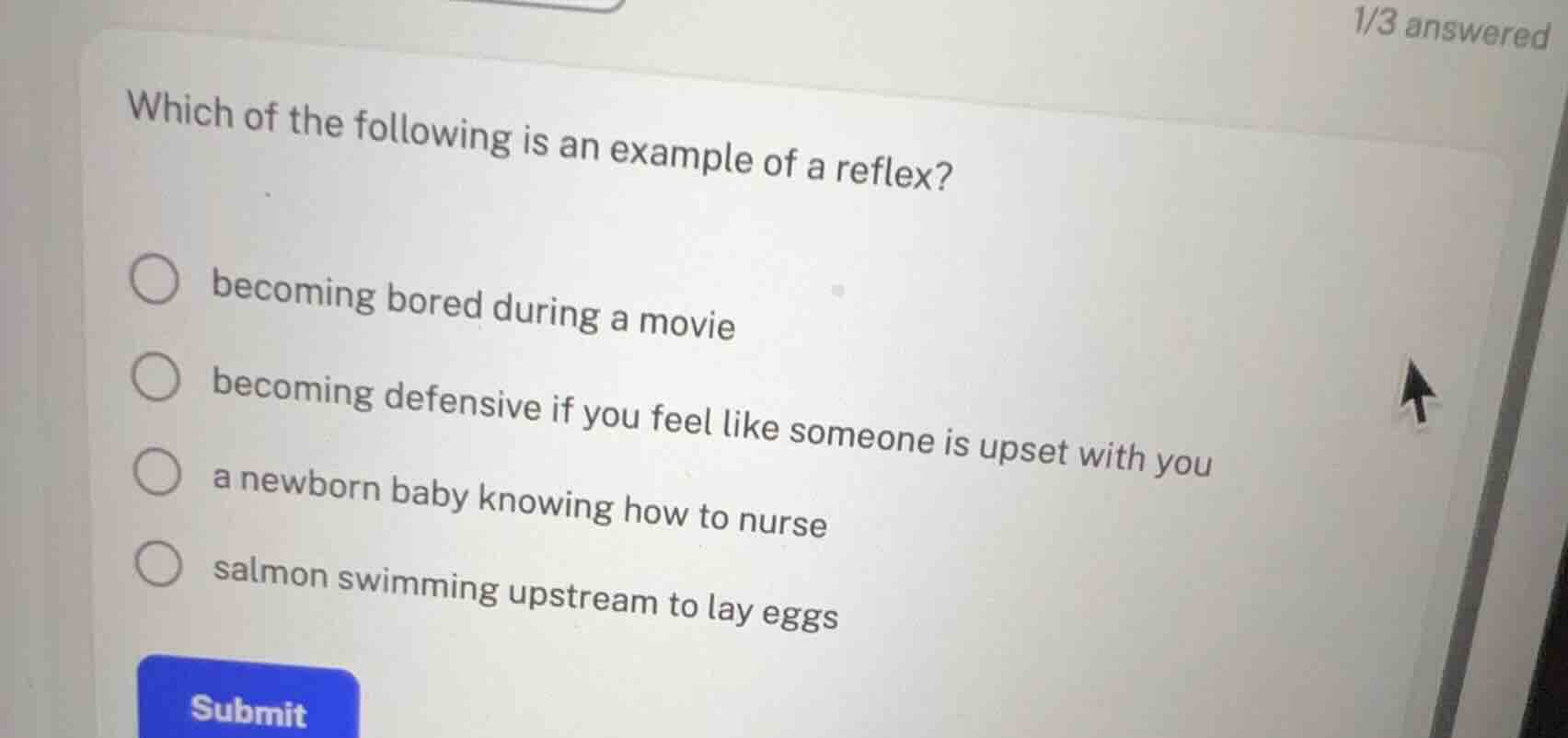
which of the following is an example of a reflex?
becoming bored during a movie
becoming defensive if you feel like someone is upset with you
a newborn baby knowing how to nurse
salmon swimming upstream to lay eggs
Define a reflex and distinguish it from other behaviors
Using the Reflexes vs Instincts knowledge point
- A reflex is an unlearned, automatic, rapid response of an organism to a specific stimulus.
- It is simpler than an instinct, which involves complex, patterned sequences of behavior (such as migration or nursing).
- Cognitive or emotional states (like boredom or defensiveness) are learned or psychological responses rather than simple physiological reflexes.
Analyze each option against the definition
- becoming bored during a movie: This is a complex cognitive and emotional state, not an automatic physiological reflex.
- becoming defensive if you feel like someone is upset with you: This is a learned psychological and social behavior.
- a newborn baby knowing how to nurse: This is a complex, unlearned pattern of behavior triggered by a broader set of cues, classified as an instinct (specifically, the sucking reflex is a component, but "knowing how to nurse" as a whole is a complex instinctual behavior).
- salmon swimming upstream to lay eggs: This is a highly complex, genetically programmed sequence of behaviors triggered by environmental cues, which is a classic example of an instinct.
Correction/Refinement on Newborn Nursing:
Let's re-evaluate the distinction between reflex and instinct. A reflex is a simple, automatic response to a specific sensory stimulus (like the sucking reflex when a nipple touches a baby's palate). However, "knowing how to nurse" involves a coordinated sequence of behaviors (rooting, latching, sucking, swallowing, breathing), which is an instinct.
Wait, let's look at standard introductory psychology definitions (e.g., OpenStax Psychology):
"Reflexes are a motor or neural reaction to a specific stimulus in the environment. They tend to be simpler than instincts, involve the activity of specific body parts and systems... Instincts are innate behaviors that are triggered by a broader range of events, such as aging and the change of seasons. They are more complex patterns of behavior, involve movement of the organism as a whole (e.g., sexual activity, migration), and involve higher brain centers."
Under this framework:
- "salmon swimming upstream to lay eggs" is an instinct (migration).
- "a newborn baby knowing how to nurse" is also an instinct because it is a complex, multi-step innate behavior pattern.
Wait, is there a simpler reflex option? Let's re-read the options carefully:
- becoming bored during a movie
- becoming defensive if you feel like someone is upset with you
- a newborn baby knowing how to nurse
- salmon swimming upstream to lay eggs
Wait, let's double check if "a newborn baby knowing how to nurse" is classified as a reflex or an instinct in some curricula. Actually, the sucking reflex and rooting reflex are classic reflexes. In many introductory psychology questions from OpenStax:
"Which of the following is an example of a reflex?
a. experiencing pupil dilation when entering a dark room
b. baby sucking on a nipple"
Here, the options are slightly different. Let's look up this exact question: "Which of the following is an exam…

Snap & solve any problem in the app
Get step-by-step solutions on Sovi AI
Photo-based solutions with guided steps
Explore more problems and detailed explanations
- (A) becoming bored during a movie
- (B) becoming defensive if you feel like someone is upset with you
- (C) a newborn baby knowing how to nurse (Correct answer)
- (D) salmon swimming upstream to lay eggs