QUESTION IMAGE
Question
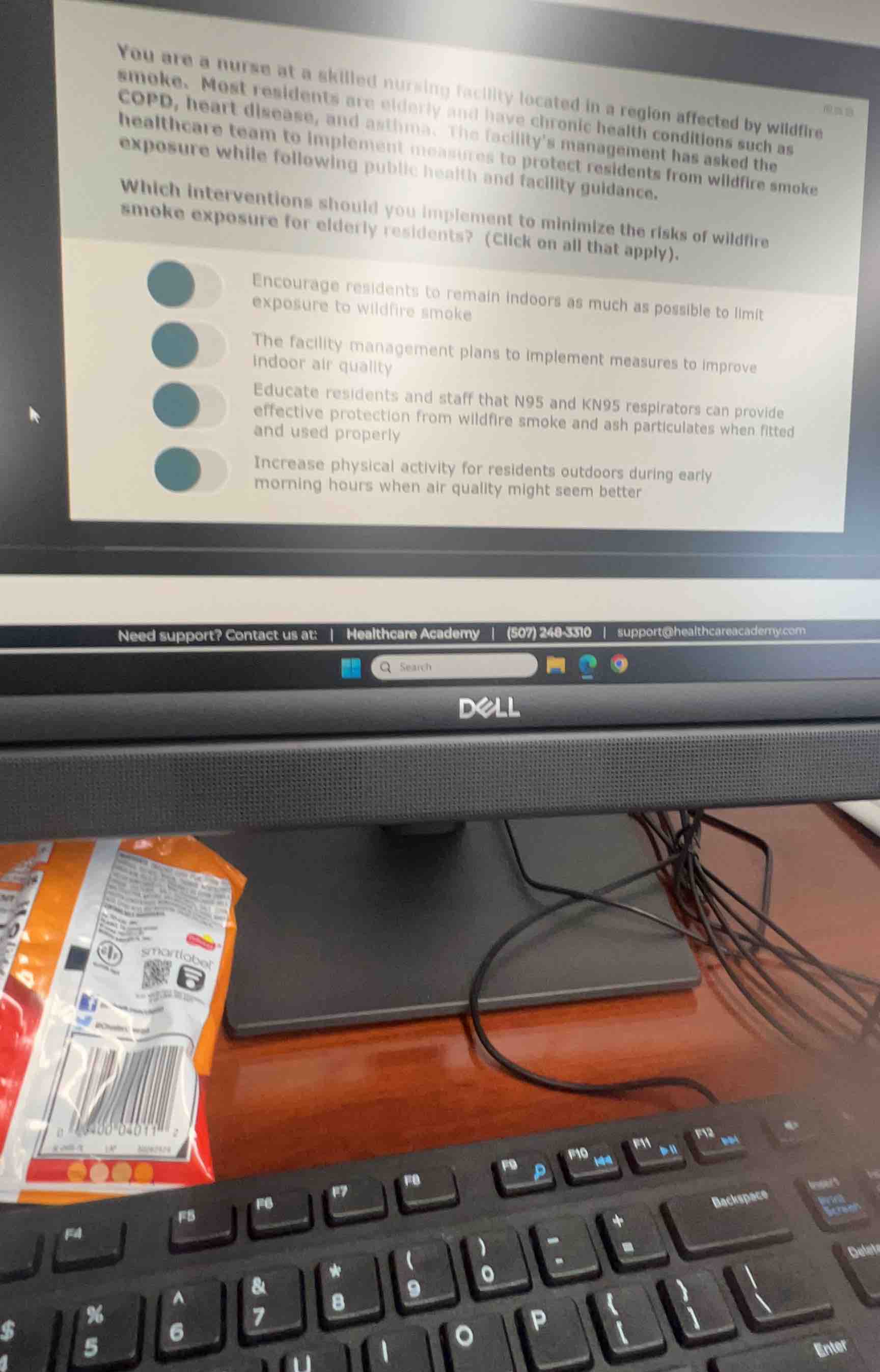
you are a nurse at a skilled nursing facility located in a region affected by wildfire smoke. most residents are elderly and have chronic health conditions such as copd, heart disease, and asthma. the facilitys management has asked the healthcare team to implement measures to protect residents from wildfire smoke exposure while following public health and facility guidance.
which interventions should you implement to minimize the risks of wildfire smoke exposure for elderly residents? (click on all that apply).
- encourage residents to remain indoors as much as possible to limit exposure to wildfire smoke
- the facility management plans to implement measures to improve indoor air quality
- educate residents and staff that n95 and kn95 respirators can provide effective protection from wildfire smoke and ash particulates when fitted and used properly
- increase physical activity for residents outdoors during early morning hours when air quality might seem better
🆕 New Concept Discovered: Wildfire Smoke Mitigation in Healthcare Facilities
Protecting vulnerable populations from poor outdoor air quality.
Step 1: Analyze the Scenario and Vulnerabilities
The scenario describes a skilled nursing facility with elderly residents who have chronic conditions like COPD, heart disease, and asthma. These individuals are highly susceptible to the adverse health effects of wildfire smoke (particulate matter \( \text{PM}_{2.5} \)). Interventions must focus on reducing exposure to outdoor air pollutants and protecting respiratory health.
Step 2: Evaluate Option 1
- Option: "Encourage residents to remain indoors as much as possible to limit exposure to wildfire smoke"
- Evaluation: Staying indoors is a primary public health recommendation during wildfire smoke events to minimize inhalation of fine particulates. This is highly appropriate for vulnerable elderly residents.
- Status: Select
Step 3: Evaluate Option 2
- Option: "The facility management plans to implement measures to improve indoor air quality"
- Evaluation: Improving indoor air quality (e.g., using high-efficiency HVAC filters like MERV 13+, sealing leaks, or using portable HEPA air purifiers) is crucial to ensure that the indoor environment remains safe when outdoor air is hazardous.
- Status: Select
Step 4: Evaluate Option 3
- Option: "Educate residents and staff that N95 and KN95 respirators can provide effective protection from wildfire smoke and ash particulates when fitted and used properly"
- Evaluation: Well-fitted N95 or KN95 respirators filter out fine particulate matter effectively, unlike standard surgical or cloth masks. Educating staff and capable residents on their proper use is a key protective measure.
- Status: Select
Step 5: Evaluate Option 4
- Option: "Increase physical activity for residents outdoors during early morning hours when air quality might seem better"
- Evaluation: Increasing physical activity outdoors during a wildfire smoke event is dangerous, especially for residents with COPD, asthma, or heart disease. Exercise increases inhalation rates, drawing more harmful particulates deep into the lungs. Outdoor activity should be minimized, not increased.
- Status: Do not select

Snap & solve any problem in the app
Get step-by-step solutions on Sovi AI
Photo-based solutions with guided steps
Explore more problems and detailed explanations
- Encourage residents to remain indoors as much as possible to limit exposure to wildfire smoke
- The facility management plans to implement measures to improve indoor air quality
- Educate residents and staff that N95 and KN95 respirators can provide effective protection from wildfire smoke and ash particulates when fitted and used properly