QUESTION IMAGE
Question
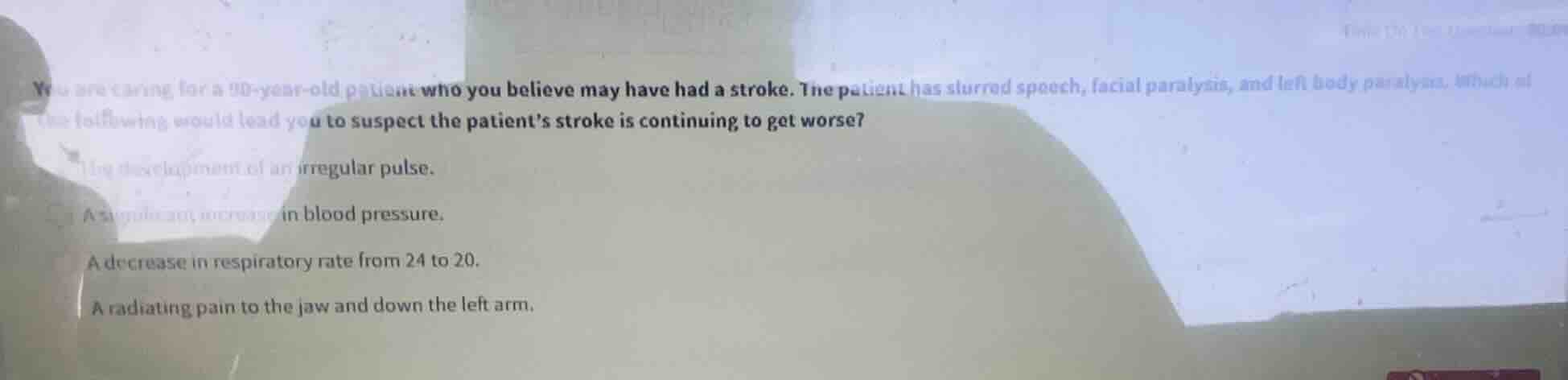
you are caring for a 90-year-old patient who you believe may have had a stroke. the patient has slurred speech, facial paralysis, and left body paralysis. which of the following would lead you to suspect the patients stroke is continuing to get worse?
the development of an irregular pulse.
a significant increase in blood pressure.
a decrease in respiratory rate from 24 to 20.
a radiating pain to the jaw and down the left arm.
Analyze the clinical scenario
The patient is a 90-year-old presenting with classic signs of an acute ischemic or hemorrhagic stroke: slurred speech, facial paralysis, and left-sided hemiplegia. We need to identify which sign indicates that the stroke is actively worsening.
Evaluate intracranial pressure dynamics
Using the Intracranial Pressure Dynamics knowledge point
An expanding hemorrhage or worsening cerebral edema leads to increased intracranial pressure (ICP). To maintain cerebral perfusion pressure (CPP), the body initiates a compensatory sympathetic response, resulting in a significant increase in systemic blood pressure (part of Cushing's triad).
Differentiate the options
Using the Stroke Pathophysiology knowledge point
- Irregular pulse: Often associated with atrial fibrillation (a risk factor for embolic stroke), but does not directly indicate acute worsening of the current stroke.
- Significant increase in blood pressure: Directly reflects rising ICP and worsening neurological status.
- Decrease in respiratory rate from 24 to 20: This represents a normalization toward a healthy respiratory rate, not a sign of deterioration.
- Radiating pain to the jaw and left arm: This is a classic presentation of acute coronary syndrome (myocardial infarction), not worsening stroke.

Snap & solve any problem in the app
Get step-by-step solutions on Sovi AI
Photo-based solutions with guided steps
Explore more problems and detailed explanations
- The development of an irregular pulse.
- A significant increase in blood pressure. (Correct answer)
- A decrease in respiratory rate from 24 to 20.
- A radiating pain to the jaw and down the left arm.