QUESTION IMAGE
Question
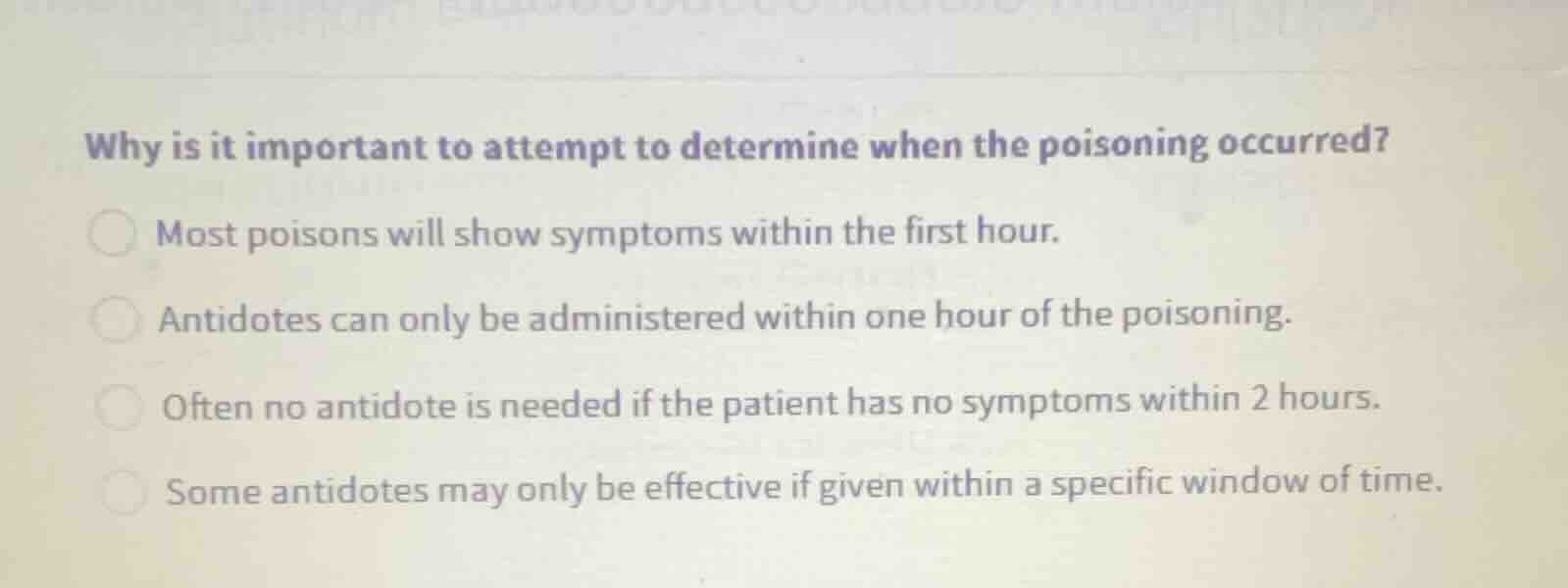
why is it important to attempt to determine when the poisoning occurred?
most poisons will show symptoms within the first hour.
antidotes can only be administered within one hour of the poisoning.
often no antidote is needed if the patient has no symptoms within 2 hours.
some antidotes may only be effective if given within a specific window of time.
Analyze the clinical significance of timing in toxicological emergencies
Using the Toxicological Emergencies knowledge point
Determining the exact or estimated time of exposure is a critical component of the patient assessment protocol. The duration of exposure and the time elapsed since exposure directly dictate the physiological progression of the toxin, the onset of clinical symptoms, and the viability of specific medical interventions.
Evaluate the physiological impact of time on toxin absorption
Using the Toxin Ingestion Pathophysiology knowledge point
Once a toxin is ingested or otherwise introduced to the body, gastrointestinal absorption and systemic distribution begin. Interventions designed to prevent absorption (such as activated charcoal) or to neutralize the toxin (such as specific pharmacological antidotes) are highly time-dependent. As time passes, the systemic concentration of the toxin increases, which can render certain localized or competitive interventions ineffective.
Assess the options and determine the correct clinical rationale
- Option 1: "Most poisons will show symptoms within the first hour." This is clinically incorrect; many toxins have delayed onsets of action (e.g., acetaminophen, certain sustained-release medications, or organophosphates) that take several hours to manifest symptoms.
- Option 2: "Antidotes can only be administered within one hour of the poisoning." This is incorrect; while early administration is ideal, many antidotes can be administered hours after exposure depending on the specific toxin and clinical presentation.
- Option 3: "Often no antidote is needed if the patient has no symptoms within 2 hours." This is dangerous and incorrect, as delayed-onset toxins can still cause severe, life-threatening toxicity long after a 2-hour asymptomatic window.
- Option 4: "Some antidotes may only be effective if given within a specific window of time." This is correct. The efficacy of many medical interventions and specific antidotes decreases significantly as the toxin binds to target receptors or undergoes metabolic activation.

Snap & solve any problem in the app
Get step-by-step solutions on Sovi AI
Photo-based solutions with guided steps
Explore more problems and detailed explanations
- (A) Most poisons will show symptoms within the first hour.
- (B) Antidotes can only be administered within one hour of the poisoning.
- (C) Often no antidote is needed if the patient has no symptoms within 2 hours.
- (D) Some antidotes may only be effective if given within a specific window of time. (Correct answer)