QUESTION IMAGE
Question
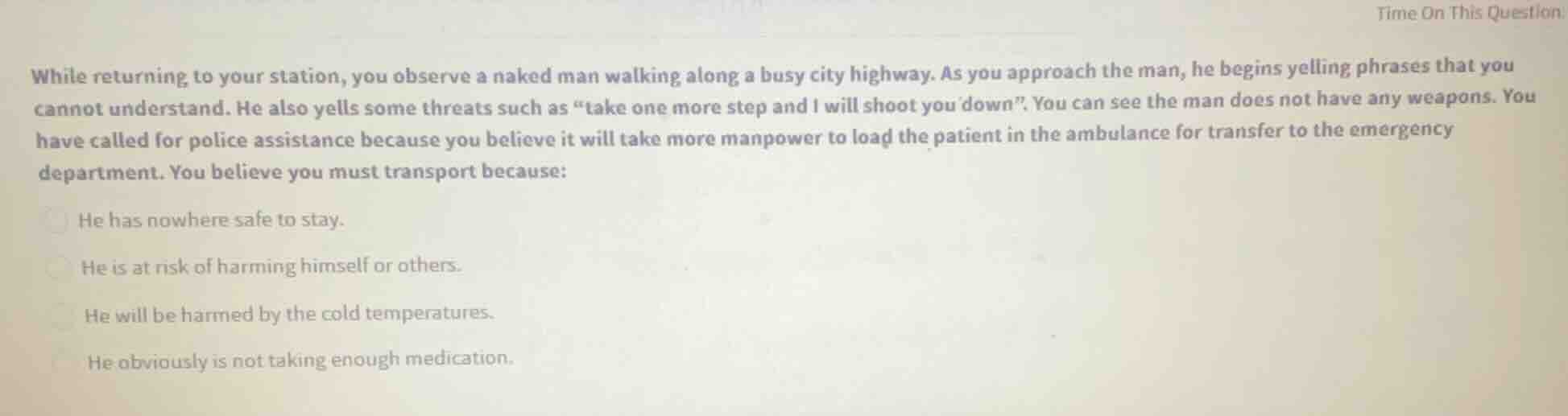
while returning to your station, you observe a naked man walking along a busy city highway. as you approach the man, he begins yelling phrases that you cannot understand. he also yells some threats such as \take one more step and i will shoot you down\. you can see the man does not have any weapons. you have called for police assistance because you believe it will take more manpower to load the patient in the ambulance for transfer to the emergency department. you believe you must transport because:
he has nowhere safe to stay.
he is at risk of harming himself or others.
he will be harmed by the cold temperatures.
he obviously is not taking enough medication.
Analyze the patient's behavior
The patient is walking naked along a busy city highway, shouting incomprehensible phrases, and making explicit verbal threats ("take one more step and I will shoot you down"). This presentation indicates a severe psychiatric crisis or altered mental status, rendering him unable to make rational decisions regarding his own safety and care.
Evaluate the legal and clinical basis for transport
In emergency medical services (EMS), a patient experiencing a behavioral emergency can be transported against their will (involuntary transport) under implied consent or emergency psychiatric hold protocols. The primary clinical and legal justification for this intervention is that the patient poses an immediate danger to himself (walking naked on a busy highway) or to others (making verbal threats of violence).
Assess the given options
- He has nowhere safe to stay: While likely true, homelessness or lack of shelter is a social issue and does not provide the legal authority for EMS to initiate involuntary medical transport.
- He is at risk of harming himself or others: This is the direct clinical and legal standard for involuntary transport and intervention during a behavioral emergency.
- He will be harmed by the cold temperatures: Environmental exposure is a risk, but it is a secondary consequence rather than the primary legal justification for involuntary psychiatric transport.
- He obviously is not taking enough medication: EMS providers cannot diagnose medication non-compliance or use it as a sole legal justification for involuntary transport.
Select the correct option
Applying the principles of Behavioral Emergencies, the patient meets the criteria for involuntary transport because his actions and threats demonstrate that he is an immediate danger to himself and others.

Snap & solve any problem in the app
Get step-by-step solutions on Sovi AI
Photo-based solutions with guided steps
Explore more problems and detailed explanations
- He has nowhere safe to stay.
- He is at risk of harming himself or others. (Correct answer)
- He will be harmed by the cold temperatures.
- He obviously is not taking enough medication.