QUESTION IMAGE
Question
which type of neurological test typically looks for muscle atrophy and asymmetry between the right and left?
answer:
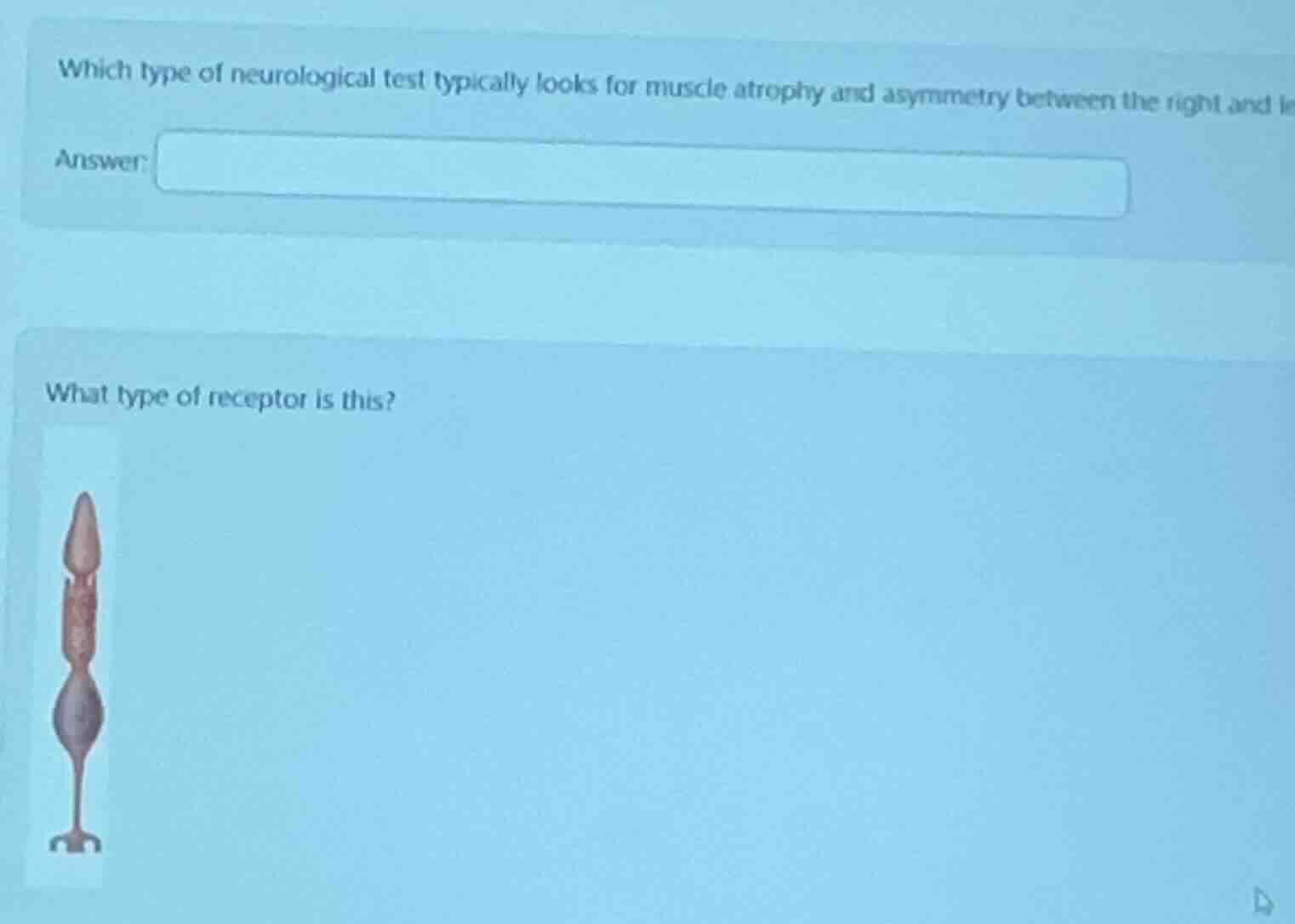
what type of receptor is this?
Analyze the first question on neurological testing
The first question asks: "Which type of neurological test typically looks for muscle atrophy and asymmetry between the right and left sides?"
During a standard neurological examination, the clinician performs a physical inspection of the muscles. This visual assessment is specifically designed to check for muscle bulk, looking for signs of muscle wasting (atrophy) and comparing symmetry between the left and right sides of the body. Therefore, the test is the inspection phase of the motor system examination (often referred to simply as "inspection" or "muscle inspection").
Analyze the second question on receptor identification
The second question asks: "What type of receptor is this?" accompanied by an anatomical diagram.
The diagram shows a specialized sensory cell with a distinct outer segment, an inner segment containing organelles, a cell body (soma) with a nucleus, and a synaptic terminal. Specifically, the outer segment is cone-shaped (tapered), which is characteristic of a cone photoreceptor (or simply a photoreceptor / cone cell) found in the retina. This is a specialized Sensory Receptors type that transduces light into electrical signals.
Synthesize the final answers
For Question 1, the primary clinical assessment is "inspection" (or "muscle inspection" / "motor exam inspection").
For Question 2, the cell depicted is a "photoreceptor" (specifically, a "cone" or "cone cell").

Snap & solve any problem in the app
Get step-by-step solutions on Sovi AI
Photo-based solutions with guided steps
Explore more problems and detailed explanations
Question 1
Inspection (or Muscle Inspection)
Question 2
Photoreceptor (specifically, a Cone cell)