QUESTION IMAGE
Question
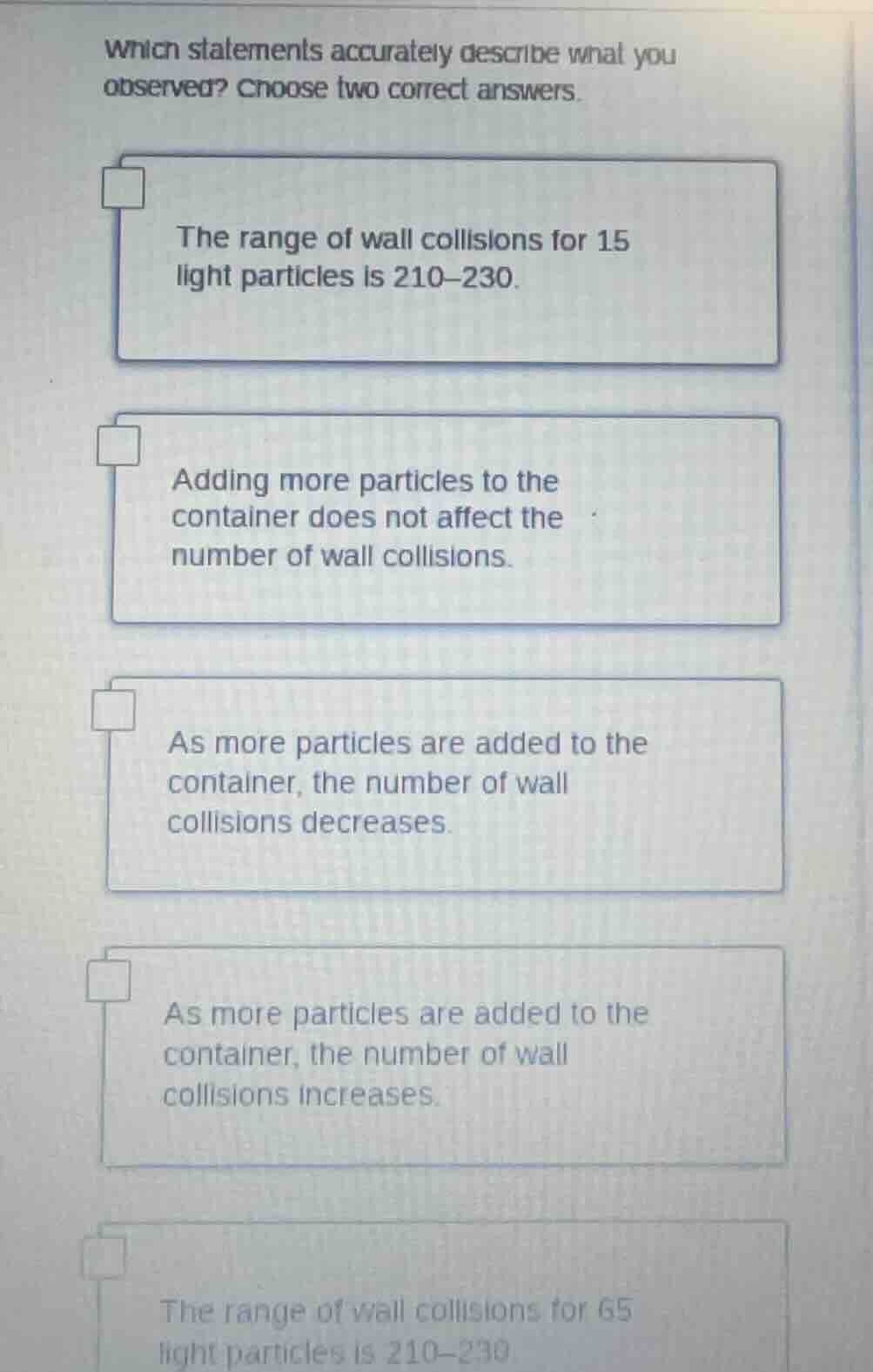
which statements accurately describe what you observed? choose two correct answers.
the range of wall collisions for 15 light particles is 210-230.
adding more particles to the container does not affect the number of wall collisions.
as more particles are added to the container, the number of wall collisions decreases.
as more particles are added to the container, the number of wall collisions increases.
the range of wall collisions for 65 light particles is 210-230.
Analyze the relationship between particle count and wall collisions
Using the Kinetic Molecular Theory and Particle Motion knowledge points, we know that gas pressure is caused by gas particles colliding with the walls of their container. If we add more particles to a container of fixed volume and temperature, the frequency of these collisions must increase. Therefore, adding more particles to the container increases the number of wall collisions. This makes the fourth statement correct, while the second and third statements are incorrect.
Evaluate the specific numerical ranges
Since we must choose two correct answers, we evaluate the remaining statements regarding the numerical ranges of wall collisions. In typical gas properties simulations (such as PhET Gas Properties), 15 light particles at standard conditions result in a relatively low number of collisions (typically much lower than 210–230). Conversely, adding more particles (such as 65 light particles) increases the collision frequency significantly, bringing the count into a higher range like 210–230. Therefore, the statement "The range of wall collisions for 65 light particles is 210–230" is the second correct observation.

Snap & solve any problem in the app
Get step-by-step solutions on Sovi AI
Photo-based solutions with guided steps
Explore more problems and detailed explanations
- The range of wall collisions for 15 light particles is 210–230.
- Adding more particles to the container does not affect the number of wall collisions.
- As more particles are added to the container, the number of wall collisions decreases.
- As more particles are added to the container, the number of wall collisions increases. (Correct answer)
- The range of wall collisions for 65 light particles is 210–230. (Correct answer)