QUESTION IMAGE
Question
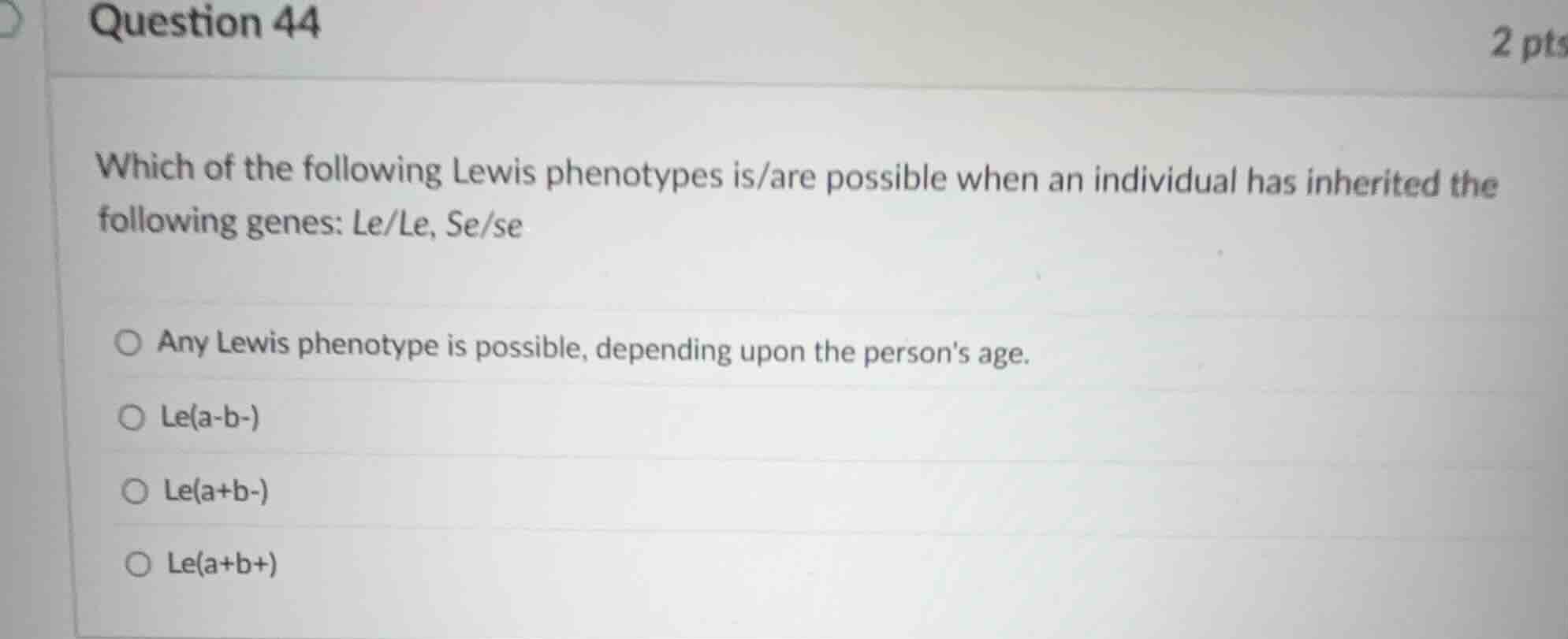
which of the following lewis phenotypes is/are possible when an individual has inherited the following genes: le/le, se/se
any lewis phenotype is possible, depending upon the persons age.
le(a-b-)
le(a+b-)
le(a+b+)
Analyze the inherited genes
Using the Lewis Blood Group and Lewis Antigen Biosynthesis knowledge points
- The individual has inherited the genotype \(Le/Le\), meaning they possess at least one functional \(Le\) gene (dominant). This allows the synthesis of the \(\text{Le}^\text{a}\) antigen from precursor substances.
- The individual has inherited the genotype \(Se/se\), meaning they possess one functional \(Se\) (secretor) gene (dominant).
Determine antigen biosynthesis
Using the Lewis Antigen Biosynthesis and Lewis Phenotypes knowledge points
- The functional \(Le\) gene encodes \(\alpha\)-(1,4)-fucosyltransferase, which adds fucose to the precursor chain to form \(\text{Le}^\text{a}\).
- The functional \(Se\) gene encodes \(\alpha\)-(1,2)-fucosyltransferase, which adds fucose to the precursor chain to form H substance in secretions.
- When both \(Le\) and \(Se\) transferases are active, the H substance is further modified by the \(Le\) enzyme to form \(\text{Le}^\text{b}\).
- Consequently, almost all \(\text{Le}^\text{a}\) is converted into \(\text{Le}^\text{b}\) on the red blood cells, resulting in the secretor phenotype.
Identify the resulting phenotype
Using the Lewis Phenotypes knowledge point
- Because the individual is a secretor (\(Se/se\)) and possesses the Lewis gene (\(Le/Le\)), their red blood cells will adsorb \(\text{Le}^\text{b}\) from the plasma.
- This leads to the characteristic adult phenotype of \(\text{Le(a-b+)}\).
- Let's evaluate the given options:
- "Any Lewis phenotype is possible, depending upon the person's age." (Incorrect, as infants are born \(\text{Le(a-b-)}\) and transition, but the stable adult phenotype is determined by these genes).
- \(\text{Le(a-b-)}\) (Incorrect, requires \(le/le\)).
- \(\text{Le(a+b-)}\) (Incorrect, requires non-secretor \(se/se\)).
- \(\text{Le(a+b+)}\) (Incorrect, extremely rare transient phenotype in children, not the standard adult phenotype for this genotype).
- Since \(\text{Le(a-b+)}\) is the standard phenotype for a secretor with the Lewis gene, and it is not explicitly listed as a standalone option, let's re-examine the options in the image:
- Option 1: Any Lewis phenotype is possible, depending upon the person's age.
- Option 2: \(\text{Le(a-b-)}\)
- Option 3: \(\text{Le(a+b-)}\)
- Option 4: \(\text{Le(a+b+)}\)
- Wait, let's look at Option 1 again. Lewis antigens are not fully developed at birth. Newborns typically type as \(\text{Le(a-b-)}\). By 3 months, they may type as \(\text{Le(a+b-)}\), then \(\text{Le(a+b+)}\) during childhood, before finally reaching their true adult phenotype of \(\text{Le(a-b+)}\) around age 6. Therefore, depending on the person's age, different phenotypes are observed during development. Thus, Option 1 is the correct choice.

Snap & solve any problem in the app
Get step-by-step solutions on Sovi AI
Photo-based solutions with guided steps
Explore more problems and detailed explanations
- (A) Any Lewis phenotype is possible, depending upon the person's age. (Correct answer)
- (B) Le(a-b-)
- (C) Le(a+b-)
- (D) Le(a+b+)