QUESTION IMAGE
Question
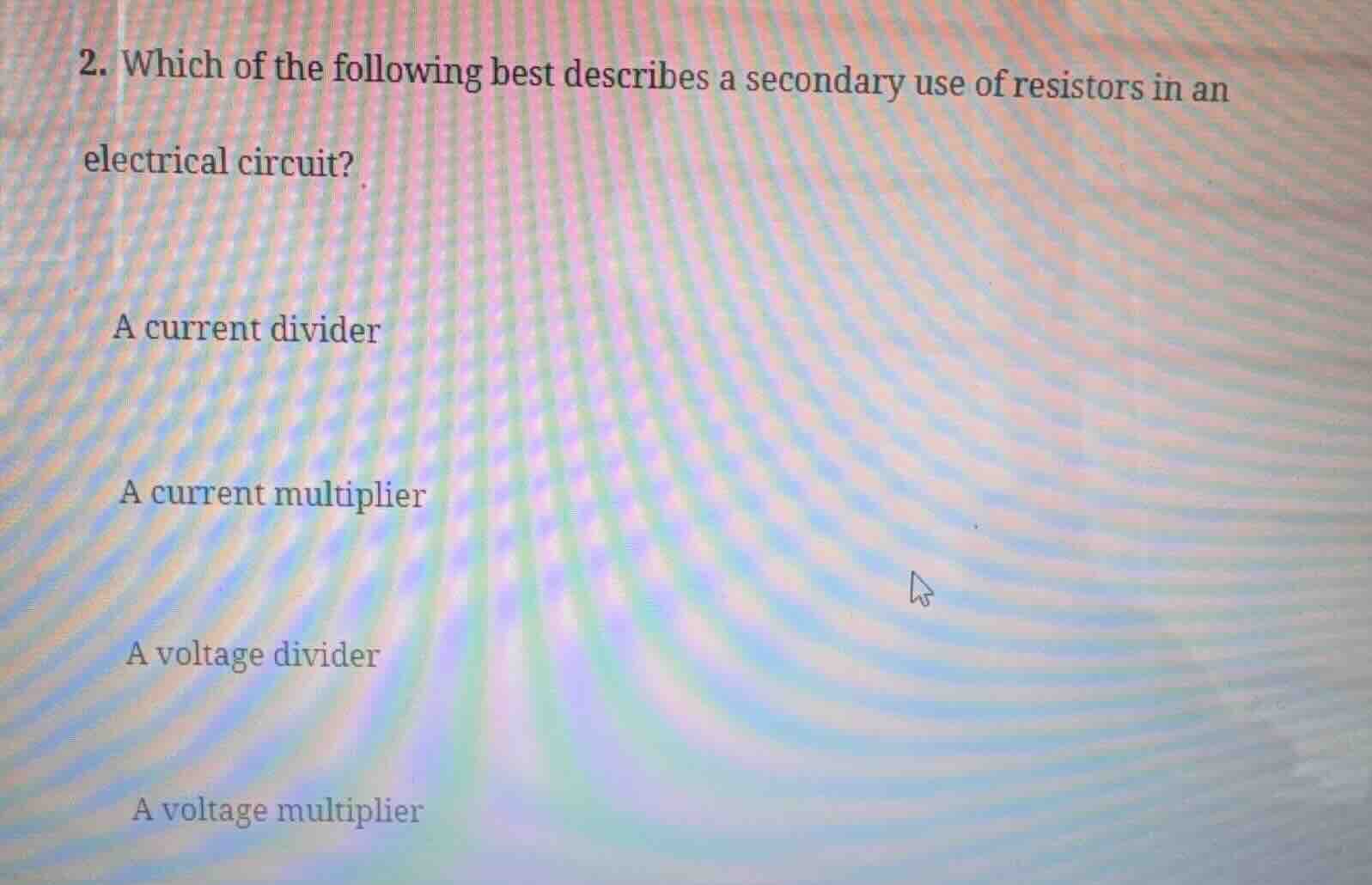
- which of the following best describes a secondary use of resistors in an electrical circuit?
a current divider
a current multiplier
a voltage divider
a voltage multiplier
Analyze the primary and secondary functions of resistors
While the primary purpose of a resistor is to limit or control the flow of electric current in a circuit, resistors are frequently configured in series to scale down voltages.
Evaluate the options
Using the Voltage Dividers knowledge point
- A current divider: Resistors in parallel can divide current, but this is typically considered a primary current-limiting behavior rather than a distinct secondary application like voltage scaling.
- A current multiplier: Resistors are passive components and cannot multiply current.
- A voltage divider: A series combination of resistors is widely used to create a specific output voltage that is a fraction of the input voltage. This is a fundamental secondary application.
- A voltage multiplier: Resistors cannot multiply voltage; this requires active components or capacitive networks.
Thus, a voltage divider is the best description of a secondary use.

Snap & solve any problem in the app
Get step-by-step solutions on Sovi AI
Photo-based solutions with guided steps
Explore more problems and detailed explanations
- A current divider
- A current multiplier
- A voltage divider (Correct answer)
- A voltage multiplier