QUESTION IMAGE
Question
which is an accurate statement about the excerpt and panel?
both support the fact that millions of innocent jews were rounded up and taken to concentration camps.
both support the idea that wiesel and spiegelmans father continue to be haunted by their memories of the holocaust.
both detail an account of wiesel and spiegelmans fathers being transported to auschwitz.
both depict the emotional impact of what it was like to be sorted and separated by the nazis and then shipped to the unknown.
Analyze the visual panel and text
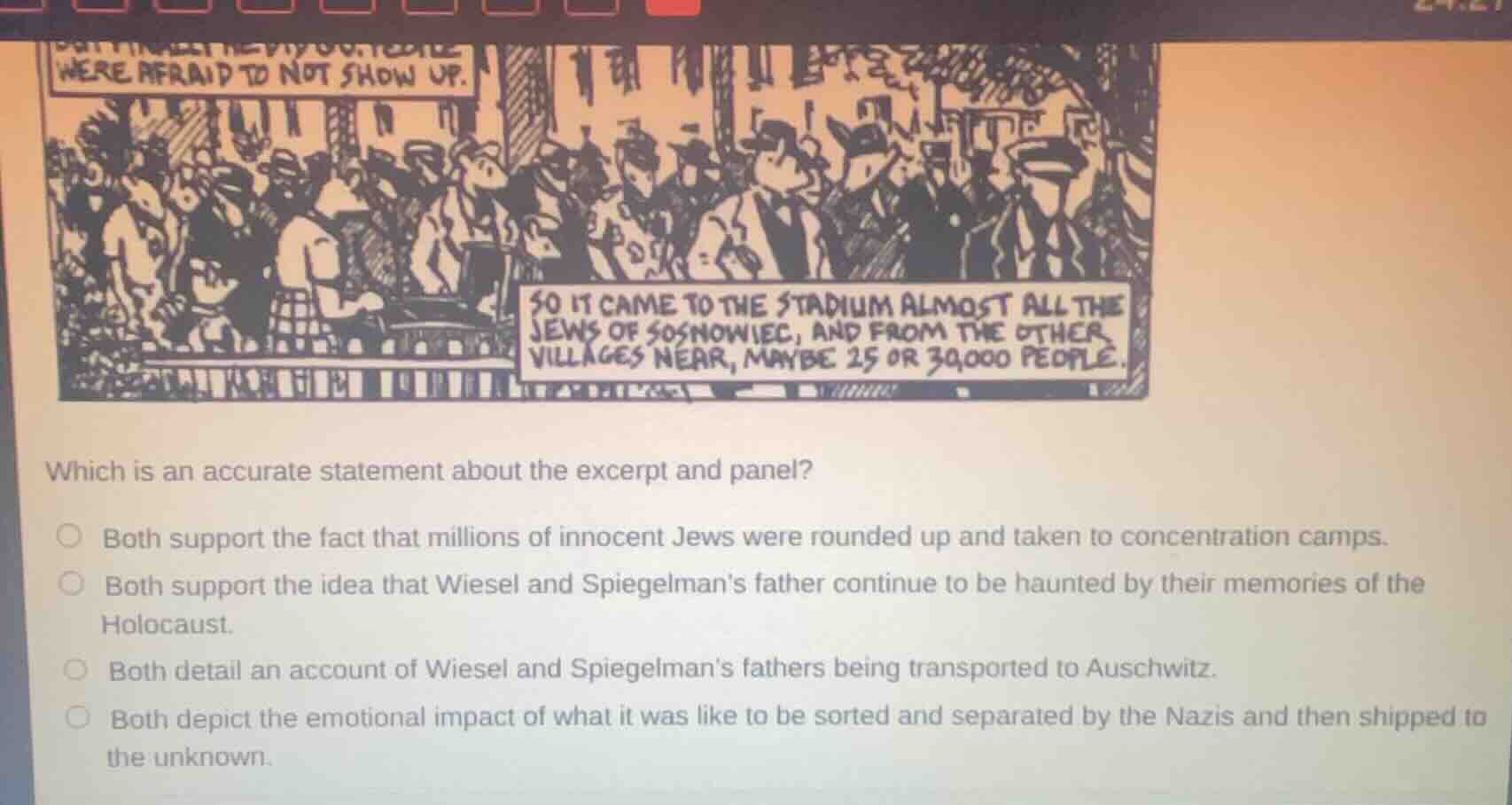
The panel is from Art Spiegelman's graphic novel Maus, depicting the Jews of Sosnowiec being ordered to register at a stadium. The text in the panel reads: "...WERE AFRAID TO NOT SHOW UP. SO IT CAME TO THE STADIUM ALMOST ALL THE JEWS OF SOSNOWIEC, AND FROM THE OTHER VILLAGES NEAR, MAYBE 25 OR 30,000 PEOPLE." This illustrates a massive, forced gathering of people under Nazi orders.
Evaluate the options against the prompt
We need to find an accurate statement about "the excerpt and panel" (referring to this panel from Maus and likely a paired excerpt from Elie Wiesel's Night or a similar memoir, as indicated by the options mentioning Wiesel and Spiegelman's father).
- Option 1: "Both support the fact that millions of innocent Jews were rounded up and taken to concentration camps." While historically true, this is a broad historical generalization rather than a specific thematic synthesis of the personal narratives.
- Option 2: "Both support the idea that Wiesel and Spiegelman's father continue to be haunted by their memories of the Holocaust." This is a central theme of both autobiographical works (Night and Maus), which explore the lifelong psychological trauma and haunting memories of the survivors.
- Option 3: "Both detail an account of Wiesel and Spiegelman's fathers being transported to Auschwitz." This is factually incorrect; Elie Wiesel himself was transported, not just his father, and this specific panel shows the stadium registration in Sosnowiec, not the direct transport to Auschwitz yet.
- Option 4: "Both depict the emotional impact of what it was like to be sorted and separated by the Nazis and then shipped to the unknown." This panel shows the massive crowd arriving at the stadium ("afraid to not show up"), but does not yet show the actual sorting, separation, or shipping process itself.
Therefore, Option 2 is the most accurate thematic synthesis of both works.
Connect to mastered concepts
Using the Maus Analysis and Visual Text Synthesis knowledge points, we synthesize the visual representation of the massive, fearful crowd in Spiegelman's work with the literary themes of trauma and memory. Both authors use their respective mediums to show how these historical events continue to haunt the survivors (Vladek Spiegelman and Elie Wiesel) in their later lives.

Snap & solve any problem in the app
Get step-by-step solutions on Sovi AI
Photo-based solutions with guided steps
Explore more problems and detailed explanations
- Both support the fact that millions of innocent Jews were rounded up and taken to concentration camps.
- Both support the idea that Wiesel and Spiegelman's father continue to be haunted by their memories of the Holocaust. (Correct answer)
- Both detail an account of Wiesel and Spiegelman's fathers being transported to Auschwitz.
- Both depict the emotional impact of what it was like to be sorted and separated by the Nazis and then shipped to the unknown.