QUESTION IMAGE
Question
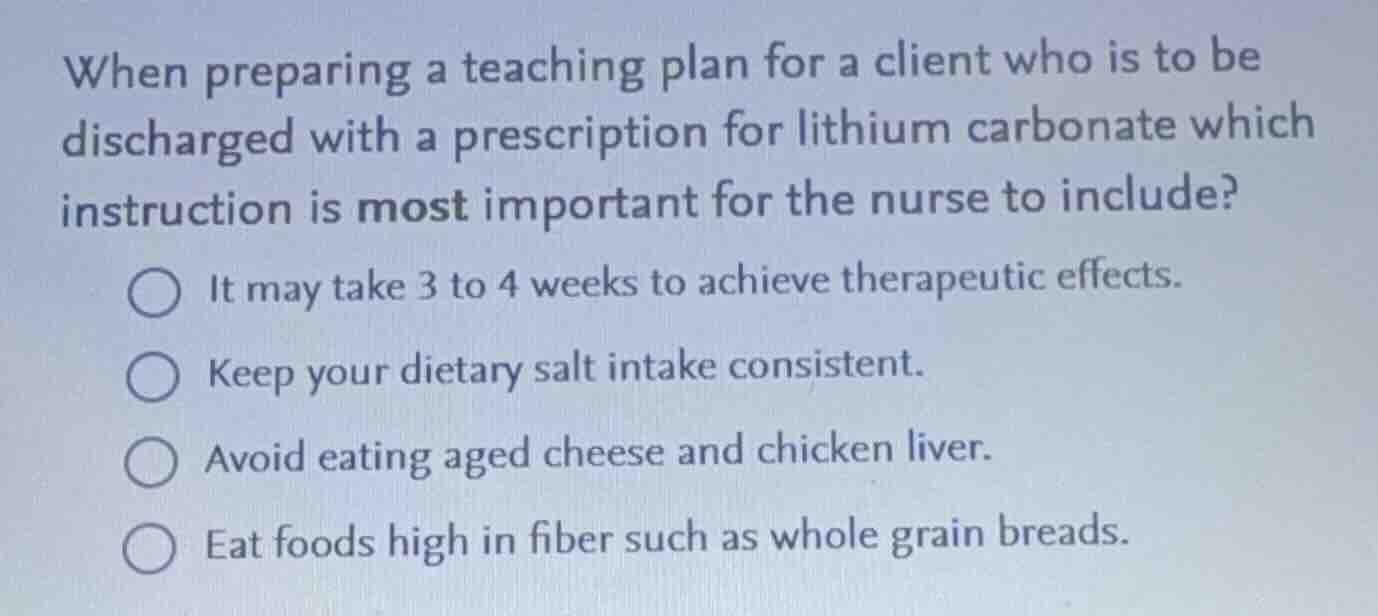
when preparing a teaching plan for a client who is to be discharged with a prescription for lithium carbonate which instruction is most important for the nurse to include?
it may take 3 to 4 weeks to achieve therapeutic effects.
keep your dietary salt intake consistent.
avoid eating aged cheese and chicken liver.
eat foods high in fiber such as whole grain breads.
Analyze lithium pharmacokinetics and sodium interaction
Lithium is a monovalent cation that is filtered and reabsorbed by the kidneys in a manner very similar to sodium. If dietary sodium intake decreases or if the body loses sodium (e.g., through excessive sweating, diarrhea, or diuretics), the kidneys reabsorb more sodium along with lithium, which can rapidly lead to toxic lithium accumulation. Conversely, a sudden increase in sodium intake can lower lithium levels below the therapeutic range. Therefore, maintaining a consistent intake of dietary salt and fluids is the most critical safety instruction to prevent lithium toxicity.
Evaluate the incorrect options
- "It may take 3 to 4 weeks to achieve therapeutic effects": Lithium typically takes 1 to 3 weeks (often 7 to 14 days) to achieve therapeutic effects, not 3 to 4 weeks.
- "Avoid eating aged cheese and chicken liver": This restriction is necessary for patients taking Monoamine Oxidase Inhibitors (MAOIs) to prevent a hypertensive crisis, not for those taking lithium.
- "Eat foods high in fiber such as whole grain breads": While a healthy diet is beneficial, fiber intake is not a specific, critical safety requirement for lithium therapy.

Snap & solve any problem in the app
Get step-by-step solutions on Sovi AI
Photo-based solutions with guided steps
Explore more problems and detailed explanations
- (A) It may take 3 to 4 weeks to achieve therapeutic effects.
- (B) Keep your dietary salt intake consistent. (Correct answer)
- (C) Avoid eating aged cheese and chicken liver.
- (D) Eat foods high in fiber such as whole grain breads.