QUESTION IMAGE
Question
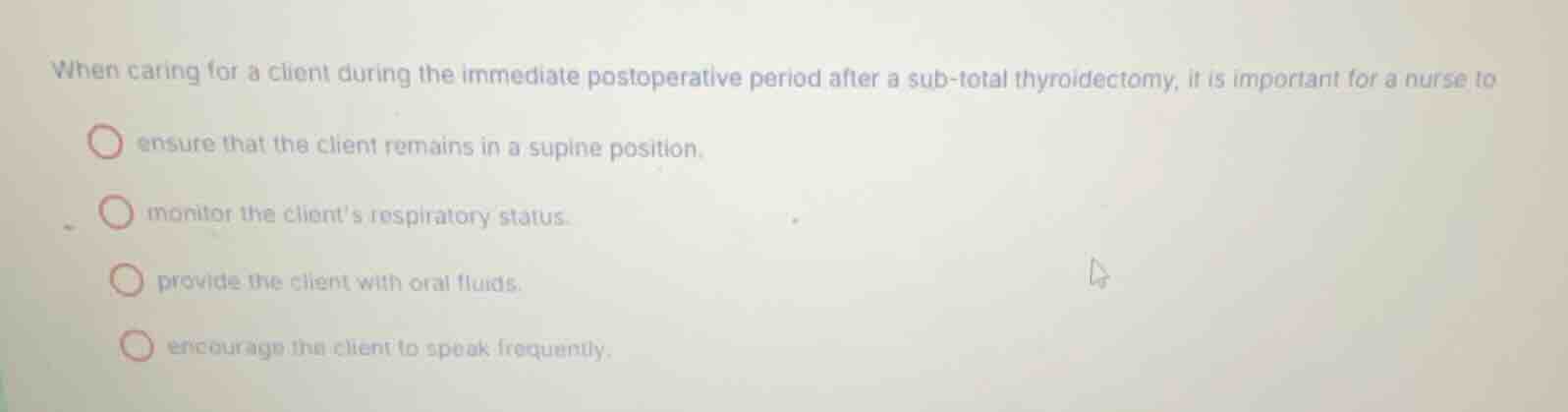
when caring for a client during the immediate postoperative period after a sub-total thyroidectomy, it is important for a nurse to
ensure that the client remains in a supine position.
monitor the clients respiratory status.
provide the client with oral fluids.
encourage the client to speak frequently.
🆕 New Concept Discovered: Postoperative Thyroidectomy Care
Prioritizing airway safety and monitoring for neck swelling
Step 1: Identify the surgical site and potential complications
A subtotal thyroidectomy involves removing a large portion of the thyroid gland, which is located in the anterior neck. Because of its location, any postoperative complications—such as bleeding, hematoma formation, or laryngeal edema (swelling)—can rapidly compress the trachea (windpipe) and compromise the patient's airway.
Step 2: Evaluate the options against clinical priorities
- Ensure that the client remains in a supine position: This is incorrect. Keeping the patient flat (supine) increases venous pressure in the head and neck, which can worsen swelling and increase the risk of bleeding. Patients are typically placed in a semi-Fowler's position to reduce swelling and ease breathing.
- Monitor the client's respiratory status: This is correct. Because the surgical site is directly over the trachea, swelling or bleeding can cause sudden airway obstruction. Monitoring for signs of respiratory distress (such as stridor, difficulty breathing, or rapid breathing) is the highest priority.
- Provide the client with oral fluids: This is incorrect. Immediately post-op, patients are kept NPO (nothing by mouth) or limited to ice chips until they are fully awake, have a positive gag reflex, and show no signs of nausea to prevent aspiration.
- Encourage the client to speak frequently: This is incorrect. While the nurse will check the patient's voice periodically to assess for laryngeal nerve damage, encouraging them to speak frequently can cause unnecessary strain on the vocal cords and surgical area.

Snap & solve any problem in the app
Get step-by-step solutions on Sovi AI
Photo-based solutions with guided steps
Explore more problems and detailed explanations
monitor the client's respiratory status.