QUESTION IMAGE
Question
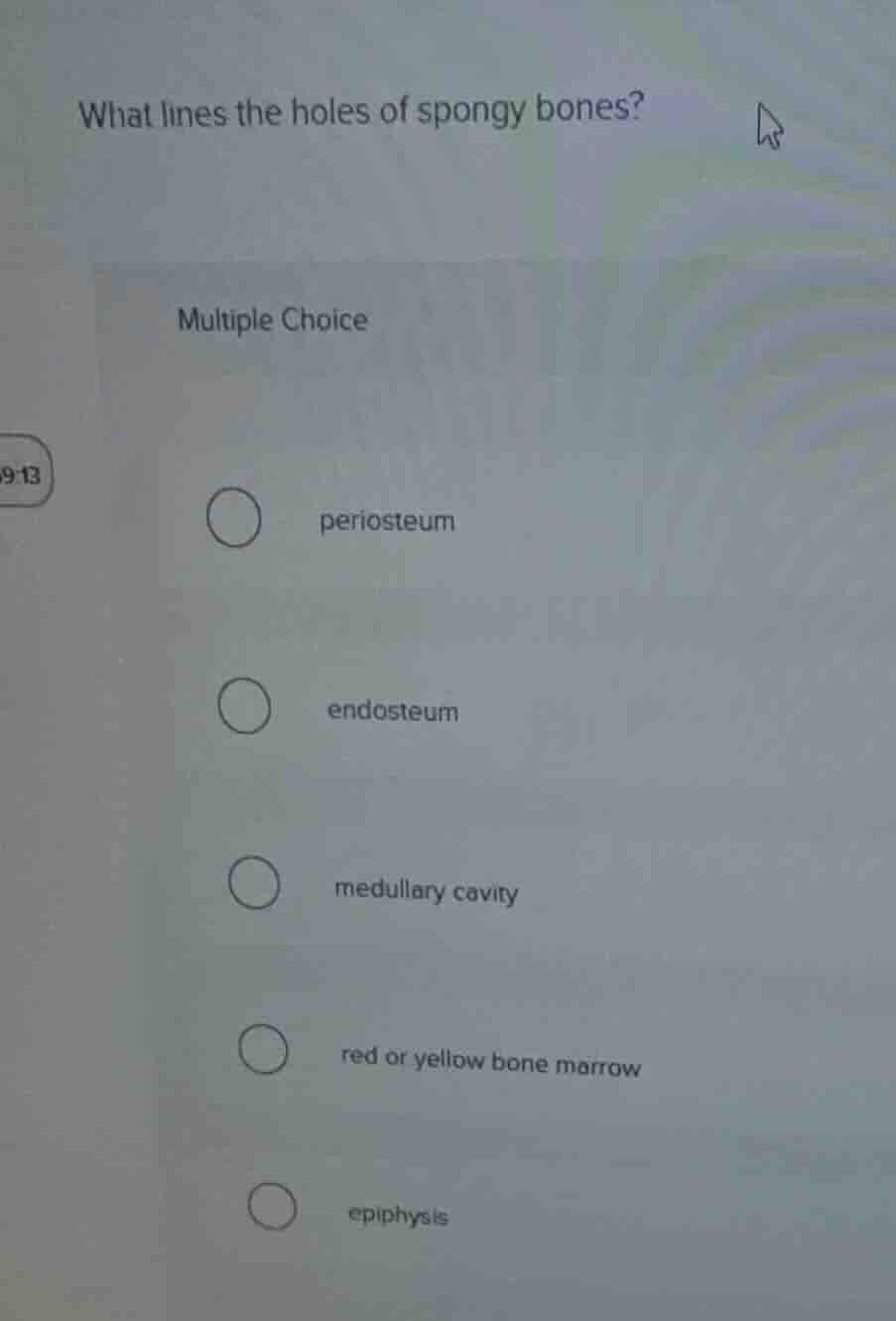
what lines the holes of spongy bones?
multiple choice
periosteum
endosteum
medullary cavity
red or yellow bone marrow
epiphysis
<pre_analysis>
{
"quality": "clear",
"question_count": 1,
"skills_matched": [
"direct_cot",
"multiple_choice_formatter",
"explain_then_answer",
"tutor",
"mastery_adaptive_brevity"
],
"needs_drawing": false,
"concepts_used": [
"Skeletal Anatomy",
"Skeletal Tissues"
],
"new_concepts": [
"Endosteum Function",
"Spongy Bone Structure"
],
"current_concepts": [
"Skeletal Anatomy",
"Skeletal Tissues",
"Endosteum Function",
"Spongy Bone Structure"
]
}
</pre_analysis>
<reasoning>
Identify the anatomical structure
Using the Skeletal Anatomy and Skeletal Tissues knowledge points
- Spongy bone (trabecular bone) contains a network of tiny, lattice-like structures called trabeculae, which form open spaces or "holes."
- The internal surfaces of all bones, including the canals of compact bone and the trabeculae/holes of spongy bone, are lined by a thin vascular membrane of connective tissue.
- This internal membrane is known as the endosteum.
Evaluate the given options
- periosteum: The fibrous membrane covering the outer surface of bones, not the internal cavities.
- endosteum: The membranous lining of the internal bony cavities, including the trabeculae of spongy bone.
- medullary cavity: The central cavity of bone shafts where red/yellow bone marrow is stored, not a lining membrane itself.
- red or yellow bone marrow: The soft tissue that fills the spaces, but does not line the bony structures.
- epiphysis: The rounded end of a long bone, which contains spongy bone but is a region rather than a lining.
</reasoning>
<answer>
<mcq-option>periosteum</mcq-option>
<mcq-correct>endosteum</mcq-correct>
<mcq-option>medullary cavity</mcq-option>
<mcq-option>red or yellow bone marrow</mcq-option>
<mcq-option>epiphysis</mcq-option>
</answer>
<post_analysis>
{
"subject": "Natural Science",
"question_type": "Multiple Choice",
"knowledge_point": [
"Natural Science",
"Biology",
"Skeletal Anatomy"
]
}
</post_analysis>
Snap & solve any problem in the app
Get step-by-step solutions on Sovi AI
Photo-based solutions with guided steps
Explore more problems and detailed explanations
<pre_analysis>
{
"quality": "clear",
"question_count": 1,
"skills_matched": [
"direct_cot",
"multiple_choice_formatter",
"explain_then_answer",
"tutor",
"mastery_adaptive_brevity"
],
"needs_drawing": false,
"concepts_used": [
"Skeletal Anatomy",
"Skeletal Tissues"
],
"new_concepts": [
"Endosteum Function",
"Spongy Bone Structure"
],
"current_concepts": [
"Skeletal Anatomy",
"Skeletal Tissues",
"Endosteum Function",
"Spongy Bone Structure"
]
}
</pre_analysis>
<reasoning>
Identify the anatomical structure
Using the Skeletal Anatomy and Skeletal Tissues knowledge points
- Spongy bone (trabecular bone) contains a network of tiny, lattice-like structures called trabeculae, which form open spaces or "holes."
- The internal surfaces of all bones, including the canals of compact bone and the trabeculae/holes of spongy bone, are lined by a thin vascular membrane of connective tissue.
- This internal membrane is known as the endosteum.
Evaluate the given options
- periosteum: The fibrous membrane covering the outer surface of bones, not the internal cavities.
- endosteum: The membranous lining of the internal bony cavities, including the trabeculae of spongy bone.
- medullary cavity: The central cavity of bone shafts where red/yellow bone marrow is stored, not a lining membrane itself.
- red or yellow bone marrow: The soft tissue that fills the spaces, but does not line the bony structures.
- epiphysis: The rounded end of a long bone, which contains spongy bone but is a region rather than a lining.
</reasoning>
<answer>
<mcq-option>periosteum</mcq-option>
<mcq-correct>endosteum</mcq-correct>
<mcq-option>medullary cavity</mcq-option>
<mcq-option>red or yellow bone marrow</mcq-option>
<mcq-option>epiphysis</mcq-option>
</answer>
<post_analysis>
{
"subject": "Natural Science",
"question_type": "Multiple Choice",
"knowledge_point": [
"Natural Science",
"Biology",
"Skeletal Anatomy"
]
}
</post_analysis>